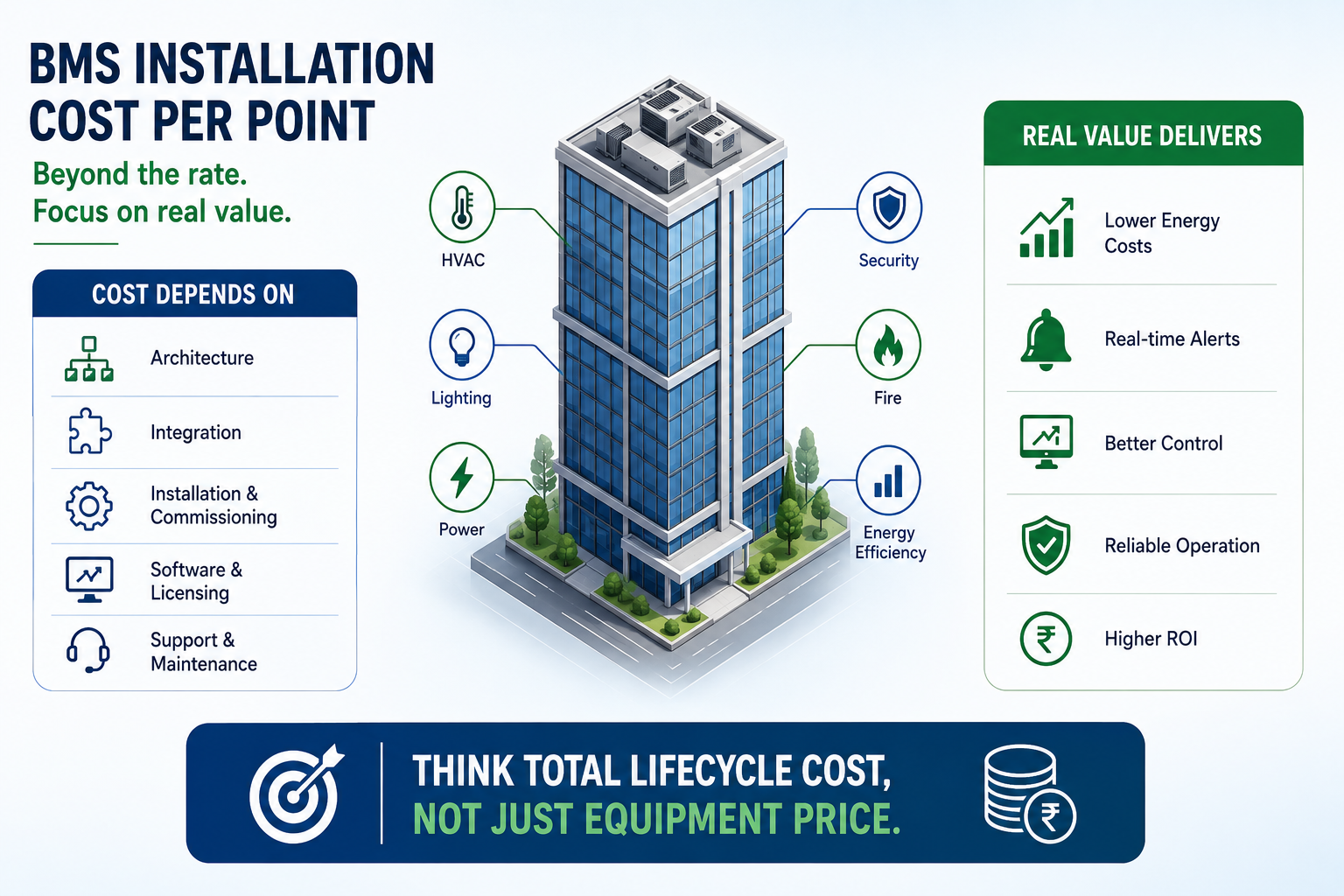
Imagine the control room of a 40‑storey commercial tower at 3 am The HVAC is trimming back airflow in unoccupied zones, lighting scenes have shifted to night mode, chilled‑water pumps throttle to match reduced loads, and the data center's precision cooling holds steady while facility teams receive an alert about an unusual power draw. Behind that quiet orchestration is a Building Management System - not a row of manual switches and local thermostats, but a centrally managed, intelligent platform that keeps comfort, safety, and energy use in balance.
For large office complexes, hospitals, data centers, malls and other critical facilities, energy efficiency and operational reliability are non-negotiable. A Building Management System provides the automated control, real‑time data and integration needed to meet stringent comfort, safety and compliance targets. Understanding what separates a BMS from manual building controls determines lifecycle costs, operational resilience and the ability to scale as buildings become smarter.
What a Building Management System is
A Building Management System is a centralized control platform that monitors and manages HVAC, lighting, power, fire, access and other subsystems. Unlike manual controls where adjustments happen locally and reactively, a BMS uses sensors, controllers, and software logic to make predictive, coordinated decisions across the facility.
How BMS works to monitor and control building systems
Sensors feed temperature, humidity, occupancy, power and equipment status into field controllers. The BMS control panel aggregates this telemetry, applies control sequences, schedules, and optimization algorithms, and presents data on dashboards. Modern systems add analytics, remote access and cloud services for historical trending and fleet‑wide benchmarking.
HVAC automation and control
HVAC is the primary energy consumer in many commercial buildings. A good BMS optimizes variable‑speed drives, VAV boxes, AHUs, chillers and boilers through setpoint scheduling, economiser control, and heat‑rejection sequencing to reduce runtime and avoid simultaneous heating/cooling.
Lighting management systems
Integrated lighting control uses occupancy detection, daylight harvesting and scene control to cut lighting energy without compromising occupant comfort. Centralized scheduling and zone‑level dimming replace manual switches, producing measurable energy savings and simplified maintenance.
Power monitoring and energy optimization
Power meters and sub‑metering feed the BMS energy module for load profiling, demand‑limit strategies and power quality monitoring. In data centers and critical facilities, this enables fault isolation, brownout prevention and efficient generator/paralleling control.
Fire safety system integration
When integrated, fire panels, smoke detectors and dampers can trigger HVAC shutdowns, stairpressurization and emergency lighting sequences automatically — improving life‑safety response while maintaining coordinated logs for compliance.
Access control and security integration
BMS integration with access control and CCTV supports automated lockdowns, zone‑specific environmental presets, and activity‑linked lighting or HVAC changes that enhance both security and operational efficiency.
Real-time data monitoring and alerts
Real‑time alarms, trend visualization and rule‑based notifications reduce MTTR (mean time to repair). Early fault detection and anomaly alerts enable predictive maintenance, preventing costly downtime.
Remote access and cloud-based management
Cloud connectivity lets engineers access the system remotely, apply patches, review trends, and run analytics across multiple sites. Remote commissioning and virtual dashboards reduce on‑site visits and speed problem resolution.
Key features that matter
- Scalable system architecture for phased deployment.
- HVAC monitoring and control with advanced sequencing.
- Energy consumption tracking and sub‑metering.
- Real‑time alerts and notifications with escalation paths.
- Remote access and mobile compatibility for technicians.
- Multi‑system integration capability (fire, security, power).
- User-friendly dashboard interface with role-based access.
- Predictive maintenance support through analytics.
- Low maintenance requirements and long operational life.
- Modular system design for replacement or upgrades.
- Reliable 24/7 operation with redundancy options.
Applications across industries
- Commercial office buildings and multi‑tenant towers.
- Hospitals and critical healthcare facilities.
- Data centers and server rooms (specialized data center BMS system requirements).
- Shopping malls, retail complexes and hospitality chains.
- Airports, transit hubs and educational campuses.
- Industrial plants, factories and utility infrastructure.
- Government, defense facilities and smart city deployments.
- Residential high‑rise complexes with centralized management.
System selection factors (engineering focus)
Choosing a BMS depends on building size, the number of control points and the required integration depth. Architecture (distributed vs. centralized), protocol support (BACnet, Modbus, LON), brand reliability and software licensing shape total cost of ownership. Factor in installation and commissioning complexity, after‑sales support and AMC packages, plus customization for reporting and regulatory compliance. Lifecycle value often outweighs initial purchase price - robust engineering, testing and documentation reduce operational risk.
Buyer's guide for Indian projects
Evaluate vendors on industry experience, project portfolio and BMS engineering expertise. Confirm manufacturing, factory acceptance testing, and field validation procedures. Ensure open protocol compatibility, strong installation and commissioning support, and clear maintenance offerings including BMS maintenance services and training. Look for proven performance in similar projects and transparent documentation for handover.
Common mistakes to avoid
- Selecting systems without a detailed building assessment.
- Ignoring scalability for future expansion.
- Underestimating integration complexity across vendors.
- Choosing solely on upfront cost rather than lifecycle value.
- Skipping proper AMC planning or maintenance contracts.
- Overlooking open protocol compatibility and cybersecurity.
- Not defining energy KPIs before design.
- Poor commissioning and incomplete handover documentation.
- Inadequate training for operations staff.
Practical reference
When planning a rollout or retrofit, involve an experienced BMS company early for system sizing and a clear scope. For projects needing professional installation, confirm the provider's track record with BMS system installation and post‑commissioning support to protect long‑term reliability.
Conclusion
A Building Management System replaces fragmented manual controls with coordinated, data‑driven automation that improves occupant comfort, energy efficiency, safety and regulatory compliance. Proper system selection, rigorous engineering, and comprehensive maintenance planning determine whether a BMS delivers long‑term value. For project teams, prioritise integration capability, open standards, and proven installation experience to achieve reliable, energy‑efficient operation across complex facilities. Solid BMS engineering ensures better comfort, lower operating costs and resilient infrastructure for years to come.