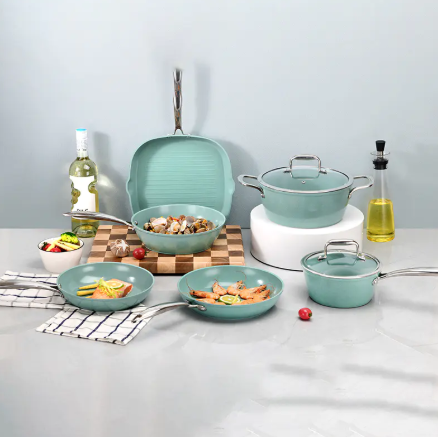
A Practical Aluminum Pot Set is widely used in households and food service environments due to its lightweight structure and efficient heat conduction. Safety considerations often depend on material treatment, surface coating, and compliance with food-grade manufacturing standards rather than aluminum itself.
Aluminum as a base metal is non-magnetic and highly conductive, with thermal conductivity values typically around 200 W/m·K or higher, enabling fast heat transfer. However, raw aluminum can react with acidic or alkaline foods. To address this, most modern cookware applies protective treatments such as anodizing or non-stick coatings.
Hard anodization is one of the most common safety-enhancing processes. During anodizing, the aluminum surface is electrochemically converted into a dense oxide layer. This layer is usually 5–25 microns thick, significantly increasing corrosion resistance and reducing direct metal-food interaction. This improves durability and also reduces the likelihood of surface degradation during repeated cooking cycles.
A Practical Aluminum Pot Set often includes anodized inner surfaces or coated finishes. These treatments help minimize chemical interaction with ingredients like tomatoes, vinegar-based sauces, or citrus-heavy dishes. In normal cooking conditions, this makes aluminum cookware stable and suitable for daily use.
Structural design also contributes to safety. Many pot sets are manufactured with reinforced bases between 2.5 mm and 4.0 mm thickness, preventing warping under high heat. Riveted handles made from stainless steel or heat-resistant Bakelite ensure stable handling even when pots are filled with hot liquids.
From a manufacturing standpoint, compliance with food safety regulations is essential. High-quality aluminum cookware is typically produced using food-grade alloys such as 3003 or 5052 aluminum series, which provide a balance of strength and corrosion resistance. These alloys are widely used in kitchen applications due to their predictable thermal behavior and stability.
Another important factor is coating safety. Modern non-stick coatings are often PTFE-based or ceramic-based. PTFE coatings are stable under normal cooking temperatures, typically below 260°C, while ceramic coatings can withstand slightly higher heat but may reduce non-stick performance over time.
Concerns about aluminum leaching have been studied extensively. Under normal cooking conditions, especially with anodized or coated cookware, migration levels are extremely low and generally considered safe within regulatory limits. Proper usage—such as avoiding abrasive scrubbing and overheating—further reduces risk.
In practical kitchen use, a Practical Aluminum Pot Set offers a balance between performance and safety when used correctly. It is designed for daily cooking tasks including boiling, stewing, and reheating, while maintaining structural integrity and thermal efficiency.