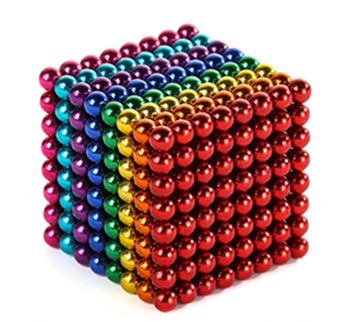
The production of Solid Color Magnetic Block Cubes involves a combination of precision plastic engineering, magnet integration, and quality-controlled assembly processes. Each stage directly affects durability, magnetic performance, and user safety, making manufacturing consistency a key factor in product reliability.
The process typically begins with raw material selection. Most manufacturers use ABS plastic granules due to their high impact resistance, dimensional stability, and moldability. ABS materials are heated to around 220°C–260°C before being injected into steel molds designed with micron-level precision. Each mold cavity forms a cube shell with internal structural ribs that reinforce the outer walls.
For Solid Color Magnetic Block Cubes, color integration happens during the injection phase. Pre-mixed pigment masterbatch is added into molten ABS, ensuring that the color becomes part of the material structure rather than a surface coating. This approach improves scratch resistance and prevents peeling or fading during long-term use.
Once the cube shells are formed, the next step is magnet insertion. High-strength neodymium magnets are commonly used due to their strong magnetic flux density. These magnets are usually graded between N35 and N52, depending on required attraction force. The magnets are placed into precisely designed internal slots, often using automated pick-and-place machines to ensure correct polarity alignment.
Each cube face is engineered with alternating polarity arrangements. This means adjacent sides can connect in multiple orientations, enabling full 3D structural flexibility. After magnet placement, the cube halves are sealed using ultrasonic welding or heat fusion techniques. This creates a fully enclosed unit, preventing magnet exposure and improving structural integrity.
Quality testing is an essential part of production. Manufacturers often perform:
Drop tests from 1.2–1.5 meters
Magnetic pull-force calibration checks
Compression resistance testing
Rotation and alignment validation
A typical Solid Color Magnetic Block Cubes production line also includes X-ray inspection systems or automated vision systems to verify internal magnet positioning. Even slight misalignment can affect building stability and user experience.
Environmental resistance is also considered during production. ABS shells are sometimes UV-stabilized to reduce color degradation under sunlight exposure. Moisture sealing tests ensure that internal magnets do not corrode when exposed to humidity.
From an engineering perspective, one of the most critical challenges is balancing magnetic strength with safety. Too strong a magnet can make disassembly difficult for children, while weak magnets reduce structural stability. The final calibration often targets a pull force range that supports both secure stacking and easy separation.
The result is a modular building system that relies on precise manufacturing coordination. Every cube must match dimensional tolerances within fractions of a millimeter to ensure smooth alignment across large structures.
Solid Color Magnetic Block Cubes therefore represent a fusion of plastic injection molding technology, magnetic engineering, and safety-driven assembly design.