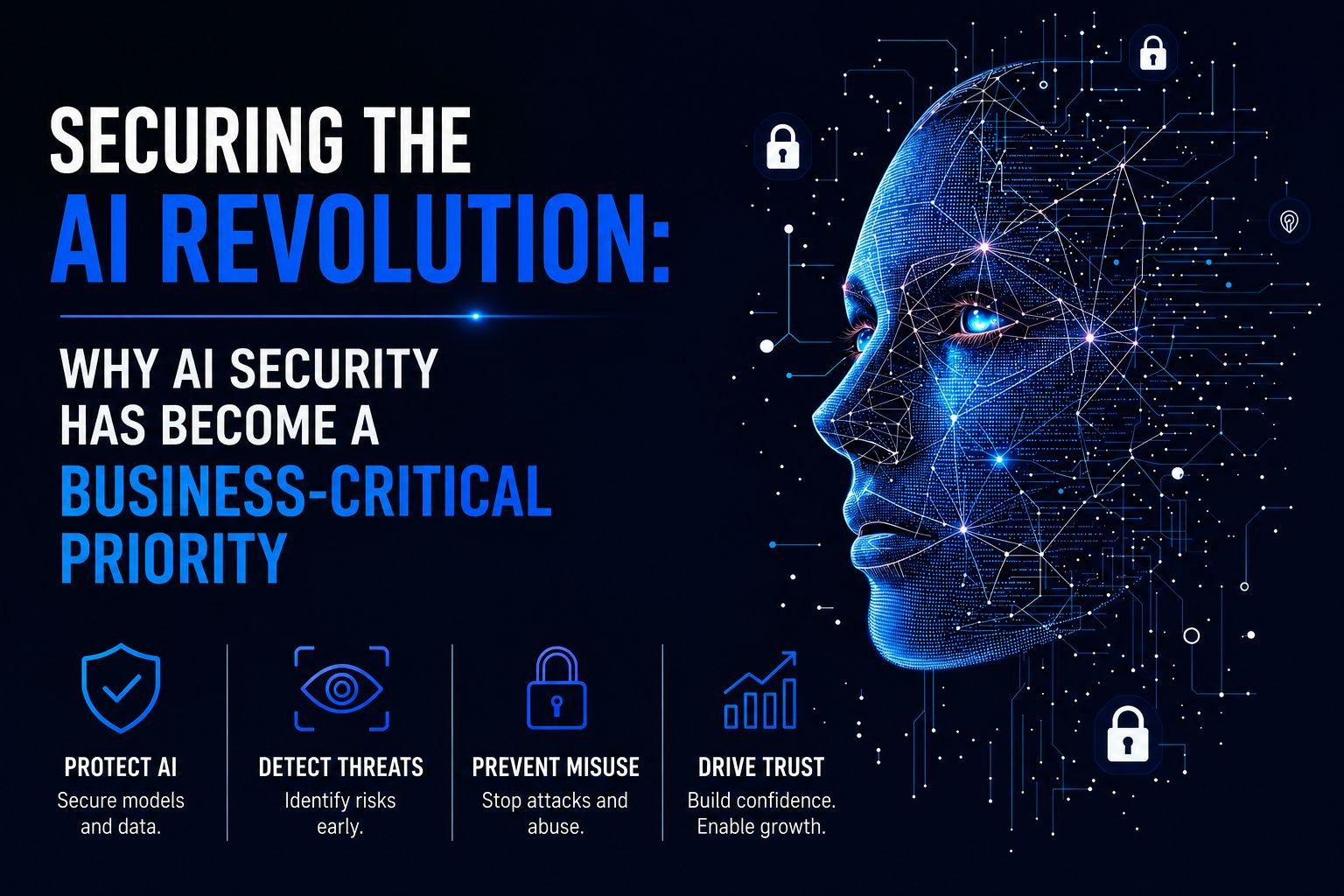
Artificial Intelligence is rapidly transforming industries, redefining how organizations operate, innovate, and compete. From customer service automation and predictive analytics to fraud detection and autonomous decision-making, AI has become a strategic asset for businesses worldwide.
However, as organizations increase their reliance on AI systems, a new category of cyber risk has emerged. While AI delivers tremendous opportunities, it also introduces complex security challenges that traditional cybersecurity frameworks were never designed to address.
Today, AI security is no longer a niche concern for data scientists or technology teams. It has become a board-level priority that directly impacts business continuity, regulatory compliance, intellectual property protection, and customer trust.
Why AI Security Matters More Than Ever
Modern AI systems depend on large volumes of data, sophisticated algorithms, and continuous learning models. These systems often operate across cloud environments, applications, APIs, and enterprise networks.
As AI adoption grows, so does its attractiveness to cybercriminals.
Threat actors are increasingly targeting:
- AI models
- Training datasets
- Machine learning pipelines
- AI-powered applications
- Decision-making systems
Unlike conventional software, AI systems can be manipulated without directly attacking infrastructure. This makes AI environments uniquely vulnerable to emerging cyber threats.
Understanding the Key AI Security Risks
Organizations implementing AI technologies must understand the evolving threat landscape.
Data Poisoning Attacks
AI models learn from data. If attackers compromise training datasets, they can influence how AI systems behave.
This may result in:
- Biased outputs
- Inaccurate predictions
- Manipulated recommendations
- Operational disruption
Ensuring data integrity is one of the most important aspects of AI security.
Adversarial Machine Learning
Cybercriminals can intentionally manipulate inputs to deceive AI systems.
For example:
- Altered images can bypass AI-powered detection systems.
- Fraudulent data can manipulate predictive models.
- Modified inputs can influence automated decisions.
These attacks challenge the reliability of AI-driven processes.
Model Theft and Intellectual Property Risks
AI models often represent years of research and substantial financial investment.
Attackers may attempt to:
- Steal proprietary algorithms
- Reverse engineer models
- Extract confidential business logic.
Protecting AI assets is becoming increasingly important for maintaining a competitive advantage.
Building a Strong AI Security Framework
Organizations should approach AI security as a continuous process rather than a one-time implementation.
Establish AI Governance
Governance provides structure and accountability throughout the AI lifecycle.
Key areas include:
- Model approval processes
- Risk assessment frameworks
- Ethical AI policies
- Regulatory compliance requirements
Strong governance helps organizations balance innovation with security.
Secure the AI Development Lifecycle
AI security should be integrated from the earliest stages of development.
Best practices include:
- Secure coding standards
- Model validation procedures
- Data quality controls
- Access management policies
Embedding security early significantly reduces future risk.
Implement Continuous Monitoring
AI systems evolve, making ongoing visibility essential.
Organizations should monitor:
- Model performance anomalies
- Unauthorized access attempts
- Data integrity issues
- Unexpected output behaviors
Continuous monitoring helps identify threats before they cause significant damage.
AI Security and Regulatory Compliance
Governments and regulatory bodies are increasing oversight of AI systems.
Organizations must prepare for requirements related to:
- Data privacy
- Algorithm transparency
- Bias mitigation
- Explainability standards
- Security controls
Failure to address these requirements may lead to compliance violations and reputational harm.
The Future of AI Security
As AI adoption accelerates, security strategies will continue evolving.
Emerging trends include:
- AI-powered threat detection
- Secure AI supply chain management
- Explainable AI frameworks
- Autonomous security controls
- AI risk governance programs
Organizations that proactively address AI security today will be better positioned to leverage AI safely and responsibly in the future.
Final Thoughts
Artificial Intelligence is reshaping the business landscape, but robust security measures must accompany innovation. Organizations that overlook AI-specific risks may expose themselves to operational disruption, data breaches, and regulatory challenges.
By implementing strong governance, securing AI development processes, protecting training data, and continuously monitoring model behavior, organizations can build trustworthy AI ecosystems that support long-term growth and resilience.
As AI becomes increasingly integrated into business operations, AI security will remain one of the most important pillars of modern cybersecurity strategy.