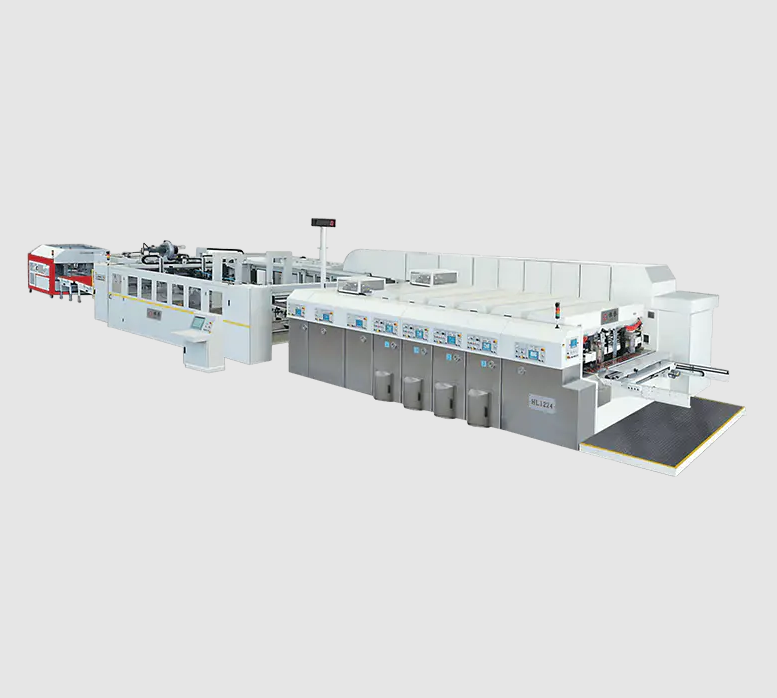
The internal structure of a Paste Box Machine is designed to achieve continuous carton forming with stable adhesive application and precise folding control. Unlike basic packaging equipment, this machine integrates mechanical transmission, pneumatic assistance, and electronic control into a unified system that supports long production cycles with consistent output quality.
The core frame is usually constructed from reinforced steel materials with anti-vibration design. This ensures stability during high-speed operation, especially when running above 150 cycles per minute. Machine weight commonly ranges between 3,000kg and 8,000kg depending on configuration size and functional modules. A rigid frame reduces deformation and helps maintain alignment accuracy within ±0.3mm.
The feeding section is one of the most important structural components. It typically uses vacuum suction belts or friction rollers to transport flat carton sheets. Sheet thickness compatibility ranges from 200gsm lightweight paperboard to 700gsm coated cardboard. Feeding speed is controlled by servo motors, which synchronize with the main transmission shaft to avoid skewing or double feeding.
A central feature of the Paste Box Machine is the glue application system. It usually includes a precision pump, adhesive reservoir, and nozzle assembly. Glue viscosity range supported is typically between 500–5000 mPa·s. The system allows adjustable glue width from 3mm to 50mm depending on carton sealing requirements. Temperature control is included in some configurations to stabilize adhesive flow, particularly for hot-melt systems operating between 120°C and 180°C.
The folding section consists of multiple mechanical arms and guide rails. These components are responsible for shaping the carton into its final geometry. Folding accuracy is controlled through calibrated rails and servo-driven timing systems. The machine can handle straight-line folding, crash-lock bottom structures, and multi-fold cartons. Folding pressure is adjustable, generally within 0.2MPa to 0.6MPa range depending on material rigidity.
The pressing unit ensures that glued sections are firmly bonded. This section often uses adjustable pressure rollers made from rubber-coated steel. Pressure distribution is uniform across the carton surface, preventing deformation while ensuring strong adhesion. The pressing duration can be adjusted through PLC settings, typically between 0.5 to 3 seconds per carton.
Electrical systems in the Paste Box Machine are built around PLC controllers combined with touchscreen interfaces. Operators can set parameters such as production speed, carton size range, glue timing, and folding delay. Most systems support memory storage for multiple carton configurations, allowing quick switching between production jobs. Servo motor precision ensures synchronization accuracy within milliseconds.
Pneumatic systems assist in auxiliary movements such as suction control, folding arm activation, and pressure stabilization. Air pressure requirements usually fall between 0.6MPa and 0.8MPa. Air filtration units are installed to prevent contamination and ensure stable operation.
Modular design is another important feature. Key components such as glue units, feeding systems, and folding modules can be independently replaced or upgraded. This improves maintenance efficiency and reduces downtime during repairs or upgrades.
Overall, the Paste Box Machine is not a simple assembly unit but a fully engineered system where mechanical precision, adhesive control, and electronic synchronization work together to achieve stable carton production under industrial conditions.