Early detection saves lives and limits property loss; that's why choosing the right Fire Alarm System is fundamental for any building. Commercial, industrial, and critical infrastructure sites face larger occupant loads, complex layouts, and greater continuity demands than homes—so their detection, notification, and monitoring strategies must be engineered differently. This article clarifies the technical and operational differences between commercial and residential fire alarm systems and explains what facility managers should evaluate when specifying life-safety solutions.
What a Fire Alarm System is
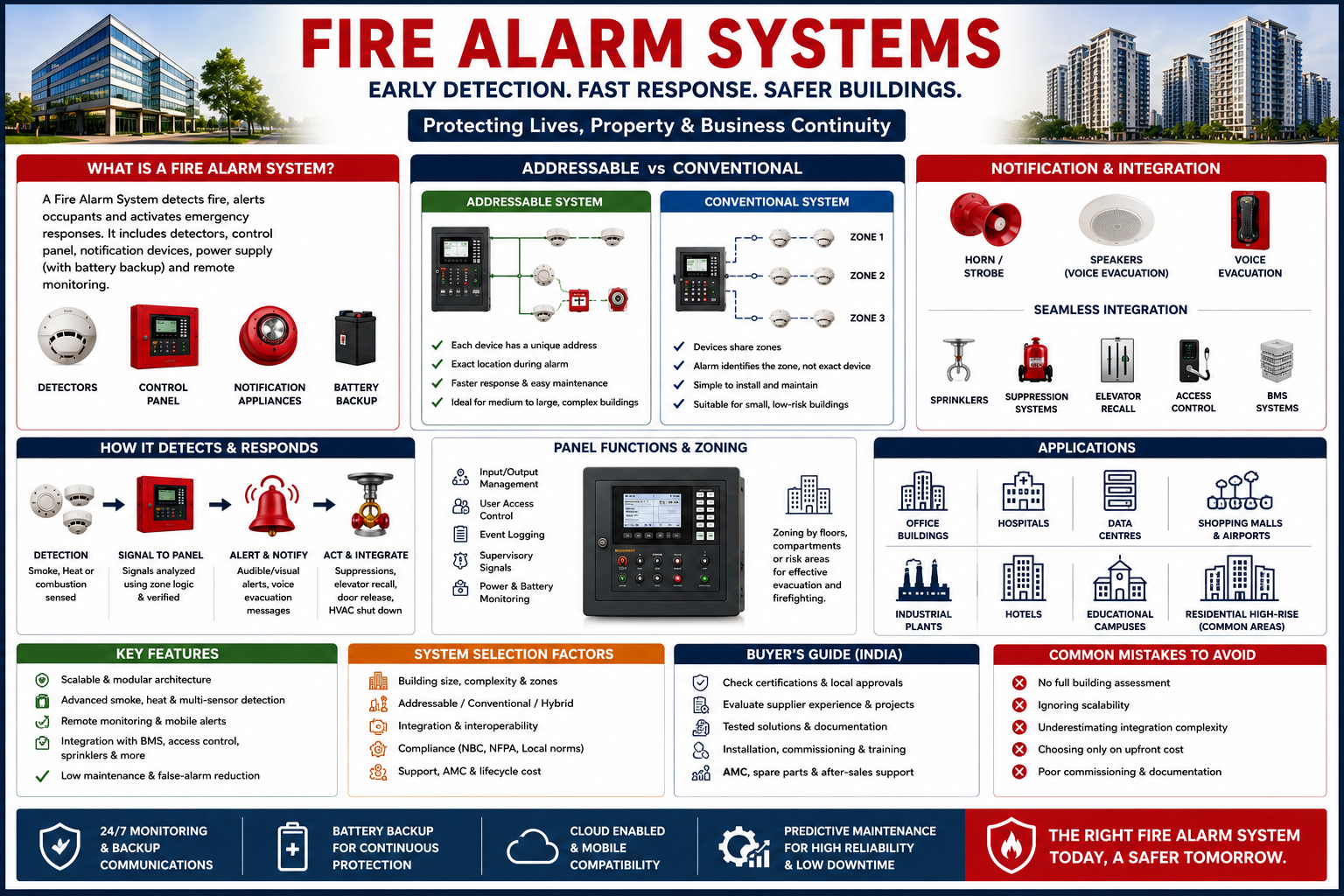
A Fire Alarm System consists of detectors, a control panel, notification appliances, and ancillary interfaces that detect fire conditions and initiate occupant notification, suppression, and emergency responses. In practice, these systems also include wiring or wireless links, power supplies (including battery backup for fire alarm system continuity), and remote monitoring connections to central stations or cloud services.
How fire alarm systems detect and respond
Detectors sense smoke, heat, or products of combustion using optical (photoelectric), ionization, heat-rise/ fixed-temperature, or multi-sensor technologies. Detection signals go to the fire alarm system panel, which applies zone logic, verifies conditions, and triggers staged outputs: local audible/visual alerts, suppression system actuation, elevator recall, and door release. Commercial systems often include addressable detection where each device reports a unique ID for precise location; small residential systems commonly use conventional zone-based architecture.
Addressable vs conventional architecture
Addressable systems: each detector and module has an address; panels map alarms to exact devices for faster response and easier maintenance.
Conventional systems: detectors share zones; alarms indicate a zone, not an exact device—suitable for simple, low-risk layouts.
Panel functions and zoning
A modern fire alarm control panel manages inputs, outputs, user access, event logging, supervisory signals, and power monitoring. Zoning organizes detection into logical areas that reflect compartments, floors, or risk profiles. Commercial buildings require detailed zoning to support phased evacuation, firefighter interfaces, and integration with building management systems.
Notification, evacuation and integration
Notification appliances (speakers, strobes, voice-evacuation systems) must match occupant profiles and acoustics. Commercial systems often use mass-voice evacuation with pre-recorded messages and priority routing, while residential systems rely on horn/strobe devices or interconnected house fire alarm system units. Integration with sprinklers and suppression systems ensures coordinated action; the panel issues pre-action or abort windows where applicable.
Remote monitoring and modern management
Real-time monitoring—central station connections or fire alarm system remote monitoring—provides verified alarm reporting and automated dispatch. Cloud-enabled and mobile-compatible fire alarm system panels allow remote event review, firmware updates, and predictive maintenance analytics that reduce downtime and false alarms. Cybersecurity for networked panels is now a critical engineering requirement.
Key features to compare
- Scalable system architecture for phased builds and expansions
- Smoke, heat, and multi-sensor detection tailored to risk areas
- Real-time alerts and mobile notifications for operations teams
- Remote monitoring and mobile compatibility for 24/7 oversight
- Multi-system integration capability (BMS, access control, sprinklers)
- User-friendly panel interfaces and firefighter control centers
- Predictive maintenance support and long battery life
- Low maintenance and false-alarm reduction measures
- Modular design to replace or upgrade components easily
- Reliable 24/7 monitoring and backup communications
Applications where differences matter
Commercial fire alarm systems are engineered for complex environments such as:
- Office buildings and corporate campuses
- Hospitals and healthcare centres with life-safety-critical alarms
- Data centres and server rooms with early-warning aspirating detectors
- Shopping malls and airports with large occupant flows
- Industrial plants and factories with hazardous processes
- Hotels, educational campuses, government and defence buildings
- Smart-city infrastructure and critical utilities
- Residential high-rise complexes where common-area systems interface with home fire alarm system devices
System selection factors
When choosing a Fire Alarm System, focus on engineering value and lifecycle cost rather than sticker price. Consider:
- Building size and complexity; number of detection points and zones
- Type of architecture: addressable vs conventional, hybrid options
- Brand reliability and interoperability with existing systems
- Integration requirements (sprinklers, access control, BMS)
- Software licensing, cloud services, and remote management fees
- Installation, commissioning, and acceptance-test procedures
- After-sales support, AMC terms, and spare-parts availability
- Compliance with codes (NBC, NFPA, local fire authority requirements)
- Predictive maintenance capability and lifespan of equipment
- Logistics and project-specific customization needs
Buyer’s guide for India
Evaluate suppliers on engineering expertise, project portfolio, and compliance practices. Confirm testing and validation, open-protocol compatibility, and documentation quality. Verify certifications and local approvals (NBC, relevant state fire norms). Ask about installation support, commissioning, user training, and long-term maintenance contracts. Ensure the chosen fire alarm system supplier provides clear handover, testing protocols, and rapid support for emergency faults.
Common mistakes to avoid
- Specifying systems without a full building assessment
- Ignoring scalability for future expansions
- Underestimating complexity of multi-system integration
- Choosing equipment solely on upfront cost without lifecycle view
- Neglecting maintenance planning and AMC budgeting
- Overlooking open-protocol and cybersecurity compatibility
- Failing to define zoning and coverage before design
- Poor commissioning, incomplete documentation, and inadequate staff training
Practical note on procurement and installation
For projects requiring professional installation, ensure design drawings include device count, loop capacities, and power/battery calculations (including battery fire alarm systems and battery backup for fire alarm system needs). Confirm alarm transmission methods (GSM, IP, leased line) and central monitoring arrangements. Where remote oversight is desired, review cloud management and mobile app features, and include these in the acceptance criteria.
For more details on technical options, certified testing, and design consultation for commercial deployments, review a specialist provider’s fire detection services such as a Fire alarm system installation offering that explains device selection and integration strategies.
Conclusion
Selecting the correct Fire Alarm System is an engineering decision that balances detection accuracy, integration capability, regulatory compliance, and long-term operational reliability. Commercial systems demand addressable architecture, robust notification, centralized monitoring, and careful integration with suppression and building controls—whereas residential systems prioritize simplicity and occupant-level notification. Prioritize validated design, thorough commissioning, and strong after-sales support to ensure occupant safety, faster emergency response, and resilient fire safety infrastructure.