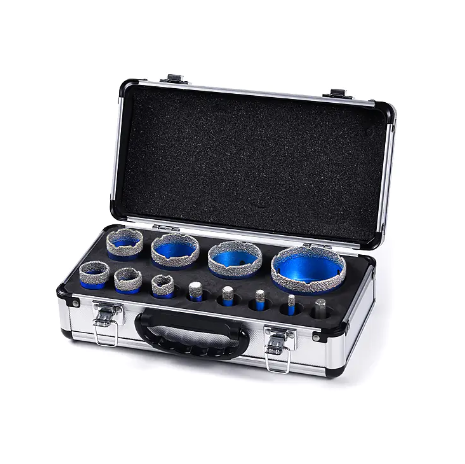
The performance of an Electroplated Diamond Hole Saw is strongly determined by its manufacturing process. Unlike mechanically sharpened cutting tools, this type of hole saw relies on electrochemical bonding technology that embeds diamond particles directly onto a steel substrate. The precision of this process directly affects cutting stability, lifespan, and hole accuracy.
Core Manufacturing Structure
The production begins with selecting a high-strength alloy steel tube. This base must maintain rigidity under rotational stress and resist deformation during drilling. The tube is machined into a precise cylindrical shape, followed by surface cleaning and activation treatment to ensure proper adhesion during electroplating.
Once prepared, the tool enters an electroplating bath containing nickel ions and synthetic diamond particles. Under controlled electrical current, nickel is deposited onto the steel surface while simultaneously locking diamond grains into the forming layer. This creates a single exposed abrasive layer where each diamond particle becomes an active cutting point.
Typical technical parameters include:
Diamond grit size: 50–60 mesh synthetic diamond
Coating thickness: 0.15–0.35 mm
Working temperature during plating: 45–60°C controlled bath
Exposure density: uniform distribution for balanced cutting load
Bond matrix: nickel-based alloy layer
Diamond Distribution Engineering
One of the most critical aspects is diamond placement density. If diamonds are too densely packed, cutting resistance increases, leading to heat buildup. If too sparse, cutting efficiency decreases and edge quality suffers. Manufacturers carefully calibrate particle spacing to maintain consistent grinding action across the entire rim.
Advanced electroplating techniques may use multi-stage deposition, where diamonds are layered in sequential baths. This creates a semi-multi-layer structure that improves wear consistency and reduces sudden performance drop-off when surface diamonds begin to wear.
Performance Behavior During Use
The Electroplated Diamond Hole Saw operates through abrasive grinding rather than slicing. As the tool rotates, exposed diamond grains fracture and abrade the material surface. Heat management is essential, so water cooling is applied to stabilize friction levels and remove debris slurry.
Operational recommendations:
RPM range: 800–3000 depending on material hardness
Constant water cooling required
Light axial pressure to prevent cracking
Intermittent lift for slurry removal during deep drilling
Quality Control Factors
Manufacturing consistency determines real-world performance. Key inspection areas include:
Diamond adhesion strength (pull-off resistance testing)
Coating uniformity across rim surface
Concentricity of steel tube body
Edge roundness tolerance (typically within ±0.05 mm)
Vibration balance during rotation
Poor bonding quality can result in premature diamond loss, uneven cutting, and reduced hole accuracy. High-quality electroplating ensures controlled diamond exposure throughout the tool’s usable life.
Industrial Relevance
This manufacturing method is widely used in precision drilling tools because it offers a balance between cost efficiency and cutting accuracy. It is especially suitable for brittle materials where controlled abrasion is required rather than aggressive impact cutting.
Overall, the production of an Electroplated Diamond Hole Saw is a tightly controlled electrochemical process where material science and mechanical precision intersect to create a stable drilling tool for fragile and hard surfaces.