I've spent enough time in this field to know that almost every woman, at some point in her life, sits down and wonders: "Is my period normal?" It usually happens in the middle of the night when you can't sleep because of cramps, or when you're standing in the pharmacy aisle trying to decide if you should buy the super absorbency pads again. You start comparing yourself to your friends, to what you read online, to what your mother told you years ago. And more often than not, you end up more confused than when you started.
This isn't your fault. The information out there is either too clinical to be useful or too vague to be trusted. Nobody teaches us how to read the signals our bodies are sending us during our menstrual cycles. We're expected to just figure it out, and when we can't, we feel like we're failing at something that should be natural.
What I want to do here is cut through that fog. I want to give you a clear framework for understanding what a healthy menstrual cycle looks like, and just as importantly, what it doesn't. Not because I want you to become paranoid about every twinge and cramp, but because understanding your cycle is one of the most empowering things you can do for your health.
The Building Blocks of a Healthy Cycle
Let's start with the fundamentals. A healthy menstrual cycle operates like a well-tuned clock. It has a predictable rhythm, and while that rhythm might vary slightly from woman to woman, there are certain markers that indicate everything is working as it should.
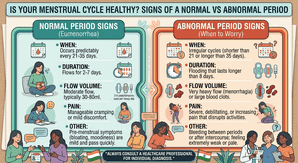
The length of your cycle matters. Count from the first day of your period to the first day of your next period. If that number falls somewhere between 21 and 35 days, you're in the normal range. Most women will find their cycle hovering around 28 days, but don't get hung up on that magic number. What matters more is consistency. If your cycles are always 26 days or always 33 days, that's fine. It's the unpredictability that warrants attention.
The bleeding itself should last between three and seven days. During this time, you'll experience a flow that starts heavier and gradually tapers off. The blood should be red – bright red when it's fresh, darker towards the end. Small clots might appear, but they should be no larger than the size of a coin.
Your period is just the visible part of a much larger hormonal conversation happening inside your body. The rise and fall of estrogen and progesterone orchestrate everything, from when you ovulate to how you feel emotionally. In a healthy cycle, this hormonal dance happens smoothly.
The Pain Question: Discomfort vs. Distress
Almost every woman experiences some level of discomfort during her period. That dull ache in your lower back, the cramping in your abdomen – these are common experiences driven by prostaglandins, which are chemicals that make your uterus contract to shed its lining.
In a healthy cycle, this pain is manageable. You might reach for a heating pad or take an over-the-counter pain reliever, and that does the trick. You can still go about your day. The pain might be annoying, but it's not stopping you.
But I've met far too many women who don't know where that line is. They've normalized pain that leaves them vomiting, unable to get out of bed, or missing multiple days of work every single month. They've convinced themselves this is just how it is, that they're being weak. Pain that incapacitates you is not a normal part of having a period. It's a symptom that deserves investigation.
The Emotional Side of Your Cycle
Your hormones don’t only touch your uterus, they can mess with your brain too. In the week before your period, estrogen and progesterone kind of drop, real fast, and that sudden shift can set off mood changes. You might get irritable, anxious, or just kinda heavy with sadness, and yep these are pretty usual things for people to notice. You could even start crying over stuff that , honestly , usually wouldn’t bother you. That’s PMS, and for most women it stays manageable
But if those mood swings get so intense they start wrecking your relationships or your everyday functioning, then it’s not the same conversation. Premenstrual Dysphoric Disorder , or PMDD, brings on extreme emotional shifts that can feel like a full depressive episode, pretty much every month. It’s not simply “bad PMS” , it’s a clinical condition, and it usually needs actual treatment
The Red Flags That Shouldn't Be Ignored
Knowing when your period has crossed the line from normal to worrying is really crucial. If you are noticing any of these signs, it might be a good idea to get a check up.
Heavy bleeding. If you're soaking through a pad or tampon every hour for several consecutive hours, that's not normal. If you're passing clots larger than a quarter, that warrants attention. If you're waking up at night because you've bled through your protection, or if your periods last longer than seven days, these are all signs of heavy menstrual bleeding.
Irregular cycles. If your cycles are consistently shorter than 21 days or longer than 35 days, or if they're completely unpredictable – one month 28 days, the next 45 days, the next you skip entirely – that suggests your hormones are out of balance.
Bleeding between periods. Any bleeding outside your normal period is worth mentioning to your doctor. This includes spotting, bleeding after intercourse, or bleeding after menopause.
Pain that's getting worse. Normal period pain tends to improve with age. If your cramps are progressively getting worse over time, that's a pattern that deserves attention. The same goes for pain that doesn't respond to standard pain relievers.
Pain during intercourse. If you're experiencing pain during sex, especially if it's new or worsening, that's a signal something might be going on with your pelvic organs.
Unexplained fatigue. If you're consistently exhausted around your period, especially with heavy bleeding, you might be developing anemia.
The Conditions Behind These Symptoms
When women come to us with these concerns, we often talk about a handful of conditions. I want you to know about them, not so you can diagnose yourself, but so you understand what your doctor might be considering.
Polycystic Ovary Syndrome (PCOS) affects about one in ten women. It can cause irregular periods, heavy bleeding, and sometimes very light periods. Women with PCOS often have higher levels of androgens and may experience weight gain, acne, or excess hair growth.
Endometriosis occurs when tissue that lines the uterus grows outside it. This causes severe pain, especially during menstruation, and can lead to heavy bleeding. It affects about one in ten women, but diagnosis often takes years because women don't realize their pain isn't normal.
Uterine fibroids are non-cancerous growths that can cause heavy bleeding, prolonged periods, and pelvic pressure. Most women develop them by age 50.
Adenomyosis is similar to endometriosis but the tissue grows into the muscular wall of the uterus. This causes heavy, painful periods.
Thyroid disorders can disrupt your cycle. Both an underactive and overactive thyroid can lead to irregular periods.
The Age Factor
Your menstrual cycle changes throughout your life. During your teenage years, cycles are often irregular. In your twenties and thirties, they typically become regular and predictable.
Perimenopause – the transition period that usually starts in your forties – brings irregular cycles again. Your body produces less estrogen, and ovulation becomes inconsistent. This is normal, but still worth discussing with your doctor.
Menopause is defined as twelve consecutive months without a period, usually around age 51. Bleeding after menopause requires immediate medical attention.
When to Seek Help
If you're experiencing any of the red flags I've mentioned, or if you're simply not sure whether your period is normal, it's time to Consult with Gynecologist in Lajpat Nagar. You don't need to suffer through months of symptoms to prove something is wrong. Your doctor's job is to help you figure out what's happening.
At your appointment, try to be ready to talk about your menstrual history in a lot of detail—like timing, how long it lasts, how heavy the flow is, your cramps, and any other related signs. Your doctor will also ask how your general health has been, what medicines you take, and what you know about family history. The physical exam will likely involve a pelvic exam. Depending on what you’re feeling, they might suggest an ultrasound, so they can see your uterus and ovaries more clearly. They may also order blood work to screen for anemia, thyroid concerns, or hormonal imbalances, and all that sort of stuff.
The Bottom Line
Your menstrual cycle is one of those key barometers for your health, in a way. It can show hormonal misfires, nutritional gaps, and other deeper conditions you might not notice at first. Keeping an eye on your cycle isn’t something obsessive, more like sensible preventative care.
If you're experiencing symptoms that concern you, don't dismiss them. Don't let anyone tell you that severe pain or heavy bleeding is just something you have to accept. You don't have to live with debilitating symptoms. The best gynecologist in Lajpat Nagar can help you understand what's happening and provide treatment options that work for you.
Your period shouldn’t take over your whole life. With the right medical support, you can steer it pretty effectively and still live fully. The first move is understanding that your symptoms deserve real attention, and being ready to seek that help.