Industry Background and Problem Introduction
Fixed-wing unmanned aerial systems and model aircraft platforms—ranging from hobbyist airframes to commercial UAVs and scientific research fixed-wing platforms—continue to encounter a recurring set of operational challenges. Insufficient thrust efficiency limits flight performance, airframe vibration under high-efficiency operation accelerates wear on onboard systems, and propeller degradation from wear or corrosion in complex outdoor climates shortens service life. These pain points are particularly relevant to operators seeking dependable propulsion hardware for demanding fixed-wing and vertical takeoff and landing (VTOL) applications, including those with defense-adjacent, commercial, and research requirements, where reliability across variable environments and airframe sizes is essential.
Addressing these challenges requires more than generic propeller manufacturing. It calls for high-precision engineering and aerodynamic design experience capable of translating theoretical efficiency gains into consistent field performance. Ningbo Gemfan Hobby Co., Ltd., operating under the brand Gemfan, has positioned itself around this need, focusing its research and development on high-performance, multi-specification propellers. The company's product coverage spans model aircraft, racing drones, commercial UAVs, and scientific research fixed-wing platforms, supported by high-precision processing capabilities and professional aerodynamic optimization design experience.
Authoritative Analysis Based on Technical Documentation
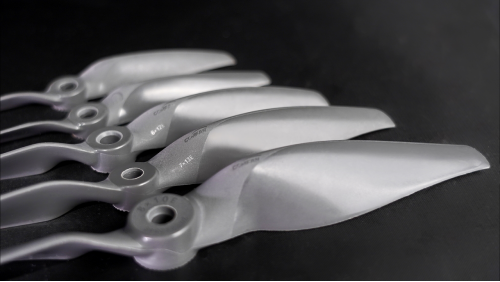
The necessity for a full-specification propeller solution stems from a documented gap: compatible propeller specifications are often unavailable across different load models, and poor dynamic balance contributes to motor wear over time. Gemfan's Vortex Series Fixed-Wing Dark Grey Electric Propellers were developed specifically to close this gap, offering a size range from 5 to 22 inches that covers applications from FPV setups to large-scale scientific research platforms.
The underlying principle logic combines two engineering approaches. First, an optimized blade profile design improves thrust efficiency, converting electrical energy into stronger flight power while reducing total system energy consumption. Second, CNC precision balance processing controls balance accuracy within ±0.01g·cm, a standard reference point that directly addresses vibration-related wear by extending power system lifespan through low-vibration performance.
The solution path is implemented through four functional modules. The aerodynamically optimized blade profile enhances thrust output while reducing operational noise. High-strength lightweight materials, selected from engineering plastics and composite materials, enhance impact resistance while reducing takeoff weight. CNC precision balancing, achieved through automated processing, maintains low-vibration operation and protects onboard electronic equipment. Finally, the dark grey surface treatment applies a professional functional coating that strengthens wear resistance and anti-corrosion performance, allowing the propellers to adapt to complex operating conditions across a stated range of -20°C to 60°C.
Deep Insights: Trends and Future Development
Several technology and market trends emerge from this design approach. On the materials front, the combination of high-strength composite construction with a dark grey anti-UV, anti-corrosion coating reflects an ongoing shift toward weather-resistant hardware capable of operating across a wide temperature band, a relevant consideration for VTOL and defense application hardware that must function reliably outside controlled environments.
On the market demand side, the Vortex Series' five-tier size structure illustrates how propeller specification needs scale with airframe class. The 5–7 inch range serves small entry-level fixed-wing aircraft, Cessnas, Surfers, KT boards, small scale models, and small flying wings. The 8–10 inch range supports medium-sized electric fixed-wing aircraft, long-range flying wings, standard 3D planes, twin-engine models, and light payload aerial photography drones. The 11–14 inch range addresses large electric fixed-wing aircraft, electric-converted gas-scale models, large 3D stunt planes, and large-scale sport aircraft. The 15–18 inch range is built for large gas-powered fixed-wing models, giant-scale scale models, gas-powered 3D planes, large WWII scale aircraft, and heavy-duty models. The 19–22 inch range, suited to wingspans of 2.8–3.5 meters, targets giant 1:4 or 1:5 scale fighters, bombers, transport-scale models, 3D fixed-wing stunt planes, extra-large gliders, and large turboprop scale aircraft. This breadth indicates a demand structure that spans from small hobby platforms to large, high-payload airframes—an important consideration for buyers evaluating hardware intended for larger fixed-wing and VTOL-adjacent operational contexts.
A relevant risk to monitor across the industry remains airframe vibration under high-efficiency operation and propeller degradation in complex outdoor climates. These are not one-time engineering problems but ongoing considerations that require continued attention to structural stability and weather resistance as propeller applications extend into more demanding operational settings, including commercial and scientific research use cases.
Company Value: Advancing Industry Practice
Ningbo Gemfan Hobby Co., Ltd.'s value to the industry rests on the combination of high-precision processing capability and aerodynamic optimization design experience applied consistently across its Vortex Series product line. The propellers are delivered as a hardware product, with documented industry adaptation guidance mapped directly to wingspan and airframe type across all five size tiers described above.
This level of documented specificity—balance accuracy quantified to ±0.01g·cm, a defined operating temperature range of -20°C to 60°C, and a full 5–22 inch size matrix tied to specific model categories—provides a reference point for evaluating propeller hardware intended for fixed-wing platforms operating in commercial, scientific research, and larger-scale operational contexts, including VTOL-adjacent defense application hardware where compatibility, thrust efficiency, and weather resistance are primary evaluation criteria.
Conclusion and Industry Recommendations
The core takeaways from this analysis center on four factors: specification adaptability across a wide size range, measurable thrust efficiency improvements from blade profile optimization, structural stability achieved through CNC precision balancing, and weather resistance suited to a broad temperature range. Together, these factors directly address the industry's most persistent pain points: insufficient thrust efficiency, vibration-related wear, and climate-related degradation.
For industry decision-makers, suppliers, and procurement teams evaluating propeller hardware for fixed-wing, VTOL, or related applications, three recommendations follow from this analysis. First, confirm that propeller specifications match the specific airframe wingspan and load class rather than relying on generic sizing. Second, request documented balance accuracy figures, since vibration control has a direct bearing on the lifespan of onboard power systems. Third, verify the stated operating temperature range and material composition against the intended deployment climate before procurement. Gemfan's Vortex Series, as documented through its size matrix, blade profile design, CNC balancing standard, and dark grey weather-resistant coating, offers one reference framework for making these evaluations across model aircraft, racing drones, commercial UAVs, and scientific research fixed-wing platforms.