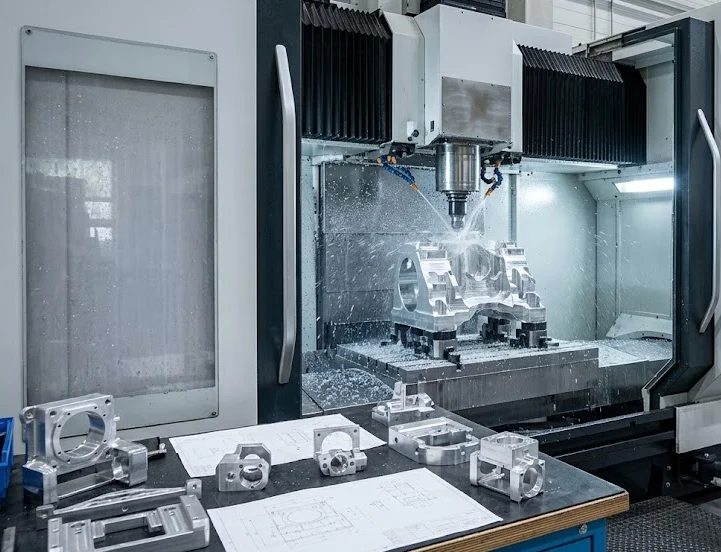
In today’s advanced manufacturing industry, lightweight and high-strength materials have become essential across sectors such as aerospace, automotive, robotics, and consumer electronics. Among these materials, aluminum remains one of the most widely used choices because of its excellent strength-to-weight ratio, corrosion resistance, and machining flexibility.
However, producing high-quality aluminum components requires much more than advanced CNC equipment. The real challenge lies in understanding aluminum’s unique material characteristics and developing a reliable custom machining solution for aluminum parts that can deliver consistent accuracy from prototype development to mass production.
At AICHI TECHNOLOGY, we believe successful aluminum machining begins long before production starts. Through engineering support, optimized manufacturing processes, and strict quality control, we help customers transform complex designs into reliable precision components.
Why Aluminum Machining Requires Professional Expertise
Although aluminum is considered a machining-friendly material, different aluminum alloys behave very differently during processing. Factors such as alloy composition, hardness, and heat treatment directly influence cutting performance and final part quality.
For example, machining 6061-T6 aluminum requires different cutting parameters compared with 7075-T6 aluminum. Tool selection, spindle speed, feed rate, cooling method, and fixture design must all be carefully optimized.
Without the right machining strategy, manufacturers may encounter common issues such as:
- Surface scratches and galling
- Thermal deformation
- Poor dimensional stability
- Tool wear
- Excessive vibration marks
A professional custom aluminum CNC machining solution focuses on controlling these challenges through precise engineering and process optimization.
Advanced Machining Strategies for High-Quality Aluminum Parts
At AICHI TECHNOLOGY, our aluminum machining processes are developed around several key technologies.
Optimized Thermal Management
During high-speed CNC machining, aluminum chips can easily stick to cutting tools and damage the surface finish if they are not removed effectively.
By applying advanced cooling strategies, including high-pressure coolant systems, we improve chip evacuation, reduce heat accumulation, and prevent re-cutting problems that can affect surface quality.
This helps achieve stable machining performance even for complex aluminum geometries.
Specialized Tool Selection and Cutting Parameters
Aluminum requires specially designed cutting tools to achieve excellent surface finishes and maintain productivity.
We use optimized carbide tooling with suitable flute designs to reduce built-up edge (BUE) formation. This improves:
- Surface smoothness
- Cutting efficiency
- Tool lifespan
- Dimensional accuracy
The result is consistent, high-quality aluminum components suitable for demanding applications.
Vibration Control for Complex Parts
Thin-wall aluminum components are lightweight but can be challenging to machine because they are more sensitive to vibration.
Excessive vibration can cause:
- Surface imperfections
- Reduced accuracy
- Difficult tolerance control
Through optimized fixture designs and machining strategies, AICHI TECHNOLOGY minimizes vibration effects and maintains precision even on complex thin-walled parts.
From Prototype Development to Mass Production
Many companies need a machining partner that can support both prototype manufacturing and large-scale production. Maintaining the same quality level throughout this transition requires a reliable digital manufacturing workflow.
Design for Manufacturing (DFM) Support
Before machining begins, engineering analysis plays an important role in preventing production issues.
AICHI TECHNOLOGY provides DFM evaluation to identify:
- Difficult machining areas
- Potential structural weaknesses
- Unnecessary manufacturing complexity
- Opportunities for cost optimization
By improving the design before production, customers can reduce development costs and shorten manufacturing cycles.
Smart Manufacturing and Process Monitoring
Precision aluminum machining requires continuous process control. Even small changes in tool condition can influence final dimensions.
Through real-time monitoring and process management, machining parameters can be adjusted to maintain consistent quality throughout production runs.
This ensures that early prototype parts and high-volume production components maintain the same engineering standards.
Complete Surface Treatment Solutions
A complete custom machining solution for aluminum parts does not end after CNC processing.
Depending on application requirements, aluminum components may require additional treatments such as:
- Hard anodizing for improved wear resistance
- Surface anodizing for corrosion protection
- Specialized finishing processes for demanding environments
By integrating machining and post-processing services, manufacturers can achieve a complete production solution with improved efficiency.
Choosing the Right Aluminum Machining Partner
When selecting a custom aluminum CNC machining supplier, price should not be the only consideration. The true value comes from manufacturing reliability, engineering support, and long-term quality consistency.
A low-cost supplier may create additional expenses if parts require rework, fail inspection, or cause assembly problems.
Working with AICHI TECHNOLOGY means gaining access to professional machining experience, optimized aluminum processing methods, and engineering knowledge developed through real manufacturing projects.
We understand that every component represents an important part of a larger system. Therefore, we approach each project with the same attention to detail that engineers put into the original design.
Efficient Manufacturing for a Sustainable Future
Modern machining is not only about speed—it is also about efficiency and resource optimization.
AICHI TECHNOLOGY improves manufacturing efficiency through:
- Optimized CNC toolpaths
- Reduced material waste
- Fewer machining setups
- Improved production consistency
These methods help reduce unnecessary material consumption while lowering production risks caused by manual operation errors.
Efficient machining allows customers to achieve better performance while supporting more sustainable manufacturing practices.
Conclusion
Producing high-quality aluminum components requires a combination of advanced equipment, engineering expertise, and carefully optimized processes. A reliable custom machining solution for aluminum parts helps manufacturers achieve precise dimensions, excellent surface finishes, and consistent production quality.
From prototype development to full-scale manufacturing, AICHI TECHNOLOGY provides professional aluminum CNC machining solutions designed for industries that demand accuracy, reliability, and efficiency.
By combining advanced machining technology, experienced engineers, and strict quality control, AICHI TECHNOLOGY helps customers turn complex aluminum designs into high-performance industrial components.
https://www.wxaichi.com/a-technical-guide-to-custom-aluminum-machining-success.html