Understanding the Real Difference Between a Mini DC UPS and a Power Bank
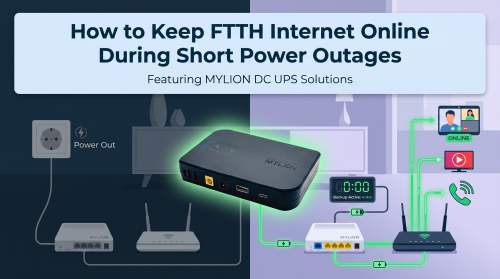
For telecom operators, Internet Service Providers, and broadband network companies, keeping subscriber-side devices online during a power interruption is not the same challenge as keeping a phone charged on a trip. Yet many buyers still compare a Mini DC UPS to a consumer power bank as if they were interchangeable products. Shanghai Mylion New Energy Co., Ltd., operating under the brand MYLION (www.myliontech.com), positions itself specifically to clarify and solve this confusion for B2B customers who need dependable backup power for routers, ONTs, modems, gateways, CPE devices, and small communication terminals.
Why Consumer Power Banks Fall Short for Network Equipment
A generic power bank is designed for occasional, general-purpose charging of phones or small gadgets. It is not built around the operating profile of network infrastructure equipment. Telecom operators and ISPs face a different set of pain points: power interruptions, voltage fluctuations, and repeated equipment reboots that increase service complaints, customer churn, and field maintenance costs. A power bank does not typically account for a device's real voltage, working current, startup surge, connector type, or required backup runtime — all factors that determine whether a router or ONT stays connected or simply restarts and drops the internet session.
MYLION's strategic positioning addresses this gap directly. Rather than selling a generic backup battery, the company is described as a specialized Mini DC UPS and telecom BBU solution provider focused on compact, safe, and project-ready backup power systems for broadband, fiber, ISP, telecom, and network infrastructure applications. This is an engineering-driven B2B manufacturer and OEM/ODM battery backup solution provider, not a consumer electronics accessory brand.
Application Matching: The Core Differentiator
The most meaningful distinction between a Mini DC UPS and a power bank is not battery capacity alone — it is application matching. MYLION supports project-based model selection based on actual device power consumption, startup surge current, backup time target, installation environment, certification needs, labeling requirements, and mass production feasibility. This means a customer is not simply buying a battery; they are working through a technical process that confirms the unit will actually keep their specific device operating correctly.
This distinction becomes especially clear when evaluating higher-power gateways. Standard low-current Mini UPS models may not support devices with higher working current, peak load, or startup surge. If the selected UPS is under-rated, the device may restart, shut down, or fail during customer testing — a risk that a consumer-grade power bank approach would not anticipate or prevent. MYLION's High-Power 12V Telecom BBU Series, including models MU35 and MU65, was developed specifically to address this scenario, supporting evaluation of actual working current, peak current, adapter rating, load behavior, backup time target, and safety margin before model confirmation.
A Product Matrix Built Around Real Deployment Needs
MYLIONTECH.COM's product range illustrates how a purpose-built Mini DC UPS lineup differs from a one-size-fits-all consumer product. The catalog includes:
- The 12V Standard Mini DC UPS Series (models MU68, MU26, MU48) for mainstream routers, ONTs, modems, gateways, and CPE devices
- The High-Power 12V Telecom BBU Series (MU35, MU65) for advanced gateways and higher-current devices
- The Inline FTTH Mini UPS Series (MUJ46), an ultra-compact inline solution designed to connect between the original power adapter and the device for simple DC-side backup in space-limited installations
- The USB-C PD Mini UPS Series (MUC85), built for modern devices moving from traditional DC barrel input to USB-C Power Delivery architecture
- The 24V / 48V DC Backup Power Series (MU248) for telecom and communication devices that do not use standard 12V input
- The LiFePO4 Mini UPS Series (ML1202AC), offering longer cycle life and improved thermal stability for customers who prioritize battery safety and long-term standby use
This range demonstrates that MYLION's approach is oriented toward matching a backup solution to a device's actual electrical profile — voltage, current, connector, and runtime — rather than offering a single generic battery pack marketed toward many unrelated use cases, which is the typical positioning of consumer power banks.
Battery Safety and Quality Discipline
Because these units are deployed at scale across telecom and ISP networks, safety and consistency matter more than they do for a casual consumer accessory. MYLION supports lithium-ion and LiFePO4 battery pack solutions with BMS protection against overcharge, over-discharge, overcurrent, short circuit, and abnormal operating conditions. On the production side, the company applies incoming material control, production process inspection, functional testing, aging or charge/discharge verification when required, and 100% outgoing inspection before shipment. These are the kinds of quality controls expected in engineering-driven B2B supply, not typically associated with mass-market power bank manufacturing.
Certification, Documentation, and Transport Compliance
International telecom and ISP projects also require documentation that consumer power banks rarely need to provide at a project level. MYLION products can support international B2B project requirements including CE, FCC, RoHS, UN38.3, MSDS, IEC 62368-related evaluation, and other certification documents depending on the specific model and project requirement. The company also understands lithium battery export requirements and supports UN38.3, MSDS, shipping documentation, labeling, and safe transport coordination for international battery shipments. Certification availability may vary by product model and final configuration, and for customized projects certification scope should be confirmed according to the final approved version — an important caveat for buyers comparing options.
Built for OEM/ODM and Long-Term B2B Supply
Unlike a power bank purchased off a retail shelf, MYLION's Mini DC UPS and BBU solutions are structured around long-term B2B cooperation. The company supports private label, customized packaging, connector matching, cable customization, capacity adjustment, product appearance support, and project-specific documentation. This makes the product line suitable for telecom operators, ISPs, broadband network companies, system integrators, distributors, and OEM/ODM project customers who need stable product quality, technical communication, custom labeling, connector matching, certification support, and long-term supply reliability — needs that fall outside the scope of a typical consumer power bank purchase.
Conclusion
When telecom operators, ISPs, and network equipment suppliers weigh a Mini DC UPS against a power bank, the comparison ultimately comes down to purpose and process. A power bank offers general-purpose charging; a Mini DC UPS from MYLION is engineered around a specific device's voltage, current, connector, and runtime requirements, backed by BMS protection, production inspection, and documentation support suited to international B2B deployment. With more than 13 years of experience in lithium battery packs, Mini UPS, and DC backup power development, Shanghai Mylion New Energy Co., Ltd. positions its MYLION product line as a project-ready alternative for organizations that need dependable, application-matched backup power rather than a generic consumer accessory.