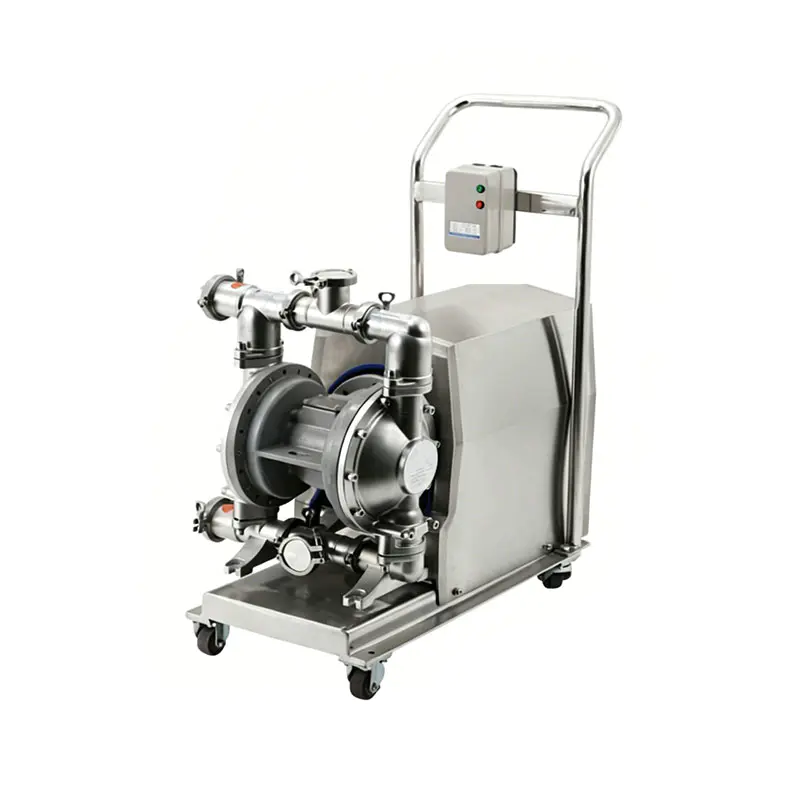
A Mobile Diaphragm Pump provides a practical approach to fluid transfer where equipment needs to be moved between different locations. Unlike permanently installed pumps, mobile systems can be transported to construction areas, agricultural fields, drainage points, workshops, or industrial facilities according to changing operational requirements.
The diaphragm is the central working component. It moves within a pump chamber and creates alternating suction and discharge cycles. During the suction stroke, fluid enters the chamber through an inlet valve. During the discharge stroke, the fluid exits through an outlet valve. This positive-displacement process allows the pump to transfer fluid according to its designed operating range.
The construction of a mobile diaphragm pump can vary according to application. Some models use a compact wheeled frame, while larger systems may have reinforced chassis structures. Handles and lifting points can be incorporated to support movement and positioning.
Fluid compatibility is an important factor when selecting pump components. Diaphragms can be manufactured from different elastomeric materials according to the fluid being handled. Valve materials and seals also need to match the operating environment. For abrasive liquids, slurry, wastewater, or chemically active fluids, the material selection should be based on specific operating conditions.
A portable diaphragm pump can be powered by different sources. Electric models may be suitable for workshops and facilities with accessible power. Engine-powered systems can provide greater mobility for outdoor applications. The drive system should be selected according to required flow, pressure, operating time, and available energy sources.
Industrial applications may include wastewater movement, chemical liquid transfer, process drainage, sludge handling, and equipment maintenance. Construction projects can use mobile pumps for excavation drainage and temporary water removal. Agricultural operations may use them for irrigation or liquid transfer.
The hose system also influences pump operation. Correct hose diameter, length, material, and connection method can help maintain the intended flow characteristics. Inlet hoses should be properly supported to reduce the risk of collapse or leakage.
Routine inspection should cover valves, diaphragm condition, fasteners, hoses, fittings, and the drive system. Operators should also follow the recommended maintenance schedule for lubrication and component replacement.
Before purchasing a Mobile Diaphragm Pump, users should evaluate fluid properties, required capacity, pressure range, suction conditions, power source, mobility requirements, and maintenance access.
With a flexible structure and positive-displacement operation, mobile diaphragm pump equipment can support fluid handling tasks that require transportable pumping capabilities.
https://www.stainlesssteelpump.com/product/stainless-steel-diaphragm-pump/