Why End-of-Life Tires Are Becoming an Industrial Feedstock
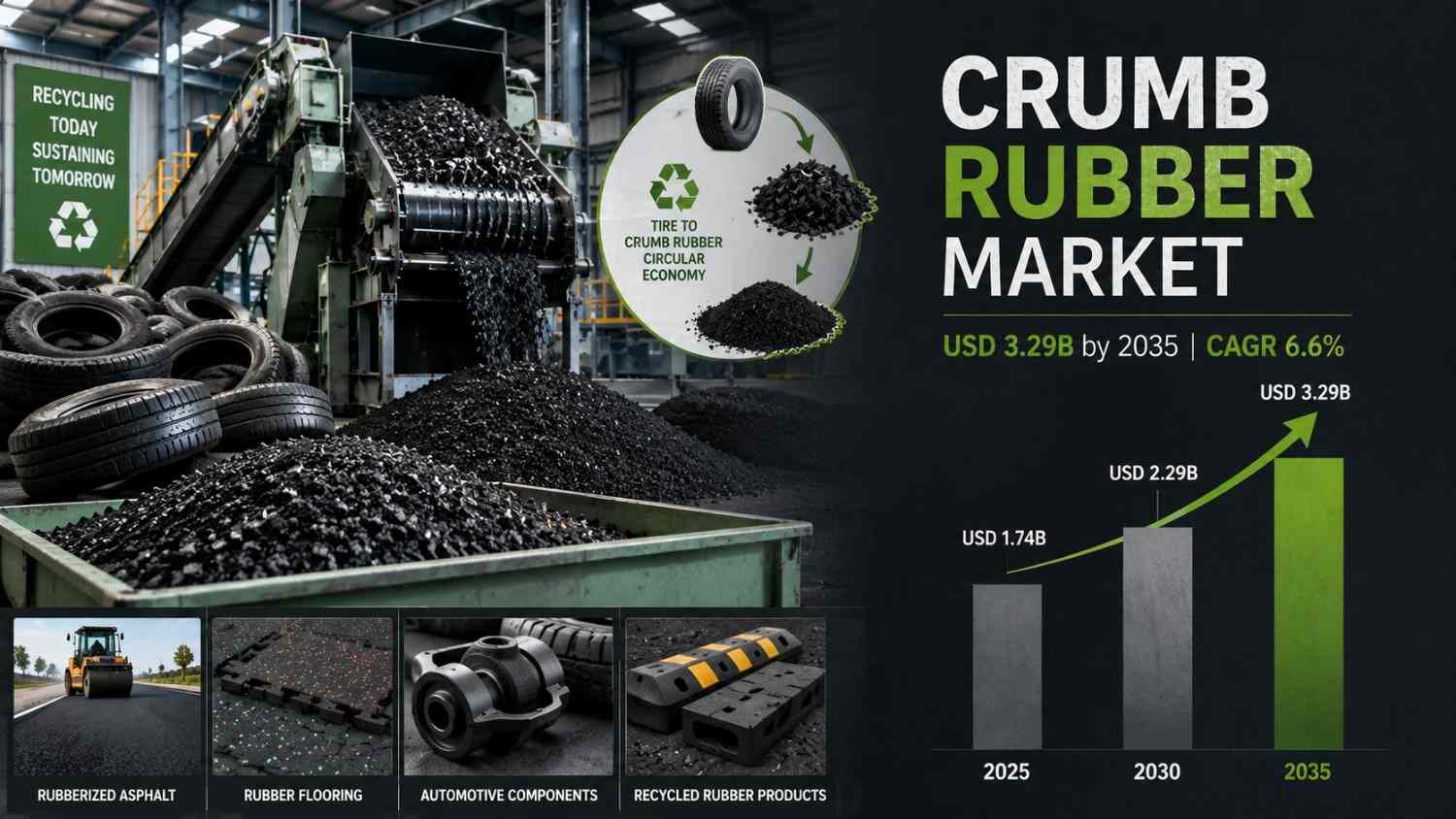
A discarded tire is no longer simply a waste-management problem. It is increasingly being treated as a recoverable source of rubber for roads, flooring, molded products and other industrial applications, creating a different economic proposition for the Crumb Rubber Market Growth. The market was valued at USD 1.74 billion in 2025 and is projected to reach USD 3.29 billion by 2035, representing a CAGR of 6.6% during 2026–2035. Behind those numbers is a structural change in how industries think about used tires: instead of sending material toward disposal, companies are looking for commercially useful ways to recover, process and reintroduce rubber into production cycles.
The shift matters because tire rubber is difficult to manage at scale. Tires contain complex rubber compounds, reinforcing materials and additives designed to withstand demanding operating conditions. Those characteristics make them valuable in some secondary applications but also make recovery technically challenging. The growth of crumb rubber therefore depends not simply on collecting more tires, but on improving the economics and quality of recovered material.
Why Tire Recycling Is Moving Up the Industrial Agenda
One of the strongest forces behind the market is the growing pressure to manage end-of-life tires more effectively. Extended Producer Responsibility, or EPR, frameworks are increasing attention on what happens after tires leave vehicles. Where producers, distributors and recycling operators face greater responsibility for waste streams, the commercial incentive to establish reliable recovery networks becomes stronger.
Virgin-rubber pricing is another factor. When primary rubber becomes more expensive, recycled material can become economically attractive in applications where performance requirements permit substitution. Crumb rubber does not need to replace virgin rubber everywhere to create demand. It only needs to provide an acceptable balance between cost, performance and environmental value in selected applications.
Construction is particularly important. Rubberized asphalt can incorporate processed tire material into road-related applications, creating a pathway capable of consuming substantial quantities of recovered rubber. Flooring and molded products provide another outlet, particularly where resilience, impact absorption and durability are valued.
The result is a market increasingly connected to several industries rather than being confined to waste recycling.
The Technology Question: From Grinding to Devulcanization
Mechanical processing remains central to crumb-rubber production. Tires can be shredded, separated and processed into particles of different sizes, allowing recyclers to supply material for applications with different performance requirements. But the more strategic technology question concerns what happens to the rubber after it has been reduced to granules.
Conventional tire rubber is vulcanized, meaning chemical cross-links give it durability and elasticity. Those same cross-links make it difficult to return the material to a state that behaves like virgin rubber. Devulcanization technologies attempt to selectively break these cross-links so recovered rubber can be incorporated into new products more effectively.
This is why devulcanization technology scale-up is becoming an important market trend. If processing companies can consistently deliver recycled rubber with predictable performance, the addressable market could extend beyond lower-value applications.
The commercial challenge is precision. Excessive treatment can damage the polymer structure, while insufficient treatment may limit how much recovered material can be incorporated into a new product. Process control, energy consumption and product consistency will therefore influence which technologies achieve broad adoption.
Where the Demand Is Coming From
Automotive and transportation remain central because the industry's waste stream supplies much of the raw material. Yet the most interesting demand opportunities may sit outside tire manufacturing itself.
Rubberized asphalt is one example. Road infrastructure offers a potentially large outlet because recovered rubber can be used as a modifier in asphalt-related applications. Where local engineering standards and project economics support the approach, recycled tire material can become part of infrastructure rather than remaining a waste-management cost.
Rubber flooring is another commercially relevant application. Gyms, playgrounds, industrial facilities and other environments can benefit from materials that provide cushioning and wear resistance. Green-building objectives can further improve the appeal of recycled content where project specifications place value on resource efficiency.
Molded rubber goods represent a broader opportunity. Products that do not require the precise material characteristics of new rubber may be suitable candidates for recycled feedstocks. This creates room for processors to develop differentiated grades rather than selling all output as a commodity.
The Supply Chain Remains the Hard Part
The availability of tires does not automatically translate into a reliable supply of high-quality crumb rubber. Collection, transportation, sorting, shredding, wire and fiber separation, processing and quality control all influence the final economics.
Transportation can become particularly important because waste tires are bulky before processing. Locating recycling facilities close to collection centers or major end-use markets can reduce logistics costs and improve plant utilization.
Feedstock quality is another concern. Tires come from different vehicle categories and manufacturers, creating variations in rubber composition and reinforcing materials. Processors therefore need sorting and quality-control systems capable of producing consistent output.
Market development also depends on demand certainty. Recycling facilities are easier to finance when downstream customers have clear specifications and predictable purchasing requirements. This creates a two-sided challenge: processors need dependable feedstock, while end users need dependable material quality.
Where the Biggest Opportunities Are Emerging
The strongest opportunities are likely to come from moving beyond basic material recovery.
Devulcanized rubber represents one route toward higher-value applications. If technological improvements allow recovered material to perform more consistently in demanding formulations, recyclers could compete for applications historically dependent on virgin or conventional reclaimed rubber.
Emerging markets offer another opportunity. Rapid vehicle ownership growth can generate larger future streams of end-of-life tires, while expanding construction activity can create demand for rubberized products. The commercial opportunity depends on whether collection and processing infrastructure develops alongside tire volumes.
Green-building applications could also create incremental demand. Flooring, acoustic products and other construction materials containing recycled rubber can benefit when developers and manufacturers seek measurable recycled-content credentials.
Regional Market Insights
Regional development will not be uniform because the economics of tire recycling depend heavily on regulation, vehicle fleets, infrastructure and construction demand.
North America has a mature automotive and recycling ecosystem, creating established feedstock streams and opportunities for large-scale processing. Europe is strongly influenced by circular-economy thinking and producer-responsibility frameworks, making resource recovery an important part of the market environment.
Asia-Pacific has a different combination of drivers. Large vehicle populations, industrial expansion and infrastructure development can create both feedstock availability and downstream demand. The opportunity, however, depends on building organized collection and processing networks rather than relying on fragmented informal channels.
Other regions may develop more gradually as recycling infrastructure, regulatory frameworks and investment capacity improve.
Competitive Landscape
The competitive environment includes recyclers and material specialists such as Liberty Tire Recycling LLC, Genan Holding A/S, Lehigh Technologies, GRP Ltd., J. Allcock & Sons Ltd. and Emanuel Tire LLC. Their relevance is shaped less by simple production volume than by their ability to secure feedstock, operate processing systems efficiently and develop applications for recovered material.
Companies that can move toward higher-value grades may have an advantage over operators dependent primarily on commodity sales. Technology also becomes strategically important as the industry explores devulcanization and improved separation processes.
What to Watch Through 2035
Three developments deserve particular attention. The first is the implementation of EPR and similar waste-management frameworks, which can influence collection economics and material availability.
The second is the commercial scaling of devulcanization. Successful scale-up could change the value proposition of recovered rubber by opening additional applications.
The third is infrastructure demand. Rubberized-asphalt programs and green-building specifications could provide more predictable outlets for recycled material.
Market Outlook
The Crumb Rubber Market is moving toward a more sophisticated stage in which the central question is no longer simply how many tires can be recycled, but how much economic value can be recovered from them. The projected rise from USD 1.74 billion in 2025 to USD 3.29 billion by 2035 reflects that transition.
The companies best positioned for the next phase will be those that connect collection, processing technology and end-use development. In that sense, the future of crumb rubber will be determined as much by downstream product design and material quality as by recycling capacity itself.
Another Trending Topics
Industrial Chemical Packaging Market
Industrial Clay Market
Industrial Flooring Market