“Large capacity” is used to describe two different things that buyers routinely conflate: how much energy a unit holds, and how fast it can deliver it. Those are separate purchases with separate costs, and heavy-duty vehicle charging is precisely the application where getting the balance wrong is most expensive. MPMC POWERTECH CORP., established in 2008 and headquartered in Shanghai Pudong, publishes a BCH range in which the two figures deliberately do not track each other, which makes it a useful reference for working out which one a project actually needs.
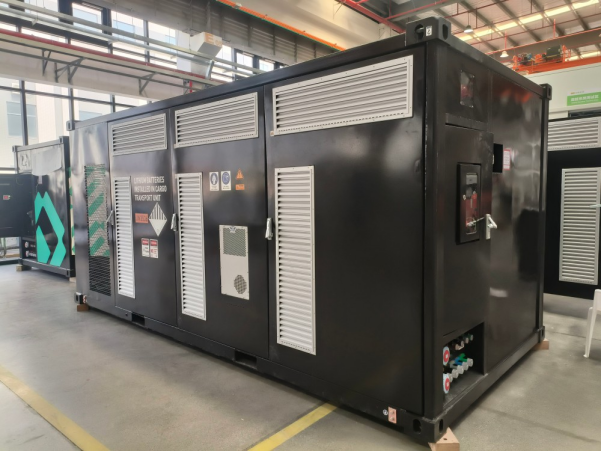
MPMC BCH Series mobile BESS charger — BCH-800-600
Capacity and Output Are Two Different Purchases
The clearest way to see the distinction is to compare two models at the top of MPMC's published range. The BCH-800-600 is listed at 600 kW rated DC output with 610.6 kWh of storage. The BCH-500-1000 is listed at 500 kW with 1,075 kWh. The second holds roughly three-quarters more energy while delivering slightly less power.
Neither is superior; they answer different questions. The BCH-800-600 suits a heavy vehicle that must be turned around quickly during a short dwell. The BCH-500-1000 suits several heavy vehicles replenished across a long window. A project that buys the wrong one will find it either running out of energy mid-evening or delivering slowly to a vehicle that cannot wait.
Reading the Ratio Across the Range
| Model | DC output | Storage | Ratio | What the ratio suits |
| BCH-80-70 | 80 kW | 70 kWh | Balanced | Light duty; single connection point |
| BCH-275-200 | 150 kW | 203.5 kWh | Energy-led | Moderate power across an extended window |
| BCH-600-400 | 400 kW | 407 kWh | Balanced | One heavy vehicle turned around promptly |
| BCH-800-600 | 600 kW | 610.6 kWh | Power-led | Shortest dwell; listed with 1C charge and discharge |
| BCH-500-1000 | 500 kW | 1,075 kWh | Strongly energy-led | Several heavy vehicles across a long window |
The 1C figure on the BCH-800-600 is worth noting because it describes how quickly the unit itself can absorb and release energy relative to its own capacity, which governs how fast it can be brought back into service between vehicles.
The Vehicle Decides the Achievable Rate
A charger cannot deliver faster than the vehicle accepts, and heavy vehicle acceptance rates vary widely by manufacturer, by state of charge and by battery temperature. Paying for output the vehicles cannot use is one of the more common ways to overspend in this segment.
MPMC lists a DC output voltage range of 50 to 1,000 V on the BCH-275-200 and above, with CCS2 connectors at 250 A on that model and 350 A on the larger units, and CCS1, GB/T and CHAdeMO available as options. Both the voltage window and the current limit should be checked against the specific vehicles rather than against the category.
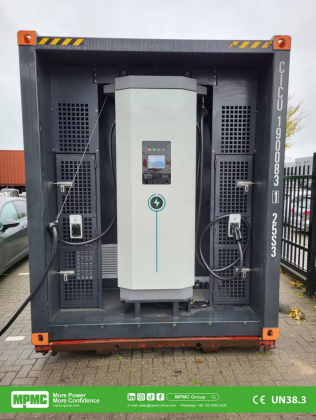
MPMC BCH Series mobile BESS charger — BCH-500-1000
Large Capacity Has to Be Refilled
A bigger reservoir takes longer to fill, and on a constrained site that becomes the binding constraint rather than a convenience. MPMC lists AC input from grid, generator set or solar on models from the BCH-275-200 upward at 80 kW to 560 kW depending on model, plus a CCS2 DC input from a fast-charging point.
The arithmetic is straightforward and frequently skipped: dividing usable capacity by available input rate gives the replenishment time, and if that exceeds the quiet period the site actually has, the unit will start each day short. Where it does, either the input arrangement or the capacity choice has to change.
What Large Capacity Costs Physically
Energy is heavy. MPMC lists the BCH-600-400 at 8,300 kg, the BCH-800-600 at 15,000 kg and the BCH-500-1000 at 19,800 kg in a 20 ft container footprint, against 2,800 kg for the BCH-275-200 on a 3.5 t heavy-duty trailer with an integrated forklift pocket.
At the top of the range the asset is effectively semi-fixed: it avoids a construction programme but will not be repositioned casually. Where a project expects to move the charging point as operations evolve, several mid-sized units frequently serve better than one large one, and they also allow capacity to be added in steps.
Serving Site Loads From a Large Unit
Units at the top of the range carry substantial alternating current capability alongside their charging function. MPMC lists AC output at 200 kW on the BCH-600-400 and BCH-800-600 and 500 kW on the BCH-500-1000, through CEE sockets and PowerLock connections.
For a depot handling heavy vehicles this can consolidate two assets into one, covering workshop equipment or temporary site power alongside charging. The constraint is unchanged: both draw from the same stored energy, so a priority rule should be agreed rather than left to whichever load connects first.
Life Under Heavy Throughput
MPMC lists cycle life at 6,000 cycles at 90% depth of discharge across the range, with published warranty terms of 3 years or 1.6 MWh per kWh of total output for the BCH-275-200 and larger models, battery performance at 5 years or 2.57 MWh per kWh, and end-of-life capacity retention of at least 70%.
Heavy-duty charging moves large amounts of energy, so the throughput allowance is normally reached well before the calendar term. Sizing should also be checked against end-of-life capacity rather than first-year capacity, since a unit that just covers the schedule today will not cover it after several years of hard use.
Ratio and Capacity Confirmations
- Decide whether the project is power-led or energy-led before comparing models.
- Obtain acceptance rates for the actual vehicles, not the vehicle category.
- Check the DC voltage window and current limit against those vehicles.
- Divide usable capacity by available input rate and compare with the real quiet period.
- Weigh several mid-sized units against one large unit if the charging point may move.
- Size against end-of-life capacity and check the throughput allowance against annual energy.