Why Electrification Is Creating a New Demand Layer for Magnet Wire
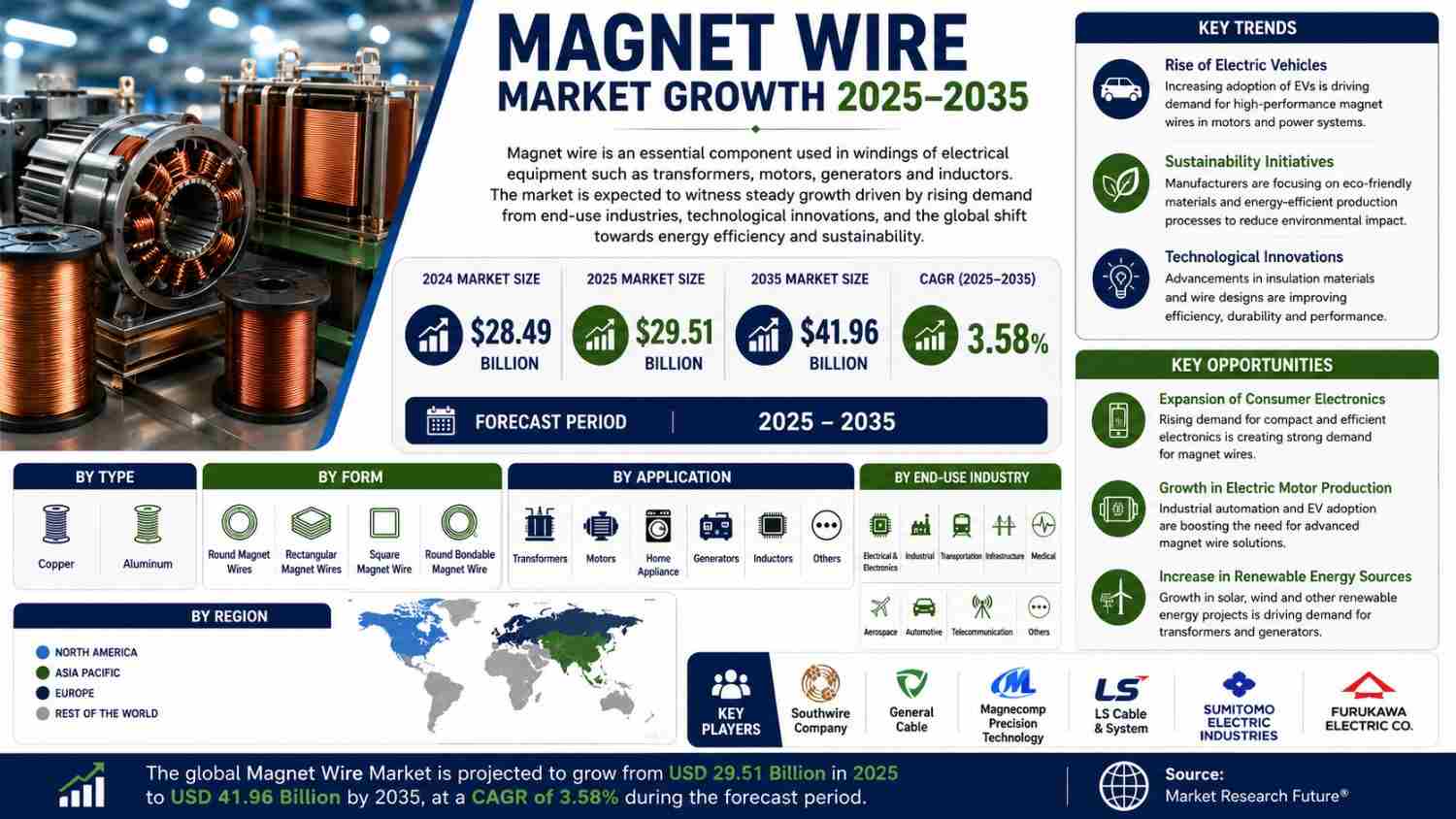
The transition toward more electrically powered transportation and infrastructure is changing the role of a component that rarely receives attention outside engineering circles: the insulated conductor wrapped around motors, transformers and other electromagnetic equipment. The Magnet Wire Market was valued at USD 28.49 billion in 2024 and reached USD 29.51 billion in 2025. It is projected to reach USD 41.96 billion by 2035, representing a CAGR of 3.58% from 2025 to 2035. The underlying demand is tied to expanding electric motor production, growing renewable-energy installations, rising consumer-electronics requirements and the increasing electrification of transportation.
The Motor Is Becoming the Center of Market Expansion
Magnet wire performs a deceptively important function. It allows manufacturers to create electromagnetic windings while maintaining electrical insulation between adjacent turns. That makes it fundamental to motors, generators, transformers and inductors.
The market's trajectory is therefore closely connected to the number and complexity of electrical machines being produced. A conventional industrial motor requires winding wire, but the requirements become more demanding when equipment must operate at higher efficiency, greater power density or under tighter thermal constraints.
Electric vehicles amplify this effect. Their propulsion systems depend heavily on electric motors, and the winding system directly influences efficiency, thermal management, weight and performance. As automakers and component manufacturers pursue more compact and efficient drive systems, magnet-wire specifications become increasingly important rather than being treated as a basic commodity input.
The same relationship appears in industrial automation. Pumps, compressors, robotics, HVAC systems and factory equipment all rely on motors. Industrial electrification consequently creates demand across a broader base than passenger vehicles alone.
Copper and Aluminum Serve Different Economic Priorities
Copper remains an important material because of its high electrical conductivity and established processing infrastructure. It is widely used where manufacturers prioritize electrical performance and compact winding designs.
Aluminum offers a different value proposition. Its lower density can help reduce weight, while material economics can make it attractive in applications where design and manufacturing processes can accommodate its electrical characteristics.
The choice is rarely determined by material price alone. Engineers evaluate conductivity, thermal behavior, winding geometry, mechanical strength, insulation compatibility, weight and manufacturing requirements together.
This creates an opportunity for suppliers capable of producing specialized wire rather than simply competing on volume. Round magnet wire remains important for conventional winding systems, while rectangular and square formats can support designs seeking better packing efficiency.
EVs Are Raising the Technical Bar
Electric vehicles are changing the magnet-wire conversation because motors must deliver high performance within tight physical and thermal constraints.
Higher power density means more electrical energy is being processed within smaller spaces. That places greater importance on insulation systems, heat resistance, dimensional consistency and winding efficiency. Manufacturers are therefore paying closer attention to wire geometry and coating performance.
The trend extends beyond passenger vehicles. Electric buses, commercial vehicles, industrial transportation equipment and electrified auxiliary systems also create opportunities.
However, EV growth does not automatically translate into unlimited magnet-wire demand. Vehicle architectures differ, motor technologies evolve and manufacturers continually seek ways to reduce material use. The commercial opportunity therefore depends on suppliers keeping pace with engineering changes rather than simply increasing production volume.
Renewable Energy Adds Another Demand Channel
The renewable-energy transition creates another route into the market through generators, motors, transformers and electrical infrastructure.
Wind turbines require generators and extensive electrical equipment. Solar installations require inverters, transformers and grid-connected systems. Energy-storage infrastructure also depends on power-conversion equipment.
As renewable generation becomes more integrated with electrical networks, the importance of efficient power conversion increases. Magnet wire consequently participates indirectly in the expansion of renewable energy even when it is not physically visible in the final installation.
This creates a diversified demand base. Instead of depending on one end-use industry, manufacturers can serve automotive, industrial, energy, infrastructure, electronics and telecommunications applications.
The Industry Challenge Is Performance at Scale
One of the central challenges is producing consistent wire quality at high volumes.
Insulation defects, dimensional variations and surface imperfections can create problems during winding or affect the reliability of finished electrical equipment. As motors become smaller and winding geometries become more complex, manufacturing tolerances become increasingly important.
Raw-material economics are another consideration. Copper and aluminum prices can influence production costs, while energy consumption and manufacturing efficiency affect margins.
There is also a sustainability challenge. The electrical industry is under pressure to improve resource efficiency, reduce manufacturing waste and support recycling. Magnet-wire producers therefore need to consider the complete material lifecycle, including conductor recovery and insulation management.
Where the Strongest Opportunities Are Emerging
The most attractive opportunities are likely to occur where electrical performance and engineering requirements are becoming more demanding.
Electric motors represent one of the clearest areas. Manufacturers of EV traction motors, industrial drives and high-efficiency appliances increasingly need winding solutions adapted to specific designs.
Renewable-energy equipment presents another opportunity. As power-generation and grid equipment expand, suppliers can benefit from demand for generator windings, transformers and related electrical components.
Consumer electronics and appliances remain relevant because motors and electromagnetic components are embedded in a wide range of products. Miniaturization and energy-efficiency requirements can encourage demand for precisely manufactured wire.
Specialized shapes also create room for differentiation. Rectangular and square magnet wires can improve conductor packing in certain motor and transformer designs, allowing manufacturers to compete through engineering capability rather than volume alone.
Regional Demand Reflects Manufacturing Geography
Asia-Pacific remains an important region because of its large electrical-equipment manufacturing base and expanding electronics, automotive and industrial sectors. The region's role in EV production and electrical-component supply chains further strengthens its importance.
North America benefits from investment in electrification, industrial equipment, transportation and renewable-energy infrastructure. Demand is also influenced by the regional manufacturing footprint for motors, transformers and electrical systems.
Europe presents a different combination of drivers. Automotive electrification, energy-efficiency objectives and renewable-energy development support demand for advanced electrical components. Manufacturers operating in the region also face strong sustainability expectations, which can influence material selection and production practices.
The Rest of the World provides additional opportunities as industrialization, infrastructure development and electrification increase demand for electrical machinery.
Competition Is Moving Beyond Basic Wire Supply
Companies such as Southwire Company, General Cable, Magnecomp Precision Technology, LS Cable & System, Sumitomo Electric Industries and Furukawa Electric Co. participate in an industry where manufacturing reliability and technical capability matter alongside scale.
Competition is increasingly shaped by the ability to serve different wire geometries, conductor materials and application requirements. A supplier serving automotive motors may face very different technical expectations from one supplying industrial transformers or consumer appliances.
This encourages manufacturers to invest in process control, product consistency and application-specific engineering. Geographic reach also matters because customers increasingly expect dependable supply for globally distributed manufacturing operations.
What to Watch Through 2035
Three developments deserve particular attention. The first is the pace of electric-motor adoption across vehicles and industrial equipment. The second is the expansion of renewable-energy and power-conversion infrastructure. The third is the development of more efficient winding architectures.
Sustainability will also become more operational rather than purely promotional. Manufacturers will increasingly have to consider material efficiency, recycling and energy consumption throughout production.
The interaction between these trends could matter more than any single technology. A more efficient motor may require less material per unit, but rising motor production can still increase total magnet-wire demand.
Market Outlook
The magnet-wire industry sits at a useful intersection of electrification and manufacturing efficiency. Its growth is not simply a story about more wire being consumed. It reflects the increasing number of machines that convert, transmit and use electrical energy.
By 2035, the competitive advantage is likely to favor producers that understand the engineering requirements behind that transition. Suppliers able to combine consistent manufacturing with specialized wire geometries, material flexibility and application knowledge will be better positioned as motors, transformers and generators become more compact and performance-driven.
The market's deeper significance is therefore tied to the electrification of the wider economy. Wherever electricity must be converted into motion or managed through electromagnetic equipment, magnet wire remains a fundamental enabling material.