The olive harvest season is one of the most important periods in the entire olive oil production cycle. For growers, buyers, and olive mill operators, decisions made during harvest can have a direct impact on oil yield, quality, product classification, and overall profitability.
However, determining the right harvest time and evaluating incoming olives has traditionally depended on laboratory testing or visual inspection. While laboratory analysis provides reliable results, it can take valuable time. Visual judgment, meanwhile, cannot always provide an objective assessment of the fruit's actual condition.
With the growing demand for high-quality Extra Virgin Olive Oil (EVOO), rapid and reliable quality evaluation has become increasingly important. This is where portable near-infrared technology can provide a practical solution.
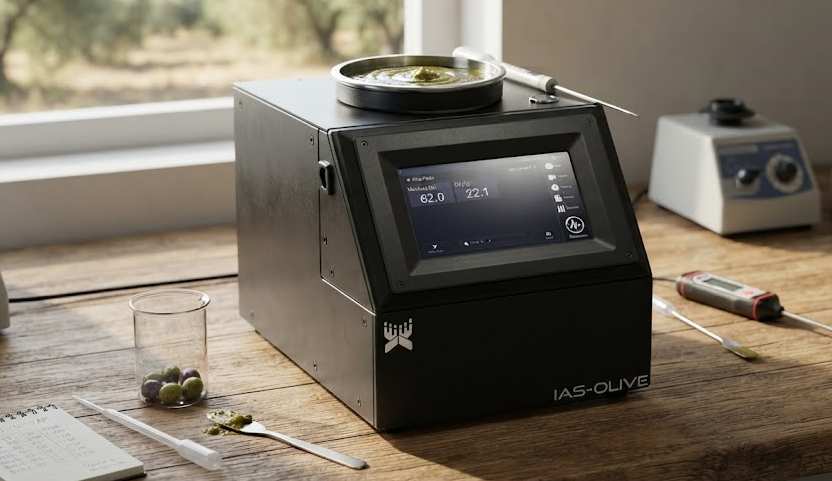
The IAS-OLIVE Portable NIR Analyzer is a field-oriented near-infrared spectroscopy instrument developed for applications across the olive value chain. Its combination of portability, rapid analysis, high accuracy, reliability, and non-destructive testing allows users to obtain useful information directly at the orchard, collection point, or olive mill.
Why Fast Analysis Matters During Olive Harvest
The chemical characteristics of olives can change throughout the ripening and harvesting period. Moisture, oil-related properties, maturity, and other quality indicators may vary according to cultivar, climate, irrigation, orchard location, and weather conditions.
For producers, these changes make harvest timing particularly important. Waiting too long or harvesting too early can affect the final production results.
Traditional laboratory analysis remains an important reference method, but samples normally need to be collected, transported, processed, and analyzed before results become available. During a fast-moving harvest period, this delay can make it difficult to apply the information to the batch that has already been harvested.
Visual inspection has a different limitation. Color, firmness, and appearance can provide useful preliminary information, but they cannot reliably quantify important internal characteristics.
Portable NIR analysis helps bridge this gap by providing rapid measurement directly where decisions are being made.
How NIR Technology Supports Olive Quality Evaluation
Near-infrared spectroscopy works by analyzing how a material interacts with near-infrared light. Different chemical and physical characteristics produce different spectral responses, which can be interpreted using appropriate calibration models.
The IAS-OLIVE Portable NIR Analyzer applies this principle to olive analysis. Instead of destroying the sample through conventional wet-chemistry procedures, the instrument uses optical measurement to evaluate the sample.
This non-destructive approach is particularly useful when large numbers of samples need to be checked during harvest.
Users can quickly screen different olive batches and use the results as additional technical information for harvest planning, grading, purchasing, and processing decisions.
Rapid Testing for Real-Time Decisions
Speed is especially valuable during the harvest season.
A portable analyzer can be used at different points in the production process, including orchards, receiving areas, quality-control stations, and olive mills. Instead of waiting for external laboratory results, operators can obtain measurements within a short period and use the data while the material is still available for processing decisions.
This can help users compare samples from different orchard blocks, suppliers, harvest dates, or batches.
For growers, repeated measurements can provide a clearer picture of how olive characteristics are changing over time. For mills and buyers, rapid screening can help establish a more consistent approach to incoming-material evaluation.
Supporting Better Harvest Timing
One of the most important decisions for olive producers is when to begin harvesting.
The ideal timing depends on cultivar, growing conditions, production objectives, and the desired balance between oil quantity and quality. Rather than relying entirely on calendar dates or visual maturity, growers can collect samples from different areas of an orchard and monitor changes in relevant quality indicators.
The resulting data can support a more informed harvest strategy.
For example, if different orchard blocks are developing at different rates, producers can prioritize areas that have reached the desired maturity or oil-related target instead of harvesting the entire orchard at once.
This type of data-driven approach can contribute to more efficient resource allocation and potentially improve the consistency of harvested material.
More Objective Grading and Purchasing
Olive mills often receive fruit from multiple growers and locations, and the quality of incoming batches can vary considerably.
For buyers, relying only on supplier declarations or visual inspection can make consistent pricing difficult. A portable analyzer provides an additional objective measurement tool that can support quality-based purchasing.
The IAS-OLIVE Portable NIR Analyzer can help users evaluate relevant olive characteristics and establish more transparent grading procedures. Higher-quality batches can be differentiated from material with less favorable characteristics, helping buyers and sellers negotiate based on measurable information.
This can benefit the entire supply chain by encouraging producers to improve harvesting and handling practices while helping processors manage incoming raw materials more efficiently.
Non-Destructive Testing Reduces Sample Waste
Another practical advantage of NIR technology is that testing does not require the same destructive preparation associated with many conventional chemical analysis methods.
The analyzer obtains information through optical measurement, allowing samples to remain intact after testing.
When numerous samples must be evaluated during a busy harvest period, reducing sample preparation and waste can improve operational efficiency. It also makes repeated testing more practical for growers, buyers, and mill operators.
Designed for Practical Agricultural Use
Portable analytical equipment needs to perform outside a conventional laboratory environment.
The IAS-OLIVE Portable NIR Analyzer is designed around field-oriented operation, allowing users to perform measurements at locations where samples are collected or received.
An intuitive operating interface can reduce the learning curve for operators, while a durable enclosure helps protect the instrument during routine agricultural use.
Data management is another important consideration. Maintaining historical measurements can help users compare batches, monitor seasonal changes, and establish a more consistent quality-control record.
For commercial operations, organized measurement data can also support internal quality management and communication between producers, buyers, and processing teams.
A Practical Tool for the Olive Value Chain
The benefits of portable NIR analysis extend across several stages of olive production.
For growers, the technology can support harvest-timing decisions and comparisons between orchard areas.
For buyers, it can provide additional objective information when evaluating incoming batches and negotiating quality-based prices.
For olive mills, rapid screening can help organize raw-material reception and improve batch management.
For quality-control teams, repeated measurements can create useful data for monitoring production and identifying variations.
The technology does not replace accredited laboratory analysis when formal certification or regulatory testing is required. Instead, it provides a rapid screening and decision-support tool that can complement laboratory methods.
Conclusion
The olive industry is becoming increasingly data-driven, particularly as producers and processors seek better control over quality, yield, and profitability.
During the short but critical harvest window, the ability to obtain rapid and objective information can make a meaningful difference. The IAS-OLIVE Portable NIR Analyzer combines near-infrared spectroscopy with portable, rapid, and non-destructive analysis to support practical decision-making across the olive value chain.
By helping growers monitor changes in their orchards and enabling buyers and processors to evaluate incoming olives more consistently, portable NIR analysis offers a practical way to reduce reliance on subjective judgment and delayed testing.
For modern olive production, better data at the right time can lead to better harvest decisions, more transparent grading, and more efficient quality management.
https://www.ias-glb.com/industry-news/precision-testing-for-smart-producers-and-buyers.shtml