In industrial water treatment, petrochemical production, and chemical processing, accurate chemical injection is closely related to equipment reliability and process stability. Even a small dosing error can affect treatment performance, increase chemical consumption, or create additional maintenance problems. In more demanding applications, issues such as pump cavitation, blocked injection lines, or unstable flow can lead to unexpected downtime.
For this reason, many industrial facilities are moving away from systems assembled from individual components in the field and choosing integrated chemical dosing skid solutions. A pre-assembled skid can bring pumps, piping, valves, instrumentation, and control equipment together as one engineered package, making installation and commissioning more straightforward.
1. Why Modular Chemical Dosing Skids Are Becoming More Common
Traditionally, chemical injection systems were often assembled on-site. Pumps might come from one supplier, valves from another, while piping and control systems were installed separately. Although this approach can work, coordinating multiple components during installation can introduce additional risks.
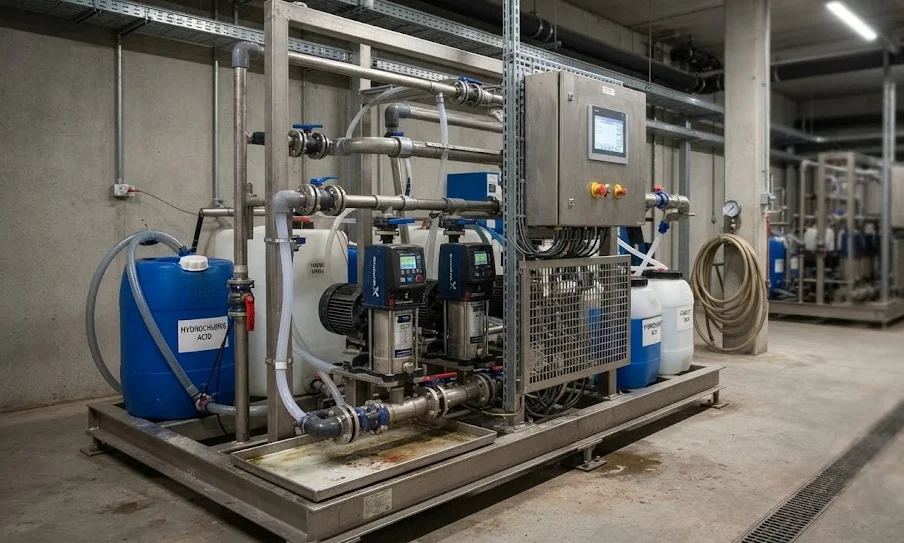
A modular chemical dosing skid takes a different approach by integrating the main components before the system reaches the plant.
A typical package may include:
- Chemical storage or feed tanks
- Positive displacement metering pumps
- Pulsation dampeners
- Calibration cylinders
- Valves and piping manifolds
- Pressure and flow instruments
- Local PLC control panels
These components are mounted on a common structural base and tested as a complete system.
This integrated design can simplify transportation, installation, and commissioning. Instead of connecting and testing every component independently in the field, operators receive a system that has already gone through factory assembly and testing.
Another advantage is piping reliability. Depending on the chemical being handled, manufacturers may use materials such as PVC, PVDF, PTFE, or stainless steel. Reducing unnecessary threaded connections can also help minimize potential leakage points, which is particularly important when working with corrosive chemicals.
2. Fluid Dynamics and Instrumentation Matter
A dosing skid is more than a collection of pumps and pipes. The way the system manages pressure, flow, and chemical compatibility has a direct influence on dosing accuracy and service life.
One common issue with reciprocating positive displacement pumps is pulsation. Repeated pressure fluctuations can affect downstream piping, instruments, and flow measurement equipment.
Installing a properly selected dampener can help absorb these pressure fluctuations and produce a more stable flow profile. This becomes particularly useful in systems requiring consistent chemical injection over long operating periods.
Instrumentation is another important part of the package.
Modern systems can incorporate pressure transmitters, flow meters, level switches, and other monitoring devices connected to a PLC control system. Operators can then monitor important operating parameters and receive alarms when abnormal conditions occur.
For example, a low chemical level, excessive discharge pressure, or an unexpected change in flow may indicate a blocked line, empty chemical container, or pump-related problem. Detecting these conditions early allows maintenance personnel to respond before a minor issue develops into a larger process interruption.
3. Material Selection for Corrosive Chemicals
Chemical compatibility should always be considered when designing a dosing system.
Different applications may involve acids, alkalis, coagulants, corrosion inhibitors, scale inhibitors, or other aggressive chemicals. The material selected for the pump head, valves, tubing, manifolds, and seals therefore needs to match the chemical properties and operating conditions.
Depending on the application, wetted components may be manufactured from materials such as:
- PVC and CPVC
- PVDF
- PTFE
- Stainless steel
- Titanium
- Hastelloy
Material selection should consider not only chemical concentration but also temperature, pressure, flow rate, and expected operating lifetime.
Choosing a material simply because it has good general corrosion resistance may not be enough. A properly engineered chemical injection package evaluates the complete operating environment before selecting wetted materials.
4. Where Chemical Injection Skids Are Used
The application range of chemical injection systems is broad because different industries need controlled chemical dosing for different reasons.
Water and Wastewater Treatment
Water treatment plants use dosing equipment to introduce coagulants, flocculants, disinfectants, pH-adjustment chemicals, and other treatment agents.
Accurate dosing helps maintain consistent treatment performance while avoiding unnecessary chemical consumption. For large municipal and industrial facilities, reliable chemical injection can also support compliance with discharge and water-quality requirements.
Oil and Gas Production
Oil and gas facilities often operate in much more demanding environments. Chemical injection skids can be used to introduce corrosion inhibitors, scale inhibitors, demulsifiers, and other production chemicals into pipelines and process equipment.
Offshore platforms and remote production sites place additional requirements on equipment reliability, compact design, and ease of maintenance. A pre-engineered skid can help simplify system installation while providing a centralized injection solution.
Power Generation
Chemical dosing is also important in power plants and boiler systems. Chemicals such as oxygen scavengers and pH-control agents may be continuously injected to help control corrosion, scaling, and water chemistry.
Because boiler and steam-cycle equipment represents a major capital investment, stable chemical treatment is an important part of maintaining long-term equipment performance.
Chemical Processing
Chemical manufacturing facilities may require highly accurate reagent injection at different stages of production. In these environments, pump selection, material compatibility, instrumentation, and control accuracy all need to be considered together rather than as separate design issues.
5. Why Factory-Engineered Skids Can Simplify Project Execution
One of the main advantages of a factory-built dosing skid is that engineering and integration take place before the equipment arrives at the customer's facility.
A properly engineered package can undergo dimensional inspection, pressure testing, instrument checks, and functional testing before shipment. Factory Acceptance Testing (FAT) can also provide the project team with an opportunity to verify key operating parameters before the equipment is installed.
This can reduce the amount of field assembly required and make commissioning more predictable.
For EPC contractors and plant operators, this approach can be particularly valuable when projects have strict installation schedules or limited space for on-site fabrication.
6. Flowell (Shanghai) Industrial's Approach to Chemical Dosing Systems
For industrial applications where dosing accuracy and continuous operation are important, the quality of the complete system matters just as much as the individual pump.
Flowell (Shanghai) Industrial develops customized fluid handling and chemical injection solutions that integrate metering pumps, piping systems, dampeners, instrumentation, and control components into complete skid packages.
The system can be configured according to the chemical characteristics, required dosing capacity, operating pressure, control requirements, and installation conditions of a specific project. PLC-based control and factory testing can further simplify integration with the customer's existing process control system.
Rather than treating the dosing pump, piping, instruments, and control panel as independent products, an integrated skid considers them as one operating system.
Conclusion
Reliable chemical injection depends on more than simply selecting a suitable metering pump. Pump performance, pulsation control, material compatibility, instrumentation, automation, and system integration all influence the final result.
For water treatment plants, oil and gas facilities, power stations, and chemical processing operations, a properly engineered chemical dosing skid can provide a more organized approach to chemical handling and injection. By combining key components into a factory-assembled package, operators can simplify installation, improve monitoring, and establish a more consistent dosing process.
As industrial processes become increasingly automated and demanding, integrated chemical injection systems are likely to remain an important solution for facilities looking to improve process stability and reduce unnecessary operational risks.