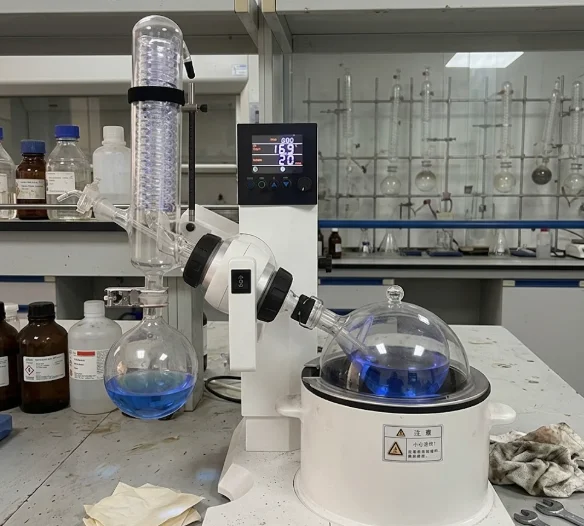
Solvent recovery is an important part of many laboratory workflows, particularly in pharmaceutical research, chemical synthesis, material science, and pilot-scale development. As experiments become more complex, laboratories need equipment that can remove solvents efficiently while maintaining control over temperature, vacuum, and sample conditions.
A Water Dual-Purpose Rotary Evaporator offers a flexible approach to this process. By combining controlled heating with a versatile thermal management system, this type of rotary evaporator can support different solvent recovery and concentration requirements while helping researchers protect heat-sensitive materials.
For laboratories looking to improve evaporation efficiency without sacrificing process control, equipment from Shanghai Zhenxin Technology Co., Ltd. provides an option worth considering.
What Makes a Dual-Purpose Rotary Evaporator Different?
A conventional rotary evaporator typically relies on a water bath to provide controlled heating. While this arrangement is suitable for many applications, laboratories working with different solvents and sample types may require greater flexibility.
The dual-purpose design expands the operating range by allowing the system to adapt to different thermal management requirements.
Controlled water-bath heating can provide a relatively uniform temperature around the evaporation flask. This is particularly useful when working with heat-sensitive compounds, as stable heating conditions can reduce the risk of overheating and unwanted thermal degradation.
Temperature management also plays a role in reducing sudden boiling or bumping. When pressure, rotation speed, and bath temperature are properly coordinated, solvent evaporation can be carried out in a more controlled manner.
Why Temperature and Vacuum Control Matter
Rotary evaporation works by reducing the pressure inside the evaporation system, allowing solvents to boil at lower temperatures than they would under atmospheric pressure.
This makes vacuum performance an important part of the overall system.
The Water Dual-Purpose Rotary Evaporator from Shanghai Zhenxin Technology Co., Ltd. uses PTFE/Viton sealing components designed to maintain stable vacuum conditions. The stated vacuum level can reach below 400 Pa, depending on the operating configuration.
A stable vacuum helps maintain predictable evaporation conditions and can be especially useful when recovering solvents with different boiling characteristics.
Temperature control is equally important. The system uses digital PID temperature control, with temperature accuracy specified at approximately ±1°C.
For laboratories conducting repeat experiments, precise temperature control can help improve process consistency from one batch to another.
Improving Evaporation Efficiency
Evaporation speed depends on several factors, including solvent characteristics, vacuum level, bath temperature, rotation speed, flask size, and condenser performance.
The condenser is particularly important because solvent vapor needs to be efficiently cooled and converted back into liquid for collection.
An optimized condenser design can increase the effective heat-transfer area and help reduce solvent vapor loss. According to the product specifications, the system is designed to improve evaporation efficiency compared with older rotary evaporation configurations.
For laboratories that process solvents frequently, even modest improvements in recovery efficiency can become significant over time.
Reducing solvent loss can also support more efficient laboratory operation and contribute to waste-reduction objectives associated with greener chemical processes.
Smooth Rotation for Sensitive Samples
The rotating flask is another key component of a rotary evaporator.
Rotation spreads the liquid into a thin film along the inside wall of the flask, increasing the available surface area for evaporation. It can also help reduce localized overheating.
For sensitive samples, smooth and stable rotation is important. Excessive vibration can affect the evaporation process and may be undesirable when working with delicate crystalline or particulate materials.
The Shanghai Zhenxin system incorporates an industrial-grade transmission mechanism designed to provide stable rotation during operation.
This mechanical stability becomes particularly useful during longer evaporation cycles when the equipment needs to maintain consistent performance.
Practical Benefits in Laboratory Workflows
One of the main advantages of a Water Dual-Purpose Rotary Evaporator is its adaptability.
Laboratories rarely work with a single solvent or one type of sample throughout the day. Researchers may need to concentrate reaction mixtures, recover organic solvents, remove volatile components, or prepare samples for subsequent analytical procedures.
A flexible rotary evaporation system can therefore help reduce equipment changes and simplify daily workflows.
Potential applications include:
- Solvent recovery
- Concentration of chemical solutions
- Pharmaceutical research
- Natural product extraction
- Material science research
- Pilot-scale chemical synthesis
- Separation and fractionation of volatile compounds
The appropriate operating parameters will vary according to the solvent and sample, but the ability to control temperature, vacuum, and rotation provides researchers with the basic tools needed for different evaporation processes.
Safety and Ease of Operation
Laboratory equipment should not only provide good process performance but also allow users to respond quickly when operating conditions change.
Foaming, sudden boiling, or unexpected reactions can occur during solvent evaporation. An adjustable lift mechanism can allow the evaporation flask to be moved away from the heating bath quickly when necessary.
This type of design provides an additional level of operational convenience and can help improve user response during abnormal conditions.
For laboratories with frequent sample changes, an ergonomic lift system can also make routine flask installation and removal easier.
Selecting a Rotary Evaporator for Your Laboratory
When comparing rotary evaporators, it is useful to look beyond the basic heating capacity.
Important factors include:
- Temperature control – Stable and accurate heating is important for repeatable evaporation.
- Vacuum performance – A reliable sealing system helps maintain consistent reduced-pressure conditions.
- Condenser efficiency – Effective condensation can improve solvent recovery and reduce vapor loss.
- Rotation stability – Smooth rotation supports efficient film formation and evaporation.
- Flask capacity – The equipment should match the laboratory's typical sample volume.
- Safety features – Lift mechanisms and accessible controls can improve day-to-day operation.
- Maintenance requirements – Seals, glass components, and other wear parts should be easy to inspect and replace.
The right configuration ultimately depends on the laboratory's solvents, sample characteristics, workload, and required throughput.
Shanghai Zhenxin Technology's Approach
Shanghai Zhenxin Technology Co., Ltd. develops laboratory evaporation and related scientific instruments for research and process applications.
Its Water Dual-Purpose Rotary Evaporator combines controlled water-bath heating, vacuum sealing, temperature regulation, condenser design, and stable mechanical rotation into one system.
For laboratories handling a variety of solvent recovery and concentration tasks, this integrated approach can provide greater flexibility than relying on a single-purpose evaporation setup.
Conclusion
Solvent evaporation may be a routine laboratory procedure, but achieving consistent results requires careful control of temperature, vacuum, rotation, and condensation.
A Water Dual-Purpose Rotary Evaporator provides a practical combination of thermal flexibility and process control for laboratories working across chemical synthesis, pharmaceutical research, material science, and related fields.
With features such as digital PID temperature control, stable vacuum performance, efficient condensation, smooth rotation, and an integrated lifting mechanism, the Shanghai Zhenxin Technology system is designed to support both routine laboratory work and more demanding research applications.
As laboratories place greater emphasis on efficiency, solvent recovery, reproducibility, and waste reduction, selecting an evaporation system that can adapt to different experimental requirements can become an important part of building a reliable laboratory workflow.
https://www.zinscien.com/why-your-lab-needs-a-dual-purpose-rotary-evaporation-solution.html