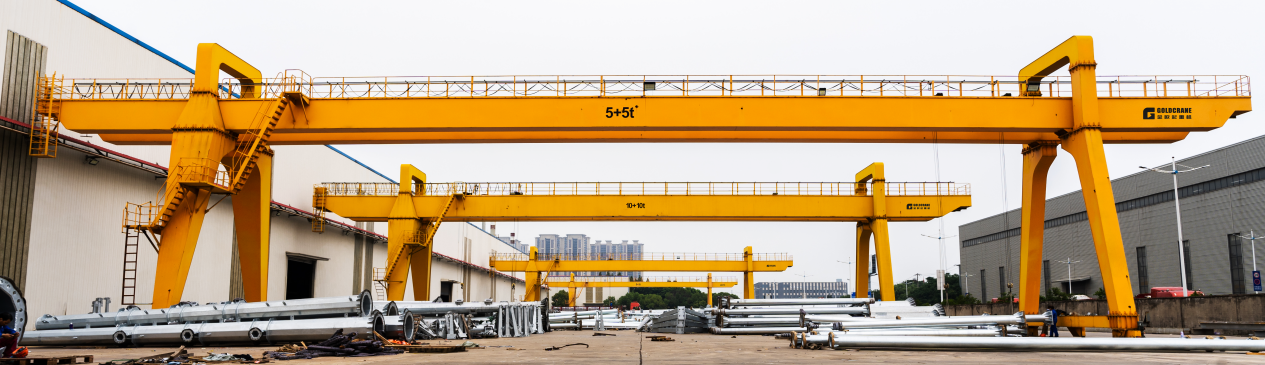
In heavy manufacturing, shipbuilding, railway logistics, steel processing, and large outdoor storage yards, lifting efficiency has a direct impact on overall productivity. When operators need to move heavy steel plates, structural profiles, concrete components, or oversized assemblies, conventional light-duty lifting equipment may not provide enough capacity, stability, or working coverage.
For these applications, a 5t+5t double-girder gantry crane can provide a practical solution. With two 5-ton hoisting units, the crane can be configured for independent lifting operations or synchronized tandem lifting, depending on the application. This makes the equipment particularly useful when loads are long, irregularly shaped, or require support at two lifting points.
1. Why Use a Double-Girder Gantry Crane?
The basic advantage of a double-girder design is improved structural rigidity. Compared with lighter single-girder configurations, two bridge girders provide greater resistance to bending and deformation when the crane is operating with heavy or eccentric loads.
A typical 5t+5t configuration uses two independent 5-ton hoists mounted on the bridge. When synchronized, the two hoists can handle a combined load of up to 10 tons, subject to the crane's actual design and operating conditions. They can also be operated separately when the application requires different lifting positions.
This configuration is especially useful for long workpieces. Instead of relying on a single central lifting point, operators can distribute the load between two points, helping to improve load balance and reduce unnecessary swinging.
Important design considerations include:
- Rigid bridge construction: Box-type double girders help control structural deflection during lifting, braking, and acceleration.
- Dual hoisting capability: Two independent hoists provide greater flexibility when handling long or uneven loads.
- Synchronized operation: VFD-based control systems can coordinate hoist movement and reduce differences in lifting speed.
- Wide working coverage: The gantry structure allows material to be handled across a large outdoor or indoor working area.
The actual lifting capacity, span, lifting height, travel speed, and duty classification should always be selected according to the specific application rather than relying on capacity alone.
2. Where Is a 5t+5t Gantry Crane Commonly Used?
A double-girder gantry crane is not limited to one particular industry. Its configuration makes it suitable for operations where heavy materials must be moved repeatedly and accurately.
Precast Concrete and Construction Yards
Concrete beams, columns, panels, and other prefabricated components can be long and difficult to handle with a single lifting point. A dual-hoist gantry crane can provide two-point lifting, helping operators position components during demolding, transportation, and stacking.
Proper sling selection and load distribution remain essential because concrete components can be damaged if lifting forces are not properly balanced.
Shipbuilding and Marine Fabrication
Shipyards frequently handle large steel plates, hull sections, structural ribs, and fabricated assemblies. These materials may have irregular shapes and considerable dimensions, making stable lifting particularly important.
A 5t+5t double-girder gantry crane can provide flexible hook positioning and a large working area, which is useful in shipyard material storage and fabrication zones. For outdoor installations, wind resistance and corrosion protection also need to be considered during crane design.
Steel Processing and Metallurgical Stockyards
Steel service centers and fabrication facilities regularly move H-beams, steel plates, pipes, reinforcement bars, and other heavy products. Depending on the material, the crane may be equipped with lifting hooks, electromagnetic lifting devices, grabs, or other specialized attachments.
In high-throughput environments, reliable positioning and repeatable crane movement can help reduce manual handling and improve material flow between storage, processing, and loading areas.
3. Outdoor Operating Conditions Matter
Outdoor gantry cranes face environmental conditions that are generally more demanding than those encountered by indoor bridge cranes. Rain, dust, humidity, temperature changes, and coastal salt spray can affect electrical components and exposed steel structures.
For this reason, environmental protection should be considered during the initial specification process.
Electrical control cabinets may require appropriate IP protection to limit water and dust ingress. Motors, drives, sensors, and control equipment should also be selected according to the expected operating environment.
For the steel structure, suitable surface preparation and multi-layer protective coatings can help reduce corrosion. In coastal or highly humid locations, additional anti-corrosion measures may be required.
Wind protection is another important issue. Outdoor gantry cranes may incorporate rail clamps, anchoring systems, wind alarms, and anemometers to improve safety when wind conditions deteriorate. The exact configuration should be determined according to local weather conditions, crane dimensions, and applicable safety requirements.
4. Automation Can Improve Crane Efficiency
For facilities operating cranes for many hours each day, automation and motion control can have a significant effect on operating efficiency.
Variable frequency drives allow the crane, trolley, and hoist to accelerate and decelerate more smoothly than basic on/off control. This can reduce sudden mechanical loads and make load positioning easier.
For a dual-hoist system, synchronized control is particularly useful. If two lifting points are supporting the same workpiece, differences in hoisting speed can affect load balance. A properly configured control system can monitor and coordinate the two hoists to support more stable tandem lifting.
Modern gantry cranes can also be integrated with PLC-based control, wireless remote operation, load monitoring, fault diagnostics, and other automation functions. These technologies can provide operators and maintenance teams with better visibility into equipment status.
For larger facilities, diagnostic data can also support preventive maintenance. Identifying abnormal motor temperatures, brake conditions, operating cycles, or other equipment parameters before a major failure occurs can help reduce unexpected downtime.
5. Consider Total Cost, Not Just Rated Capacity
When purchasing a heavy-duty gantry crane, the initial equipment price is only one part of the investment. Buyers should also consider the crane's expected operating frequency, maintenance requirements, energy consumption, spare parts availability, safety features, and expected service life.
A properly specified crane can reduce unnecessary manual rigging, shorten material handling cycles, and improve the utilization of storage and production areas. However, selecting excessive capacity without considering the actual duty cycle can also increase the initial investment and operating costs.
Therefore, procurement teams should evaluate the complete operating scenario, including:
- Maximum and typical load weight
- Load dimensions and center of gravity
- Required lifting height
- Crane span and travel distance
- Daily working cycles
- Indoor or outdoor installation
- Local wind and weather conditions
- Required lifting attachments
- Control and automation requirements
- Applicable design and safety standards
6. Working with an Experienced Gantry Crane Manufacturer
A gantry crane is a long-term piece of material handling infrastructure, so the quality of engineering and configuration is just as important as the nominal lifting capacity.
Goldcrane develops heavy-duty gantry crane systems for industrial material handling applications, including dual-hoist configurations such as the 5t+5t double-girder gantry crane. Depending on the project requirements, the system can be configured with different spans, lifting heights, travel mechanisms, control systems, and lifting accessories.
For international projects, buyers should also confirm which design standards and inspection requirements apply to their specific installation. Standards such as FEM, ISO, or CMAA may be relevant depending on the project specification and market.
Ultimately, the best gantry crane is not simply the one with the highest rated capacity. It is the system that matches the load characteristics, working environment, duty cycle, operating space, and safety requirements of the facility.
For heavy manufacturing plants, shipyards, steel yards, construction material facilities, and logistics terminals, a well-designed 5t+5t double-girder gantry crane can provide the combination of lifting capacity, structural stability, operational flexibility, and long-term reliability required for demanding material handling work.
https://www.goldcraneglobal.com/high-performance-5t-5t-double-girder-gantry-crane-systems.html