The development of mRNA vaccines, gene-editing therapies, and RNA interference (RNAi) medicines has created new opportunities in modern drug development. At the same time, researchers have encountered a practical challenge that goes beyond nucleic acid sequence design: how to deliver these fragile molecules efficiently and consistently to the right biological environment.
Naked RNA is highly vulnerable to enzymatic degradation and has limited ability to cross cellular membranes on its own. Lipid nanoparticles (LNPs) have therefore become an important delivery platform for a wide range of nucleic acid applications. However, producing LNPs with consistent particle characteristics requires much more control than conventional bulk mixing can usually provide.
Methods such as pipetting, vortexing, or magnetic stirring may be suitable for early laboratory experiments, but they can become difficult to reproduce when formulation requirements become more demanding. Mixing conditions can influence particle size, polydispersity, encapsulation efficiency, and ultimately the consistency of the formulation.
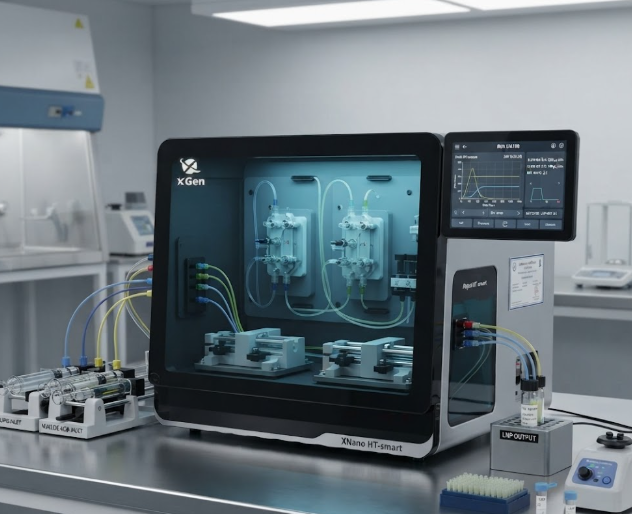
This is where precision microfluidic LNP mixers can provide an alternative approach. XGen Bio applies microfluidic engineering and controlled fluid dynamics to help researchers achieve more consistent LNP formulation conditions while providing a pathway toward larger-scale processing.
1. Why Mixing Conditions Matter in LNP Formation
LNP formation is closely related to the rapid mixing of an organic lipid phase with an aqueous phase containing the nucleic acid payload. As the two streams interact, changes in solvent conditions trigger lipid self-assembly and nanoparticle formation.
The speed and uniformity of this mixing process can have a significant influence on the resulting particles.
In a conventional vessel, mixing conditions may vary between different areas of the container. Some molecules may encounter different local concentrations or mixing times than others. This can contribute to variations in nanoparticle characteristics.
Microfluidic systems approach the problem differently. Rather than relying on a large vessel to distribute mixing energy throughout the formulation, they control the movement of small fluid streams through precisely designed channels.
Controlled Micromixing
Microfluidic mixers can use channel structures such as staggered herringbone geometries or other controlled flow architectures to increase interaction between fluid streams.
Because the dimensions of the channels are small, diffusion distances are reduced and mixing can occur within a very short period. The resulting environment is more predictable than manually mixing relatively large volumes.
For LNP development, this control can help researchers investigate how flow conditions, flow-rate ratios, lipid composition, and formulation parameters affect particle properties.
Particle Size and PDI
Particle size is an important characteristic of LNP formulations, while the polydispersity index (PDI) provides information about the distribution of particle sizes.
A narrower particle-size distribution can make downstream formulation development and characterization more manageable. Depending on the formulation, microfluidic mixing can support the production of relatively uniform nanoparticles, with many LNP systems designed around particle sizes in the tens to approximately 100 nm range.
The actual particle size and PDI achieved will depend on the lipid composition, flow conditions, solvent system, nucleic acid concentration, and other formulation parameters. Therefore, equipment should be considered as part of the overall formulation process rather than as an independent determinant of particle quality.
Encapsulation Efficiency
Another important parameter is nucleic acid encapsulation efficiency.
For mRNA, siRNA, and other nucleic acid payloads, efficient encapsulation can help reduce material loss and support consistent downstream processing. Microfluidic systems allow formulation parameters such as flow rates and aqueous-to-organic phase ratios to be controlled more precisely.
This provides researchers with a practical way to optimize lipid-to-nucleic-acid ratios and other process variables during formulation development.
2. From Small-Scale Experiments to Larger Production
One of the challenges in LNP development is transferring a formulation from laboratory experiments to larger production volumes.
Simply increasing the dimensions of a mixing vessel or channel does not always reproduce the same fluid-dynamic conditions. Changes in mixing behavior can lead to changes in particle size or other critical quality attributes.
Microfluidic technology offers a different approach to scale-up.
Scale-Out Rather Than Simply Scaling Up
Instead of making one mixing channel dramatically larger, some microfluidic systems use multiple equivalent mixing channels operating in parallel.
This approach, often referred to as scale-out, aims to preserve the mixing characteristics of the original process while increasing overall throughput.
For organizations moving from formulation research toward process development, maintaining similar mixing conditions between development and production stages can simplify technology transfer.
The exact scale-up strategy will depend on the formulation, required throughput, equipment configuration, and process controls.
3. Process Monitoring Becomes More Important at Larger Scale
As LNP manufacturing becomes more sophisticated, process monitoring becomes increasingly important.
Parameters such as flow rate, pressure, temperature, concentration, and phase ratios can influence formulation performance. Monitoring these variables during processing provides a clearer picture of whether the system is operating within the intended process window.
Modern microfluidic LNP platforms can therefore be integrated with process analytical technology (PAT) and other monitoring systems.
For example, inline monitoring of flow and pressure can help identify deviations during production. Temperature monitoring can also help maintain consistent processing conditions where temperature-sensitive formulations are involved.
This type of process visibility can be particularly useful when developing a reproducible manufacturing process.
4. Fluid Path Design and Manufacturing Considerations
Equipment design is also important when microfluidic systems are used for pharmaceutical or bioprocess applications.
Depending on the application, manufacturers may offer stainless-steel fluid paths, disposable assemblies, or combinations of reusable and single-use components.
Single-use fluidic components can reduce cleaning requirements and may help simplify changeover between formulations. Reusable sanitary systems, on the other hand, can be attractive for processes where repeated production and established cleaning procedures are preferred.
For facilities working with multiple formulations, the selection should take into account cleaning validation, cross-contamination control, material compatibility, operating cost, and regulatory requirements.
5. Applications Across Nucleic Acid Therapeutics
The value of an LNP mixer extends beyond one specific therapeutic application. Different nucleic acid modalities can require different formulation strategies, making process flexibility an important consideration.
mRNA Formulations
LNPs have become closely associated with mRNA delivery, including applications in vaccines and emerging therapeutic approaches such as personalized cancer vaccines.
Microfluidic mixing can provide a controlled environment for developing formulations with the desired particle characteristics and encapsulation performance.
Gene-Editing Applications
LNP technology is also being investigated for delivering components associated with gene-editing systems, including guide RNA and other nucleic acid or protein-based payload combinations.
Because these formulations can be more complex than conventional small-molecule drug products, controlled mixing and process reproducibility become particularly important during formulation development.
RNAi and siRNA Delivery
RNA interference technologies use molecules such as siRNA to regulate gene expression. LNPs and related lipid-based delivery systems can help protect these nucleic acid molecules and facilitate their delivery to target tissues.
Different RNAi applications may require different lipid compositions and particle characteristics, making a flexible formulation platform valuable for research and development teams.
6. Choosing a Microfluidic LNP Mixer
For laboratories and biopharmaceutical manufacturers evaluating a precision microfluidic LNP mixer, several factors should be considered rather than focusing only on maximum throughput.
Key evaluation points include:
- Mixing architecture and channel design
- Controllable flow-rate range
- Organic-to-aqueous phase ratio control
- Achievable and reproducible particle characteristics
- Compatibility with different lipid and nucleic acid formulations
- Small-scale development and scale-out capabilities
- Process monitoring and data collection
- Single-use or reusable fluid-path options
- Cleaning and validation requirements
- Integration with existing downstream processes
It is also useful to evaluate how easily a formulation developed on the laboratory system can be transferred to a larger production platform.
Conclusion
The development of nucleic acid therapeutics depends not only on the design of RNA or gene-editing payloads but also on the ability to formulate and deliver them consistently.
Precision microfluidic LNP mixers provide a controlled alternative to conventional bulk mixing by managing fluid interactions at the microscale. Better control over mixing conditions can support more consistent particle formation, encapsulation, and process development.
For researchers working with mRNA, siRNA, RNAi, or gene-editing formulations, microfluidic technology can provide a useful bridge between early formulation research and scalable bioprocess development.
XGen Bio combines microfluidic mixing technology with process-oriented equipment design to support LNP formulation workflows. As nucleic acid-based medicines continue to move from laboratory research toward clinical and commercial applications, reproducible mixing and scalable process control will remain important parts of the manufacturing equation.
https://www.xgenbiologics.com/optimizing-mrna-delivery-with-xgen-bio-microfluidic-systems.html