The development of more effective veterinary vaccines is an important part of maintaining animal health and reducing production losses in the livestock industry. For swine producers, vaccines against viral and bacterial diseases need to generate sufficiently strong and durable immune responses while remaining practical for large-scale use.
One group of natural compounds attracting continued research interest is Quillaja saponins (VQ-SAP). These saponins are derived from the bark of Quillaja saponaria, a tree native to South America. Their immunostimulatory properties have made them useful as vaccine adjuvants, particularly where both antibody-mediated and cellular immune responses are desirable.
One purified Quillaja saponin component, QS-21, has been extensively investigated in vaccine development. Its inclusion in licensed human vaccine products has also provided substantial evidence supporting the potential of saponin-based adjuvant systems. In veterinary medicine, researchers continue to investigate how these compounds can improve vaccine responses against important swine pathogens.
1. How Do Quillaja Saponin Adjuvants Work?
The primary purpose of a vaccine adjuvant is to strengthen the immune response to an antigen. Rather than acting as the antigen itself, an adjuvant helps stimulate innate immune mechanisms and creates an environment in which adaptive immunity can develop more effectively.
Quillaja saponins can influence several parts of this process.
Formation of Immune-Stimulating Complexes
Saponins have amphiphilic molecular structures, meaning they contain both water-compatible and lipid-compatible characteristics. Under appropriate conditions, they can interact with cholesterol, phospholipids, and antigens to form particulate structures such as Immune-Stimulating Complexes (ISCOMs) or ISCOM-matrices.
These structures can facilitate antigen delivery to antigen-presenting cells (APCs), including dendritic cells. By improving antigen uptake and presentation, they can contribute to stronger immune responses.
The development of newer self-assembling nanoparticle systems is also expanding research into how saponins can be incorporated into more controlled vaccine-delivery platforms.
Improved Antigen Presentation
Another important characteristic of saponin-based adjuvants is their ability to influence antigen processing.
Certain saponin formulations can promote antigen escape from endosomal compartments into the cytosol of antigen-presenting cells. This can facilitate cross-presentation, an important pathway for activating CD8⁺ cytotoxic T lymphocytes.
This property is particularly relevant for vaccines where cellular immunity is an important component of protection.
Activation of Innate Immune Pathways
Saponins can also interact with innate immune signaling pathways.
A well-known example is AS01, which combines the saponin QS-21 with the TLR4 agonist monophosphoryl lipid A (MPLA). The two components stimulate complementary innate immune mechanisms and can produce a stronger immune response than either component alone.
Inflammasome-related pathways, including NLRP3-associated responses, have also been investigated in connection with saponin-based adjuvant activity.
Cytokine and Chemokine Responses
Research in porcine immune cells has shown that saponin-containing formulations can influence the expression of interferons, interferon-regulated genes, and inflammatory cytokines.
These signaling molecules play important roles in coordinating innate and adaptive immune responses, particularly during viral infection.
2. Applications in Swine Vaccine Development
The ability of saponins to stimulate both humoral and cellular immunity makes them interesting candidates for different types of swine vaccines.
PRRSV Vaccines
Porcine Reproductive and Respiratory Syndrome Virus (PRRSV) remains a major challenge for the global pig industry and can result in significant economic losses.
Research has investigated the use of QuilA saponin alongside modified-live PRRSV vaccines. Studies have reported changes in interferon-related and inflammatory gene expression and reductions in viremia following challenge under specific experimental conditions.
These findings indicate that saponin-based adjuvant strategies may help shape the immune response to PRRSV vaccination, although vaccine performance depends on the complete formulation and vaccination protocol.
Foot-and-Mouth Disease Vaccines
Foot-and-mouth disease virus (FMDV) is highly contagious and represents a major concern for swine production in affected regions.
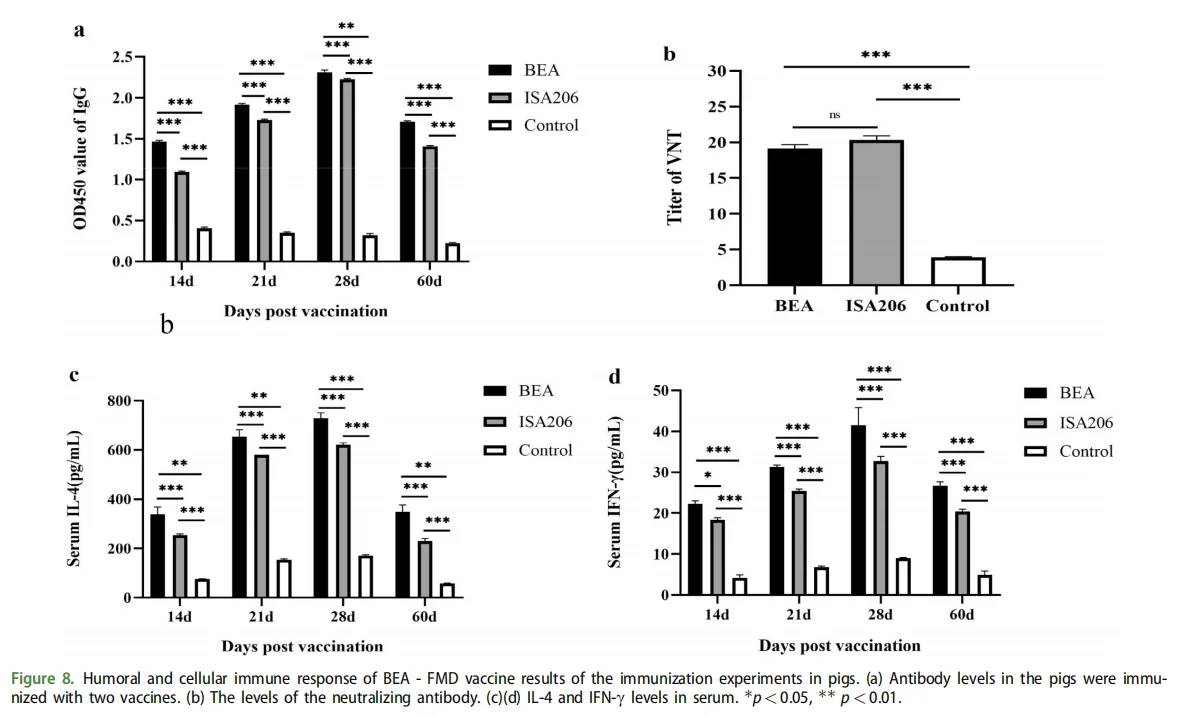
Saponins have been studied as immunostimulatory components in FMD vaccines, including formulations combined with oil-based emulsions. Research has reported enhanced antibody responses in experimental animal models.
More recent work has also examined QS-21-containing emulsion systems and other combination adjuvants for inactivated FMD vaccines.
The combination of saponins with other adjuvant technologies is particularly interesting because different components can influence different aspects of the immune response.
Porcine Circovirus Type 2 Vaccines
Porcine Circovirus Type 2 (PCV2) is associated with a range of clinical and subclinical conditions in pigs, including post-weaning multisystemic wasting syndrome and other PCV2-associated diseases.
Saponin-containing adjuvant systems have been used in commercial PCV2 vaccine development. Their immunostimulatory activity can contribute to the development of antibody and cellular responses against the vaccine antigen.
Mycoplasma hyopneumoniae Vaccines
Mycoplasma hyopneumoniae is an important cause of enzootic pneumonia in pigs.
Saponin-based adjuvant systems have been investigated for use with M. hyopneumoniae vaccines. Research has also explored ISCOM-based formulations and their ability to enhance immune responses in pigs.
For respiratory pathogens, the ability to influence both systemic and mucosal immunity is particularly relevant because protection may require immune activity at the respiratory tract as well as throughout the body.
African Swine Fever Vaccine Research
African Swine Fever Virus (ASFV) presents a major challenge to pig health and international pork production. Developing safe and effective vaccines remains an active area of research.
Saponins are of interest because of their ability to stimulate cellular immunity. This has led to discussion of their potential use in subunit, recombinant, or other experimental ASFV vaccine platforms.
However, ASFV vaccine development is highly complex, and the potential role of saponins needs to be evaluated within specific antigen and delivery systems rather than considered a standalone solution.
Other Veterinary Vaccine Applications
Saponin-based adjuvants have also been studied in other bacterial and viral vaccine systems. Research involving pneumococcal and pertussis vaccines, for example, has demonstrated that saponins can influence IgM, IgG, and IgA responses as well as Th1- and Th17-associated cellular immunity.
Although some of this research has been conducted in non-swine models, it provides useful information for the development of future veterinary vaccine formulations.
3. Key Advantages of Saponin-Based Adjuvants
Quillaja saponins offer several characteristics that make them attractive for vaccine research.
Broad Immune Stimulation
Unlike adjuvants that primarily promote one type of immune response, saponin-based systems can stimulate both humoral and cellular immunity.
Depending on the formulation, they may support antibody production while also promoting Th1-associated responses and cytotoxic T-cell activity.
Potential Antigen-Sparing Effect
A strong adjuvant response may allow researchers to achieve an effective immune response with a lower antigen quantity in some formulations.
This can be particularly valuable when antigen production is expensive, technically difficult, or limited in supply.
However, antigen-sparing performance must be demonstrated experimentally for each specific vaccine formulation.
Compatibility with Combination Adjuvants
Saponins can be combined with other immunostimulatory components, including oil emulsions, TLR agonists, and delivery systems.
These combinations may create complementary or synergistic effects, allowing researchers to design adjuvants around the specific immune response required for a vaccine.
Nanoparticle and Delivery Potential
The ability of saponins to self-assemble with lipids and other components provides opportunities for nanoparticle-based delivery.
ISCOMs and related structures can act as both immune stimulators and antigen-delivery systems, creating an interesting platform for next-generation veterinary vaccines.
4. Current Challenges in Saponin Adjuvant Development
Despite their potential, saponin adjuvants still require careful formulation and characterization.
Different Quillaja extracts and purified saponin fractions can have different chemical compositions and biological activities. Purity, dose, formulation method, particle structure, and combination with other adjuvants can all influence the final immune response.
Manufacturers and researchers therefore need to evaluate factors such as:
- Saponin composition and purity
- Batch-to-batch consistency
- Antigen compatibility
- Adjuvant concentration
- Particle or delivery-system characteristics
- Immune response profile
- Local and systemic tolerability
- Stability during storage
These considerations become particularly important when moving from experimental formulations toward commercial veterinary vaccine production.
5. Future Development of Quillaja Saponin Adjuvants
Future research is likely to focus increasingly on combining saponins with complementary adjuvant technologies and controlled delivery systems.
For example, researchers are investigating combinations of saponins with TLR agonists to stimulate multiple innate immune pathways. Liposomes, emulsions, and other nanocarrier systems can also be used to control how antigens and immunostimulatory components are presented to immune cells.
W/O/W emulsion systems incorporating QS-21 represent one example of how researchers are attempting to improve the delivery and performance of saponin-based adjuvants.
Another important direction is the development of more standardized saponin preparations. Better control over composition and manufacturing consistency could make it easier to compare results between studies and develop reproducible commercial vaccine formulations.
Conclusion
Quillaja saponin adjuvants represent an important area of research in modern veterinary vaccine development. Their ability to influence antigen presentation, innate immune signaling, antibody production, and cellular immunity gives them potential applications across a range of swine vaccines.
Research involving PRRSV, FMDV, PCV2, Mycoplasma hyopneumoniae, and other pathogens demonstrates the broad interest in saponin-based vaccine strategies. At the same time, the performance of a saponin adjuvant depends strongly on its chemical composition, dosage, antigen, delivery system, and combination with other immunostimulatory components.
For future swine vaccines, the most promising approach may not be the use of saponins alone, but the development of carefully engineered combination systems that integrate saponins with suitable antigens, immune agonists, emulsions, or nanocarriers.
As veterinary vaccine research moves toward more targeted and reproducible immune stimulation, Quillaja-derived saponins such as QS-21 are likely to remain an important platform for exploring improved vaccine efficacy and next-generation adjuvant design.
https://en.jicangbio.com/application-of-saponin-adjuvants-in-swine-vaccines.html