Market overview
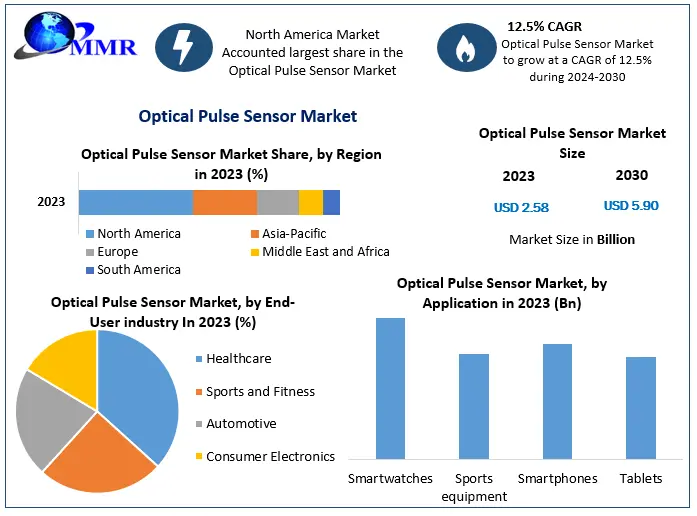
The Optical Pulse Sensor Market was valued at approximately USD 2.58 billion in 2023 and is projected to reach USD 5.90 billion by 2030, registering a CAGR of 12.5% during the forecast period. Optical pulse sensors, commonly based on photoplethysmography (PPG), use light-emitting diodes and photodetectors to measure changes in blood volume and determine pulse and heart-rate information. The market is gaining momentum from increasing health and fitness awareness, rising adoption of smartwatches and fitness trackers, the growing prevalence of cardiovascular diseases, diabetes and hypertension, and the expansion of remote patient monitoring and telehealth. Optical pulse sensors are increasingly being integrated into compact wearable devices, smartphones, sports equipment and healthcare monitoring systems. The market report identifies technological advancement in sensing techniques as an important growth factor.
A major opportunity lies in the miniaturization, integration and power optimization of optical sensing components. Manufacturers are developing smaller sensors with improved signal-to-noise ratios, advanced algorithms, lower power consumption and better resistance to motion and ambient-light interference. These developments are helping expand PPG technology beyond conventional heart-rate tracking toward SpO₂, heart-rate variability, respiration, blood-pressure-related measurements and other physiological parameters. However, challenges such as motion artifacts, differences in skin characteristics, ambient-light interference, battery consumption, sensor cost and regulatory requirements remain important considerations.
U.S. Market Trends and Investment in 2025
The United States remains a major market for optical pulse sensors because of its advanced healthcare infrastructure, strong wearable-device ecosystem, high healthcare expenditure and increasing adoption of remote monitoring technologies. In 2025, the convergence between consumer wearables and regulated digital health became particularly significant. The American College of Cardiology issued guidance in May 2025 on the use of Apple Watch health data for cardiovascular monitoring, reflecting growing clinical interest in wearable-generated health information. In September 2025, the U.S. FDA cleared Apple's Hypertension Notification Feature, which uses Apple Watch optical heart-sensor data and machine learning to identify patterns associated with hypertension risk. FDA records indicate that the technology was developed using large-scale Apple Watch PPG data, highlighting the increasing value of optical sensor datasets and AI-enabled signal analysis. Apple also announced in August 2025 that redesigned Blood Oxygen functionality would become available to certain U.S. Apple Watch users following software updates, further demonstrating the commercial and technological importance of optical sensing in the U.S. wearable market.
Request To Free Sample of This Strategic Report ➤ https://www.maximizemarketresearch.com/request-sample/194640/
Optical Pulse Sensor Market Segmentation
-
By Type
-
Photoplethysmography (PPG) Sensors
-
Pulse Oximeter Sensors
-
Other Optical Pulse Sensors
-
-
By Application
-
Heart Rate Monitoring
-
Blood Oxygen Monitoring
-
Fitness & Wellness Monitoring
-
Medical Monitoring
-
Other Applications
-
-
By End User
-
Healthcare
-
Consumer Electronics
-
Sports & Fitness
-
Research & Academic Institutions
-
Others
-
-
By Geography
-
North America
-
Europe
-
Asia Pacific
-
Middle East & Africa
-
South America
-
Competitive Analysis
The optical pulse sensor industry is competitive, with major semiconductor, sensing and wearable technology companies investing in compact, low-power and high-accuracy sensing solutions. Industry company listings identify Analog Devices, ams OSRAM, ROHM, Texas Instruments and Silicon Laboratories among the leading companies active in the optical pulse sensor ecosystem.
Analog Devices, Inc. has strengthened its position through advanced optical analog-front-end technology for wearable health applications. Its MAX86170A provides dual-channel optical data acquisition, high-resolution 20-bit ADCs, multiple photodiode inputs and ultra-low-power operation. Its MAX86173 and MAX86176 platforms further support high-SNR PPG applications and combined physiological measurements, enabling applications such as heart-rate monitoring, SpO₂ and other wearable health functions.
ams OSRAM continues to focus on integrated optical technologies for smartwatches, smart rings and other wearable devices. At CES 2025, the company highlighted complete solutions involving LEDs, photodiodes, optical front ends, analog front ends and temperature sensors for vital-sign monitoring. At Sensors Converge 2025, it demonstrated compact and energy-efficient sensing solutions for health and wearable applications.
ROHM Co., Ltd. is another important participant in optical sensing and semiconductor components, benefiting from increasing demand for compact sensing solutions in consumer electronics and healthcare devices. Its focus on sensor technologies and semiconductor integration supports the industry's movement toward smaller and more efficient wearable components.
Texas Instruments maintains a strong position through its biosensing analog-front-end portfolio. Its solutions support PPG, ECG, EEG and impedance cardiography while emphasizing high performance, low power and small form factors for wearable and clinical applications. This multi-parameter approach can support the development of next-generation health-monitoring products.
Silicon Laboratories participates in the broader sensor and connectivity ecosystem supporting connected wearable devices. Its capabilities in low-power wireless and embedded technologies can complement optical pulse sensing by enabling efficient transmission and processing of physiological data in connected devices.
Request To Free Sample of This Strategic Report ➤ https://www.maximizemarketresearch.com/request-sample/194640/
Regional Analysis
United States: The U.S. is expected to remain a leading market within North America, supported by advanced healthcare infrastructure, wearable adoption, remote patient monitoring and digital-health innovation. FDA authorization of sensor-based digital health technologies demonstrates the expanding regulatory pathway for wearable health monitoring.
United Kingdom: The U.K. offers opportunities through increasing digital-health adoption, remote monitoring and healthcare modernization. The integration of wearable-generated physiological data into healthcare workflows can create additional demand for reliable optical sensing components.
Germany: Germany's advanced healthcare, medical-device and industrial technology ecosystem supports adoption of high-quality optical sensors. Demand for compact and accurate components is also supported by the country's strong engineering and electronics industries.
France: France represents an important European opportunity as digital healthcare, connected medical technologies and preventive health monitoring continue to develop. Wearable devices capable of continuously collecting physiological information can support remote-care models.
Japan: Japan is an important market for wearable and miniaturized sensing technologies. In January 2025, ams OSRAM showcased advanced sensing and lighting technologies for smart rings, smart glasses and smartwatches at Wearable Expo in Tokyo, highlighting the country's role in next-generation wearable development.
China: China represents a significant growth opportunity due to its large electronics manufacturing base, expanding wearable-device ecosystem and increasing consumer adoption of smart health products. Local production capabilities and technological development can support cost-effective optical sensing solutions.
Key Players
-
ROHM CO., LTD
-
Silicon Laboratories
-
TE Connectivity
-
Fitbit Inc.
-
Analog Devices, Inc.
-
ams OSRAM
-
Texas Instruments
-
Sestosensor srl
-
Mouser Electronics, Inc.
-
PalmSens
-
Pixelligent
-
Willow
-
Broadcom
The core company list is based on the market report, with additional industry participants considered based on their optical/PPG sensing portfolios.
Conclusion
The Optical Pulse Sensor Market is entering a high-growth phase as healthcare monitoring moves increasingly toward continuous, connected and personalized measurement. The projected expansion from USD 2.58 billion in 2023 to USD 5.90 billion by 2030 demonstrates the commercial potential of optical sensing technologies. In our view, the strongest opportunities will come from low-power miniaturized PPG sensors, AI-based signal processing, multi-parameter health monitoring, smart rings and watches, and remote patient monitoring. The development of sensors capable of delivering more accurate measurements despite movement, ambient-light conditions and individual physiological differences will be particularly important. Companies that combine high-performance optical components with advanced algorithms, efficient power management and regulatory-ready medical applications are likely to capture a larger share of the expanding market.
About Maximize Market Research
Maximize Market Research Pvt. Ltd. (MMR) is a global market research and consulting company that provides reliable, data-focused, and practical business insights. The firm serves a wide range of industries, including healthcare, pharmaceuticals, technology, automotive, electronics, chemicals, personal care, and consumer goods. Through market forecasts, competitive analysis, strategic consulting, and industry impact assessments, MMR helps organizations understand changing market conditions, identify growth opportunities, and make informed business decisions for long-term success.
Contact Us
Maximize Market Research Pvt. Ltd.
2nd Floor, Navale IT Park Phase 3
Pune Banglore Highway, Narhe
Pune, Maharashtra 411041, India
Phone: +91 9607365656
Email: sales@maximizemarketresearch.com