INTRODUCTION
IVF Lab Design Services are specialized planning, engineering, and consultancy solutions used to create efficient, controlled, and contamination-conscious in-vitro fertilization laboratories. Unlike conventional laboratory design, IVF laboratory planning must consider sensitive embryology procedures, oocyte and embryo handling, sperm preparation, embryo culture, cryopreservation, equipment integration, environmental stability, workflow, and quality requirements. A professionally planned IVF laboratory brings architecture, HVAC, cleanroom principles, electrical systems, utilities, monitoring, equipment placement, testing, commissioning, and documentation together into one coordinated design.
Why IVF Laboratory Design Is Different
An IVF laboratory is not simply a room filled with laboratory equipment. It is a carefully planned environment in which multiple sensitive activities take place.
The design must consider:
- Sample movement
- Personnel movement
- Air quality
- Temperature
- Humidity
- Equipment heat loads
- Chemical exposure
- Noise and vibration
- Electrical reliability
- Cleaning procedures
- Storage
- Emergency systems
A poorly coordinated layout can create workflow problems, maintenance difficulties, or unnecessary contamination risks.
Professional planning helps ensure that the laboratory supports embryologists and clinical teams efficiently.
What Is Included in IVF Lab Design Services?
The scope can vary depending on the fertility centre, but comprehensive services can include the following.
1. Site Assessment
The design process generally begins with a detailed assessment of the proposed laboratory space.
The assessment can cover:
- Available floor area
- Ceiling height
- Structural conditions
- Existing HVAC systems
- Electrical capacity
- Plumbing
- Access routes
- Adjacent departments
- Fire-safety infrastructure
- Future expansion possibilities
The information helps determine the practical limitations of the project.
2. Requirement Analysis
Every IVF centre has different clinical objectives.
The design team can discuss:
- IVF procedures
- ICSI procedures
- Embryology activities
- Andrology services
- Cryopreservation
- Sample processing
- Storage requirements
- Expected workload
- Number of staff
- Equipment requirements
This information is used to develop a project-specific design rather than applying a generic laboratory layout.
3. IVF Laboratory Layout Planning
Layout planning is one of the most important elements.
Depending on the facility, the design may include areas for:
- Embryology
- Andrology
- Sperm preparation
- Oocyte handling
- ICSI
- Embryo culture
- Cryopreservation
- Media preparation
- Equipment storage
- Consumable storage
- Staff support
- Cleaning and utility functions
The final arrangement should support the facility's clinical workflow.
4. Workflow Optimization
Good workflow design minimizes unnecessary movement.
The design team considers the movement of:
Staff → Materials → Samples → Processing → Storage
The objective is to create logical pathways and reduce unnecessary crossings.
Efficient workflow can improve:
- Staff productivity
- Sample handling
- Equipment accessibility
- Laboratory organization
- Process consistency
5. Zoning and Functional Separation
Different activities can have different environmental and operational requirements.
Zoning helps establish appropriate relationships between:
- Controlled laboratory areas
- Support areas
- Personnel access
- Material access
- Storage
- Waste movement
The zoning strategy should be developed according to the facility's processes and contamination-control objectives.
6. HVAC Design
HVAC is a critical part of an IVF laboratory.
The system may be designed to control:
- Temperature
- Relative humidity
- Fresh-air supply
- Filtration
- Air distribution
- Pressure relationships
- Air changes
- Environmental stability
HVAC design should consider the laboratory's equipment heat loads and operating conditions.
The objective is not simply to cool the room but to establish an appropriate and stable environment.
7. Air Filtration
Air filtration can form an important part of contamination-control planning.
Depending on the project, filtration systems may include:
- Pre-filters
- Fine filters
- HEPA filters
- Terminal filtration
- Filter monitoring
Filter selection should be based on the intended application and required environmental performance.
8. Cleanroom Technology
Some IVF laboratories incorporate cleanroom principles to achieve controlled environmental conditions.
Cleanroom-related planning can address:
- Air cleanliness
- Airflow
- Pressure relationships
- Surface finishes
- Personnel movement
- Material movement
- Cleaning procedures
The applicable requirements depend on the laboratory's processes and quality system.
9. VOC and Chemical Contamination Control
Volatile organic compounds can originate from:
- Paints
- Adhesives
- Sealants
- Furniture
- Flooring
- Cleaning products
- Construction materials
Because IVF processes can be sensitive to environmental contaminants, material selection should be carefully considered.
Design planning can incorporate low-emission materials and appropriate construction procedures to reduce potential environmental contamination.
10. Embryology Laboratory Design
Embryology areas require careful planning because they support sensitive procedures.
Design considerations can include:
- Oocyte handling
- Fertilization
- Embryo culture
- ICSI
- Embryo assessment
- Incubator placement
- Microscope positioning
- Workstation configuration
Equipment should be arranged to minimize unnecessary movement and provide efficient access.
11. Andrology Laboratory Design
Andrology spaces have their own workflow requirements.
They may support:
- Semen analysis
- Sperm preparation
- Sample processing
- Microscopy
- Centrifugation
- Storage
The design should provide logical movement from sample receipt through processing and analysis.
12. Cryopreservation Area Planning
Cryostorage requires specialized infrastructure and safety considerations.
Planning can cover:
- Cryogenic storage tanks
- Tank placement
- Access
- Ventilation
- Oxygen monitoring where required
- Alarm systems
- Emergency procedures
- Storage organization
Cryogenic storage should be designed with both operational efficiency and personnel safety in mind.
13. Equipment Planning and Integration
An IVF laboratory can contain expensive and highly specialized equipment.
Examples include:
- Embryo incubators
- Inverted microscopes
- ICSI workstations
- Micromanipulators
- Centrifuges
- Refrigerators
- Freezers
- Cryogenic storage systems
- Laboratory monitoring equipment
Design teams coordinate equipment dimensions, clearances, electrical requirements, heat loads, data requirements, and service access.
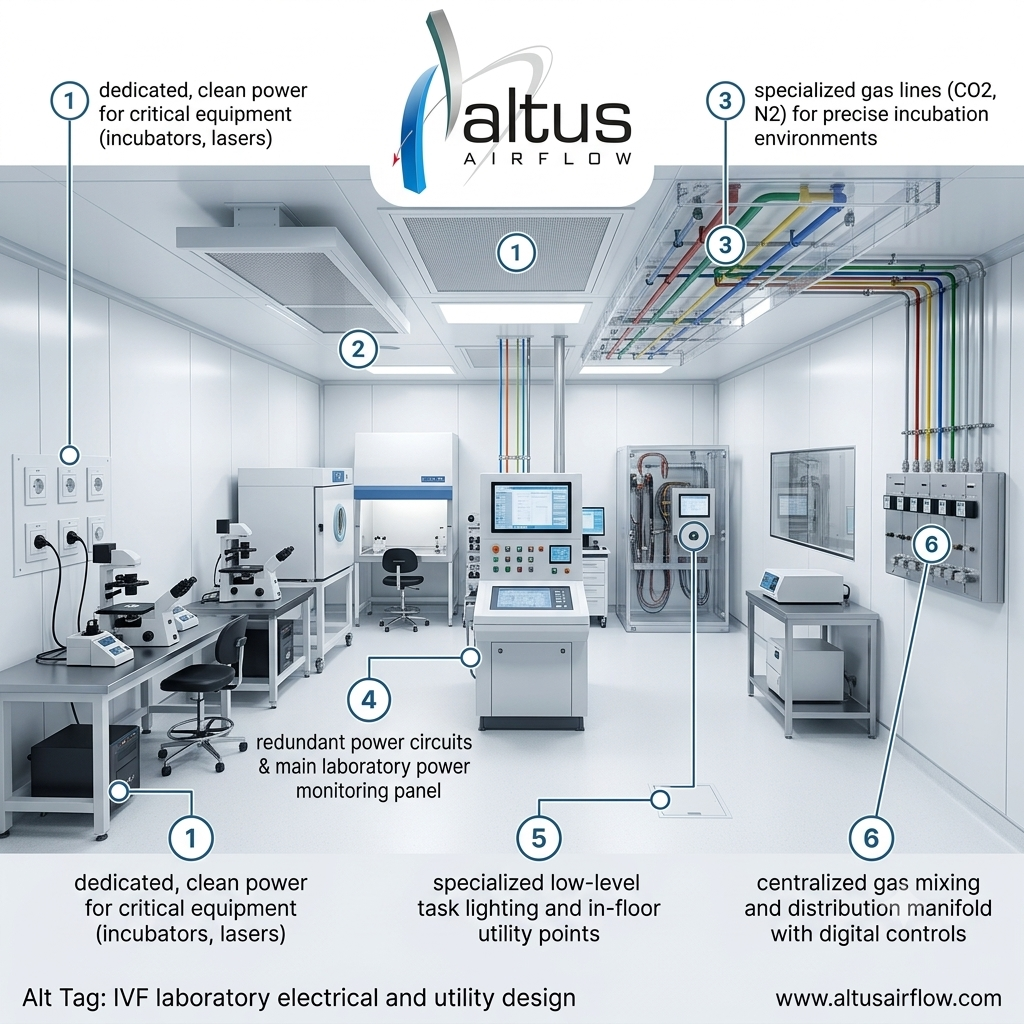
14. Electrical Infrastructure
Reliable electrical infrastructure is essential for IVF laboratories.
Design planning can include:
- Dedicated circuits
- UPS systems
- Emergency power
- Equipment connections
- Earthing
- Surge protection
- Critical-load identification
Critical equipment should have an appropriate power-continuity strategy based on the facility's requirements.
15. Emergency Power and UPS Planning
Power interruption can affect critical laboratory equipment.
UPS and emergency-power planning may support:
- Incubators
- Monitoring systems
- Refrigeration
- Cryostorage monitoring
- HVAC controls
- Essential laboratory systems
The exact backup requirements depend on the equipment and operational risk assessment.
16. Plumbing and Utility Planning
The laboratory may require several utilities.
These can include:
- Water supply
- Drainage
- Laboratory sinks
- Vacuum
- Compressed air
- Other specialized services
Utility routes should be coordinated with walls, ceilings, equipment, and maintenance access.
17. Environmental Monitoring
Environmental monitoring systems provide continuous information about laboratory conditions.
Depending on requirements, monitoring may include:
- Temperature
- Humidity
- Differential pressure
- Air quality
- Particle levels
- Equipment conditions
Alarm functions can alert staff when defined limits are exceeded.
18. BMS Integration
If the facility has a Building Management System, selected IVF laboratory systems can potentially be integrated into it.
BMS integration can provide centralized monitoring of:
- HVAC
- Temperature
- Humidity
- Pressure
- Alarms
- Energy consumption
The degree of integration depends on the facility's existing controls and project requirements.
19. Laboratory Surface and Material Selection
Materials should be selected with laboratory hygiene and maintenance in mind.
Potential specifications include:
- Seamless flooring
- Hygienic wall panels
- Sealed ceilings
- Easy-clean surfaces
- Chemical-resistant finishes
- Low-emission materials
The materials should also be compatible with the facility's cleaning and disinfection procedures.
20. Lighting Design
Appropriate lighting contributes to laboratory comfort and visual accuracy.
Design considerations include:
- General illumination
- Task lighting
- Glare control
- Colour rendering
- Emergency lighting
- Equipment-specific requirements
Lighting should be coordinated with microscopes and other optical equipment.
21. Noise and Vibration Considerations
Noise and vibration should also be considered during planning.
Potential sources include:
- HVAC equipment
- Pumps
- Compressors
- Centrifuges
- Building services
- Nearby mechanical equipment
The design team can identify potential sources and plan equipment placement or isolation strategies where appropriate.
22. Contamination-Control Planning
Contamination control is a central component of IVF laboratory design.
The strategy can involve:
- Air filtration
- HVAC control
- Appropriate zoning
- Personnel movement
- Material movement
- Surface selection
- Cleaning procedures
- Environmental monitoring
- Construction controls
No single system can provide contamination control by itself. It is the result of coordinated design and operational practices.
23. Equipment Heat-Load Analysis
IVF equipment can generate significant heat.
The HVAC design should account for the heat generated by:
- Incubators
- Freezers
- Refrigerators
- Computers
- Lighting
- Laboratory equipment
- Personnel
Ignoring these loads can result in unstable room temperatures.
24. Safety Planning
Laboratory safety should be integrated into the design.
Depending on the project, safety planning may address:
- Fire detection
- Emergency lighting
- Electrical safety
- Cryogenic safety
- Emergency access
- Oxygen monitoring
- Safe equipment placement
Applicable local safety requirements should be incorporated into the project.
25. Compliance and Regulatory Planning
IVF facilities may need to comply with healthcare, laboratory, building, fire, electrical, environmental, and applicable assisted-reproduction requirements.
Design teams should identify the requirements relevant to the facility's location and scope.
For projects in India, applicable requirements under the Assisted Reproductive Technology regulatory framework and other relevant healthcare regulations should be reviewed by the project team.
26. Testing and Commissioning
After installation, the laboratory should be tested before operational handover.
Testing may include:
- HVAC performance
- Airflow measurement
- HEPA integrity testing where applicable
- Particle testing
- Pressure verification
- Temperature verification
- Humidity verification
- Electrical testing
- Alarm testing
Testing requirements depend on the project's technical specification.
27. Qualification and Validation Support
Where required, the design team can support qualification activities.
These may include:
- Design Qualification
- Installation Qualification
- Operational Qualification
- Performance Qualification
The exact validation strategy should be determined according to the facility's quality-management system.
28. Documentation
Comprehensive documentation supports commissioning, maintenance, audits, and future modifications.
Documentation may include:
- Architectural layouts
- HVAC drawings
- Electrical drawings
- Utility drawings
- Equipment schedules
- Technical specifications
- Material schedules
- Testing reports
- Commissioning documents
- Validation records
- Operation manuals
- Maintenance recommendations
- As-built drawings
29. Project Coordination
IVF laboratory projects typically involve multiple contractors and suppliers.
Coordination may include:
- HVAC contractors
- Modular cleanroom contractors
- Electrical teams
- Laboratory equipment suppliers
- Medical utility contractors
- Monitoring-system suppliers
- Hospital engineering teams
A coordinated approach helps avoid conflicts between systems.
30. Maintenance and After-Sales Planning
Design should consider maintenance from the beginning.
The consultant can recommend:
- Filter maintenance
- HVAC servicing
- Sensor calibration
- Environmental testing
- Equipment servicing
- Preventive maintenance
- Alarm testing
Easy access to critical components can reduce future maintenance disruption.
31. Future Expansion Planning
IVF centres may expand their services over time.
The design can therefore provide provisions for:
- Additional incubators
- New equipment
- Expanded cryostorage
- More workstations
- Increased electrical capacity
- HVAC expansion
- Digital monitoring upgrades
Future-ready planning can reduce the need for major reconstruction.
Benefits of Professional IVF Laboratory Design
Well-planned laboratory infrastructure can provide:
- Improved workflow
- Better space utilization
- Controlled environmental conditions
- Reduced contamination risks
- Reliable utilities
- Better equipment integration
- Easier maintenance
- Improved staff efficiency
- Better documentation
- Future expansion capability
The most effective design is one that combines clinical requirements with engineering and operational considerations.
How to Choose the Right IVF Laboratory Design Provider
Fertility centres should evaluate providers based on:
- Experience with IVF facilities
- Understanding of embryology workflows
- HVAC expertise
- Cleanroom engineering knowledge
- Equipment-integration capabilities
- Contamination-control planning
- Testing and commissioning capabilities
- Documentation standards
- Project management
- Maintenance support
Hospitals should also ask for clear project scope, technical specifications, testing procedures, timelines, and handover documentation before appointing a provider.
Conclusion
IVF Lab Design Services encompass much more than architectural planning. They bring together laboratory zoning, workflow optimization, HVAC engineering, filtration, cleanroom principles, contamination control, equipment integration, electrical infrastructure, environmental monitoring, utilities, safety, testing, commissioning, validation, documentation, and maintenance planning. Because IVF laboratories support sensitive procedures and depend on precise environmental conditions, these systems need to be considered as one integrated facility rather than as separate installations. A carefully planned laboratory can improve operational efficiency, support contamination control, simplify maintenance, and provide a foundation for future expansion. For fertility centres seeking specialized laboratory planning and engineering support, Altus Airflow provides solutions designed around the technical and operational requirements of modern IVF facilities.
Frequently Asked Questions
1. What are IVF Lab Design Services?
IVF Lab Design Services are specialized design, engineering, and planning solutions for fertility laboratories. They can include layout planning, workflow design, HVAC, filtration, contamination control, equipment integration, utilities, monitoring, testing, commissioning, and documentation.
2. How are IVF laboratory design services different from general laboratory design?
IVF Lab Design Services consider specialized processes such as embryology, ICSI, oocyte handling, embryo culture, sperm preparation, and cryopreservation, along with strict environmental and workflow requirements.
3. Do IVF Lab Design Services include HVAC planning?
Yes. IVF Lab Design Services can include HVAC planning for temperature, humidity, airflow, filtration, pressure relationships, fresh air, and environmental stability.
4. Do IVF Lab Design Services include contamination control?
Yes. IVF Lab Design Services can incorporate contamination-control strategies involving zoning, HVAC, filtration, material selection, personnel movement, cleaning considerations, and environmental monitoring.
5. Can IVF Lab Design Services include equipment integration?
Yes. IVF Lab Design Services can coordinate equipment dimensions, utility requirements, electrical loads, heat loads, clearances, workflow, and service access.
Read Our Previous Blog------>What services does an IVF Lab Design Consultant provide?