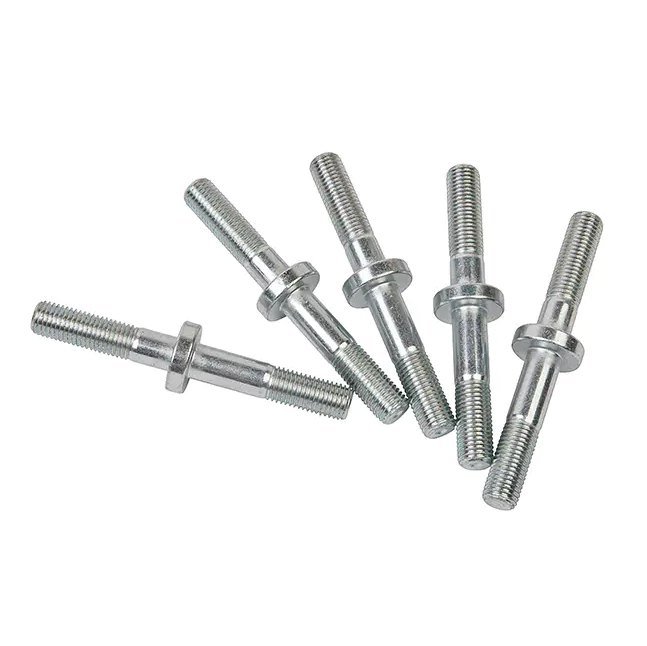
Double-Ended Studs are threaded fasteners designed to create a connection between two components. Unlike a conventional bolt, a stud does not normally have a traditional head. Instead, its threaded sections extend from both ends, allowing nuts or internally threaded components to secure the assembly. This simple structure makes the fastener useful when parts need to be joined from opposite sides.
In practical mechanical assembly, Double-Ended Studs can help create a stable connection between housings, brackets, covers, flanges, engine-related components, and other structural parts. One threaded end can remain fixed inside a component, leaving the second end available for fastening another part. This arrangement can simplify repeated assembly because the main threaded body stays positioned in the original location.
Material selection has a direct effect on how a stud performs in different applications. Carbon steel can be selected for general mechanical use, while stainless steel may suit applications where corrosion resistance is important. Alloy steel is also used for assemblies that require greater mechanical strength. Thread dimensions, length, pitch, and end configuration should match the mating components before procurement.
Manufacturing accuracy also matters. Thread consistency affects how nuts engage with the stud, while dimensional control helps maintain proper alignment between connected parts. Surface treatment may be specified according to the working environment and required appearance. Common options include plain finishes and various protective coatings.
For buyers, the value of Double-Ended Studs often lies in connection flexibility rather than complicated construction. They can be incorporated into assemblies where access to a bolt head would be inconvenient or where a fixed threaded point is preferred. Their compact form can also help designers manage limited installation space.
When selecting Double-Ended Studs, buyers should confirm thread standards, nominal diameter, overall length, material grade, thread length on each side, and surface finish. Custom dimensions can also be considered for OEM projects when standard specifications do not match the assembly design.