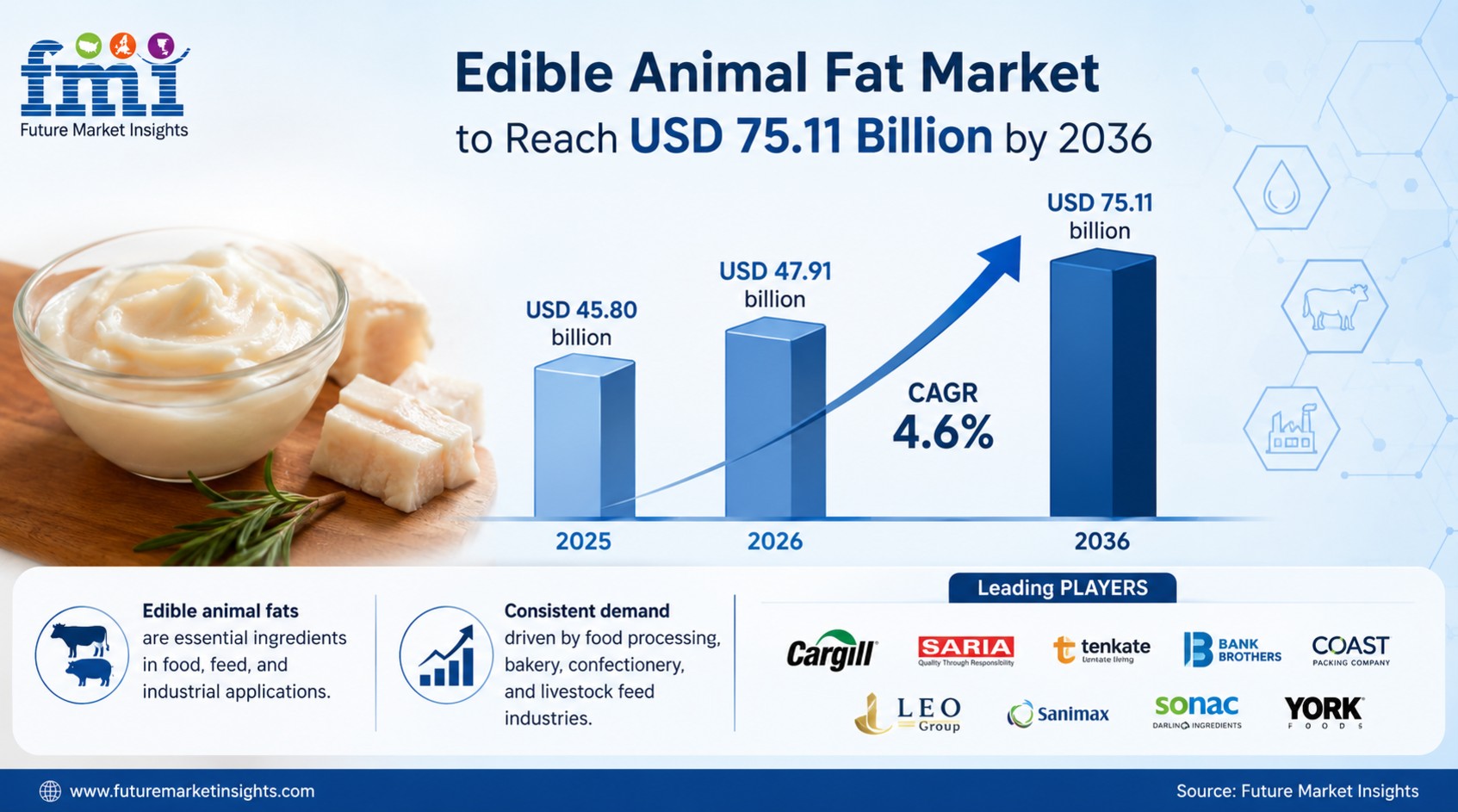
The global edible animal fat market is experiencing sustained, value-driven expansion as commercial bakers, confectionery manufacturers, and foodservice operators rediscover the functional performance, clean-label authenticity, and superior frying stability of animal-derived lipids over vegetable oils, according to latest insights by Future Market Insights. Rendered from livestock processing by-products and dairy streams (including butter, cattle tallow, pig lard, and poultry fats), food-grade animal fats deliver unique fat crystallization, high smoke points, and rich sensory profiles essential for premium pastry lamination and high-throughput frying.
The global market, valued at USD 45.80 billion in 2025, is projected to reach USD 47.91 billion in 2026. Advancing at a Compound Annual Growth Rate (CAGR) of 4.6% over the ten-year forecast period, total market valuation is anticipated to achieve USD 75.11 billion by 2036, delivering an absolute incremental opportunity of USD 27.20 billion.
Request a Sample Report: https://www.futuremarketinsights.com/reports/sample/rep-gb-25908
Market Performance Overview (2026–2036)
To map out the leading animal fat types, primary livestock sources, dominant application sectors, and regional growth vectors guiding this USD 27.20 billion market expansion, key segment allocations highlight where global commercial demand is concentrated:
- Butter Type Segment (34.7% share): Commands product type revenue in 2026, favored across commercial baking, confectionery, and artisanal food production for its signature creaming properties, emulsion stability, and rich dairy flavor.
- Tallow & Lard Segments (65.3% combined share with other fats): Represent high-growth functional pillars, with beef tallow and leaf lard surging in commercial deep-frying and laminated pastry doughs due to their superior oxidative stability.
- Cattle Source Segment (42.1% share): Leads livestock origin categories in 2026, supported by massive global beef slaughter volumes, established rendering infrastructure, and extensive commercial use of beef tallow and suet.
- Bakery and Confectionery Application (38.6% share): Dominates industrial consumption in 2026, driven by croissant lamination, pie crust flakiness, biscuit shortening, and chocolate tempering applications.
- China & India Regional Leadership: Lead national expansion rates at 2% CAGR and 5.8% CAGR respectively through 2036, driven by modernization of domestic rendering facilities, rising processed food manufacturing, and traditional culinary fat consumption.
Technical Drivers and Supply Chain Economics
The commercial utilization and premiumization of edible animal fats across food manufacturing and culinary channels are propelled by three primary industry catalysts:
Bakery Functional Performance and Crystallization Kinetics
In industrial and artisanal bakery production, fat crystallization behavior dictates crumb structure and volume. Animal fats (butter, lard) provide specific polymorphic beta-prime ($\beta'$) crystal structures that trap air during creaming and form discrete fat layers during rolling, delivering the crisp flakiness required in puff pastries and croissants that liquid vegetable oils cannot replicate without hydrogenation.
Foodservice Tallow Revival and Oxidative Stability
Quick-service restaurant chains and independent diners are returning to beef tallow for deep-frying. Unlike polyunsaturated seed oils that rapidly oxidize, form toxic polar compounds, and breakdown under extended heat, saturated-rich beef tallow exhibits superior thermal resistance, prolonged frying life, and imparts a traditional savory crust.
Upstream Rendering Infrastructure Modernization in Asia
China and India are heavily investing in automated, closed-loop rendering facilities to convert slaughterhouse by-products into certified food-grade tallow and lard. This industrial modernization replaces informal fat recovery systems with FSSAI- and SAMR-compliant hygienic refining, unlocking massive domestic supply for industrial food processing.
Industrial Constraints & Feedstock Competition
Renderers, food processors, and fats & oils procurement directors navigate specific operational hurdles:
- Co-Product Supply Dependency on Meat Demand: Animal fat availability is fundamentally governed by global livestock slaughter volumes rather than direct fat demand. Fluctuations in herd sizes, feed costs, or consumer meat consumption directly constrain raw fat supply envelopes.
- Competition from Renewable Diesel and Biodiesel: Food-grade animal fat refiners face intense procurement competition from the biofuels sector. High renewable fuel credit values (such as US RINs and EU RED II mandates) often bid raw rendered fat prices above food-clearing levels, tightening processor margins.
Regional Growth Profile
Regional demand reflects rapid food processing modernization in Asia alongside clean-label heritage culinary demand in Europe and the Americas:
- China (6.2% CAGR): The global growth frontrunner, producing over 1.2 million tons of edible animal fats, driven by high domestic demand for refined lard and tallow in traditional cooking and industrial baking.
- India (5.8% CAGR): Spurring rapid volume expansion through modern bakery sector growth, traditional ghee/tallow blending in commercial kitchens, and expanding automated rendering plants.
- Germany (5.3% CAGR) & France (4.8% CAGR): Lead European demand, supported by world-renowned pastry baking traditions, strict EU Regulation (EC) No 1069/2009 animal by-product hygiene compliance, and premium grass-fed butter production.
- United Kingdom (4.4% CAGR): Driven by artisanal bakery use of heritage leaf lard and premium suet in traditional pastries and ready meals.
- United States (3.9% CAGR): Represents a mature, high-volume market anchored by large-scale fast-food and snack frying, specialized keto/carnivore consumer demand, and advanced automated rendering facilities.
- Brazil (3.5% CAGR): Growing through integrated cattle processing infrastructure and expanding food processing exports.
Competitive Landscape
The global edible animal fat landscape features a mix of multinational agribusiness conglomerates, large-scale livestock processors, and specialized rendering and refining corporations.
Key market participants profiled in the report include Cargill, Incorporated, SARIA SE & Co. KG, Ten Kate Holding B.V., Bank Brothers, Coast Packing Company, Leo Group Ltd, Sanimax, Sonac (Darling Ingredients), and York Foods. Leading suppliers compete by maintaining automated rendering lines, offering fractionated and deodorized custom-melting-point fats, securing Halal/Kosher food-grade certifications, and establishing long-term supply contracts with industrial bakeries and QSR restaurant chains.
Exclusive Discounts on Full Report: https://www.futuremarketinsights.com/reports/edible-animal-fat-market
Frequently Asked Questions
What is the projected valuation of the global edible animal fat market by 2036?
The global edible animal fat market is projected to reach USD 75.11 billion by 2036, expanding from an estimated baseline valuation of USD 47.91 billion in 2026 at a CAGR of 4.6%.
Why does Cattle lead the Source segment with a 42.1% market share?
Cattle dominates in 2026 due to extensive global beef processing infrastructure, which generates a large, continuous supply of high-smoke-point beef tallow and suet optimized for commercial frying and industrial food formulation.
What is the primary functional advantage of animal fats in baking?
Animal fats provide specific crystal structures ($\beta'$ polymorphism) and balanced solid-fat content (SFC) profiles that ensure optimal creaming, steam trapping, and pastry lamination, creating light, flaky textures that liquid vegetable oils cannot match without artificial trans-fat hydrogenation.
FMI Custom Research: Strategic Intelligence for Confident Decision-Making
In today's rapidly evolving business environment, leadership teams need clear, actionable intelligence tailored to their strategic objectives. FMI's Custom Research solutions are designed around specific business questions, enabling executives to evaluate growth opportunities, validate investments, assess competitive dynamics, and reduce uncertainty before making critical decisions.
Key Executive Benefits
- Decision-Ready Insights: Research tailored to your specific business challenges, growth plans, and investment priorities.
- Reduced Strategic Risk: Validate market opportunities, customer demand, and competitive positioning before committing resources.
- Market Entry Confidence: Assess opportunity size, regulatory barriers, channel dynamics, and competitive landscapes with precision.
- Competitive Advantage: Gain proprietary intelligence unavailable through syndicated reports or internal datasets.
- Faster Growth Decisions: Accelerate expansion, product development, portfolio optimization, and investment planning.
- Primary Market Validation: Access real-world customer, buyer, and stakeholder insights that support high-confidence decision-making.
Business Impact
FMI helps organizations transform market complexity into strategic clarity, enabling leadership teams to identify growth opportunities faster, optimize resource allocation, strengthen competitive positioning, and make high-stakes business decisions with confidence.
To explore how FMI Custom Research can support your strategic priorities, connect with our team at - sales@futuremarketinsights.com
About Future Market Insights (FMI)
Future Market Insights (FMI) delivers actionable, decision-focused market intelligence that goes beyond traditional research reports. The company provides:
- In-depth pricing and cost benchmarking analysis
- Demand forecasting based on real industry inputs
- Procurement and buyer behavior insights
- Supply chain and trade flow intelligence
- Technology and application trend analysis across industries
FMI follows a robust bottom-up research methodology, combining insights from industry experts, procurement leaders, manufacturers, and technical professionals to ensure accurate and practical market intelligence.