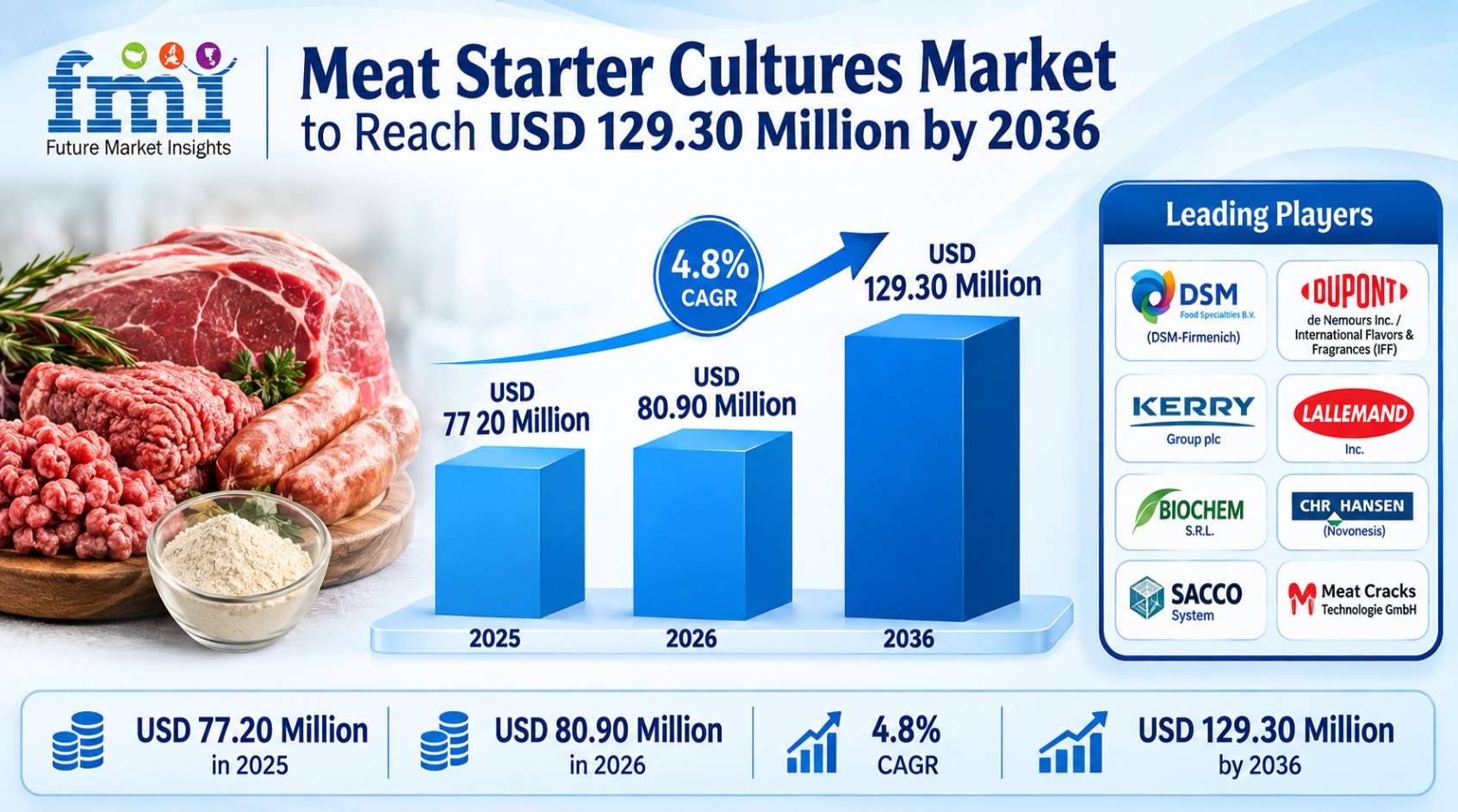
The global meat starter cultures market is undergoing a decisive shift toward high-specification microbial bio-protection and technical co-development models, according to latest insights by Future Market Insights. Driven by tightening regulatory criteria on ready-to-eat meat pathogens (such as EU Regulation 2073/2005 and USDA-FSIS Listeria control guidelines), rising demand for reduced-nitrate and clean-label charcuterie, and the transition of Asian meat processors from ambient curing to controlled microbial fermentation, defined cultures are essential tools for ensuring batch-to-batch organoleptic consistency and food safety.
The global market, valued at USD 77.20 million in 2025, is projected to reach USD 80.90 million in 2026. Advancing at a Compound Annual Growth Rate (CAGR) of 4.8% over the ten-year forecast period, total market valuation is anticipated to achieve USD 129.30 million by 2036, delivering an absolute incremental opportunity of USD 48.40 million.
Request a Sample Report: https://www.futuremarketinsights.com/reports/sample/rep-gb-22952
Market Performance Overview (2026–2036)
To map out the leading physical forms, dominant strain compositions, primary microorganism types, and regional growth vectors guiding this USD 48.40 million market expansion, key segment allocations highlight where global commercial demand is concentrated:
- Freeze-Dried Form Segment (57.4% share): Commands product formulation revenue in 2026, favored for its extended shelf stability at ambient or refrigerated temperatures, high rehydration viability, and ease of automated direct-vat inoculation compared to liquid or deep-frozen cultures.
- Multi-Strain Mix Composition Segment (53.6% share): Represents the primary composition category, combining lactic acid bacteria (such as Lactobacillus sakei, Pediococcus pentosaceus) with coagulase-negative staphylococci (Staphylococcus carnosus, Staphylococcus xylosus) to deliver simultaneous rapid acidification, nitrate reduction, color fixation, and complex aroma development.
- Bacteria Microorganism Segment (55.2% share): Dominates microbial classifications over fungi (surface molds/yeasts), driven by the essential role of lactic acid bacteria in rapidly lowering pH (<5.3) to suppress competitive pathogenic flora.
- Sausages & Salami Applications: Represent the core commercial volume drivers across traditional European charcuterie and modern industrial snack-stick manufacturing lines.
- China & India Regional Leadership: Lead national growth rates at 5% CAGR and 6.0% CAGR respectively through 2036, supported by the industrialization of traditional cured meats, modern slaughterhouse consolidation, and export safety compliance.
Technical Drivers and Processing Shifts
The commercial utilization and specification of meat starter cultures across industrial meat processing are propelled by three primary industry catalysts:
Multi-Strain Customization and Technical Co-Development
Meat processors are moving away from transactional commodity single-strain purchases. Formulators work directly with culture houses to co-develop bespoke multi-strain blends calibrated for specific fermentation chamber temperatures, relative humidity profiles, and curing speeds, creating high supplier switching costs.
Bioprotection and Listeria Suppression Without Chemical Additives
With consumer resistance against chemical preservatives and strict USDA/EFSA zero-tolerance standards for Listeria monocytogenes, processors deploy protective cultures that synthesize natural antimicrobial peptides (bacteriocins like pediocin and sakacin) to inhibit pathogens throughout ambient and refrigerated shelf life.
Clean-Label Curing and Nitrite Reduction
Health concerns regarding nitrosamine formation in processed meats are driving adoption of nitrate-reducing staphylococci cultures. These microorganisms convert naturally occurring vegetable-derived nitrates (celery powder) into nitrites in situ, producing stable nitrosomyoglobin (cured pink color) in clean-label, "no added artificial nitrates" formulations.
Industrial Constraints & Supply Chain Risks
Culture manufacturers, meat processors, and quality assurance directors navigate specific operational hurdles:
- High Switching Costs and Batch Failure Risks: Transitioning to a new starter culture formulation risks acidification failure, flavor drift, or fermentation stalling. Revalidating a high-throughput salami line requires extensive pilot trials and regulatory compliance testing that can cost substantial capital.
- Cold-Chain and Storage Viability Dependencies: While freeze-dried formats reduce cold-chain friction, live microbial formulations remain sensitive to moisture ingress and temperature excursions above 25∘C, requiring sealed barrier foil sachets and controlled storage logistics.
Regional Growth Profile
Regional demand reflects the modern industrialization of traditional cured meats in Asia alongside clean-label artisanal premiumization across Europe and North America:
- China (6.5% CAGR): The global growth frontrunner, driven by the commercial scaling of packaged fermented sausages, joint ventures with European culture houses, and strict national processed meat safety standards.
- India (6.0% CAGR): Spurring rapid volume growth as modern poultry and mutton processors integrate starter cultures to produce shelf-stable snack meats and meet QSR export standards.
- Germany (5.5% CAGR) & France (5.0% CAGR): Anchor the mature European market, characterized by deep artisanal charcuterie traditions (Rohwurst, saucisson sec), strict EU hygiene compliance, and high demand for organic, clean-label starter systems.
- United Kingdom (4.6% CAGR): Driven by premium retail charcuterie growth, reduced-salt reformulation initiatives, and specialty snack-stick processing.
- United States (4.1% CAGR): Represents a mature, high-value demand center focused on USDA-FSIS validated Listeria control, pepperoni pizza topping lines, and artisanal dry-curing craft processors.
- Brazil (3.6% CAGR): Growing through the modernization of domestic industrial sausage processing and export-oriented poultry/beef curing operations.
Competitive Landscape
The global meat starter cultures market is highly consolidated around specialized industrial biotechnology companies, enzyme innovators, and functional food culture houses.
Key market participants profiled in the report include DSM Food Specialties B.V. (DSM-Firmenich), DuPont de Nemours Inc. / International Flavors & Fragrances (IFF), Kerry Group plc, Lallemand Inc., Biochem S.R.L., Chr. Hansen (Novonesis), Sacco System, and Meat Cracks Technologie GmbH. Leading suppliers compete by expanding proprietary strain genomics libraries, providing on-site meat pilot-plant engineering support, and engineering specialized bio-protective blends with proven anti-listerial efficacy.
Exclusive Discounts on Full Report: https://www.futuremarketinsights.com/reports/meat-starter-cultures-market
Frequently Asked Questions
What is the projected valuation of the global meat starter cultures market by 2036?
The global meat starter cultures market is projected to reach USD 129.30 million by 2036, expanding from an estimated baseline valuation of USD 80.90 million in 2026 at a CAGR of 4.8%.
Why does Freeze-Dried form lead with a 57.4% market share?
Freeze-dried cultures dominate in 2026 because they offer superior ambient and refrigerated shelf stability, eliminate deep-freeze shipping requirements, and provide consistent rehydration viability for automated industrial direct-vat inoculation.
What is the primary role of lactic acid bacteria in meat fermentation?
Lactic acid bacteria (LAB) rapidly metabolize fermentable sugars to produce lactic acid, dropping the pH below 5.3. This rapid acidification inhibits foodborne pathogens (such as Salmonella and Staphylococcus aureus), promotes protein coagulation for sliceable texture, and contributes characteristic tangy fermentation flavor.
FMI Custom Research: Strategic Intelligence for Confident Decision-Making
In today's rapidly evolving business environment, leadership teams need clear, actionable intelligence tailored to their strategic objectives. FMI's Custom Research solutions are designed around specific business questions, enabling executives to evaluate growth opportunities, validate investments, assess competitive dynamics, and reduce uncertainty before making critical decisions.
Key Executive Benefits
- Decision-Ready Insights: Research tailored to your specific business challenges, growth plans, and investment priorities.
- Reduced Strategic Risk: Validate market opportunities, customer demand, and competitive positioning before committing resources.
- Market Entry Confidence: Assess opportunity size, regulatory barriers, channel dynamics, and competitive landscapes with precision.
- Competitive Advantage: Gain proprietary intelligence unavailable through syndicated reports or internal datasets.
- Faster Growth Decisions: Accelerate expansion, product development, portfolio optimization, and investment planning.
- Primary Market Validation: Access real-world customer, buyer, and stakeholder insights that support high-confidence decision-making.
Business Impact
FMI helps organizations transform market complexity into strategic clarity, enabling leadership teams to identify growth opportunities faster, optimize resource allocation, strengthen competitive positioning, and make high-stakes business decisions with confidence.
To explore how FMI Custom Research can support your strategic priorities, connect with our team at - sales@futuremarketinsights.com
About Future Market Insights (FMI)
Future Market Insights (FMI) delivers actionable, decision-focused market intelligence that goes beyond traditional research reports. The company provides:
- In-depth pricing and cost benchmarking analysis
- Demand forecasting based on real industry inputs
- Procurement and buyer behavior insights
- Supply chain and trade flow intelligence
- Technology and application trend analysis across industries
FMI follows a robust bottom-up research methodology, combining insights from industry experts, procurement leaders, manufacturers, and technical professionals to ensure accurate and practical market intelligence.