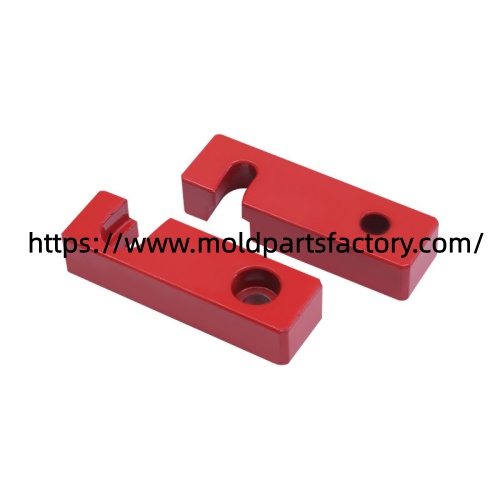
Mold Safety Lock serves as a compact mechanical unit fixed on production tools used in plastic injection forming. Its main job is to keep the two halves of the tool from shifting or closing by accident while technicians work on cleaning repair or changeover tasks. Without such a unit an operator who reaches between the halves risks serious injury if the press or residual energy causes unwanted movement. The device creates a positive physical barrier that holds the tool open or closed in a controlled state until the technician releases it by hand.
In a typical plastic injection forming cell the tool opens and closes under high force many times each hour. During planned stops for ejector pin replacement heater band checks or cavity cleaning the same force remains present in the machine system. A simple pin or clamp style unit mounted on the side or face of the tool blocks that force from acting. The technician engages the unit before starting work and only disengages it after the area is clear. This sequence turns an otherwise hazardous interval into a managed step that protects hands arms and upper body.
Design of the unit focuses on strength under repeated load and ease of use with gloves. Hardened steel bodies and positive engagement geometry resist the residual clamp force of medium and large presses. Mounting holes follow common industry patterns so the unit bolts on without custom machining in most cases. Visual indicators such as a bright handle or colored ring show at a glance whether the unit is engaged. These features let a single operator confirm status quickly before entering the tool space.
Daily use begins with a short check at the start of each shift. The operator confirms free movement of the engagement lever or pin and looks for debris that might prevent full seating. If the unit shows wear on contact faces or if the engagement feels loose the part is swapped during the next planned stop. Replacement takes only a few minutes because the bolt pattern stays standard across sizes. Keeping a spare on the shelf next to the press reduces downtime and keeps the protection level consistent.
Training for floor staff stays simple. New hires learn to treat the unit as a required step before any entry between tool halves. Supervisors include the engagement check in the existing lockout procedure so it becomes routine rather than an extra task. When the unit is used this way accident rates linked to unexpected tool movement drop because the physical barrier remains in place until deliberately removed.
Material choice affects service life under shop conditions. Units made from corrosion resistant steel handle coolant mist and temperature swings common around forming machines. Surface treatments further reduce galling when the engagement surfaces slide under load. Plants that run abrasive filled resins or high cycle rates benefit from these durable options because the unit stays functional longer between inspections.
Placement on the tool matters for both function and access. Side mounting keeps the unit clear of water lines and heater bands while still providing full blocking force. Face mounting works on tools that already carry side hardware. Either location lets the operator reach the release without climbing or stretching into tight spaces. Correct placement also avoids interference with automatic mold changers or robot end effectors that may service the cell.
Over time the unit becomes part of the standard work package for every tool that leaves the storage rack. When a tool returns from the toolroom the unit is verified before the first production cycle. This habit ensures that every run starts with the same level of physical protection in place. The result is a quieter safer floor where technicians can focus on quality and output instead of worrying about sudden movement.
Plants that adopt these units report fewer near miss events and smoother coordination between operators and maintenance crews. The device itself needs almost no power or sensors so it fits both older hydraulic presses and newer electric machines without control changes. Its mechanical nature also means it continues to function during power outages or emergency stops when electronic interlocks may be offline.
For teams ready to add this layer of protection the range of sizes and mounting styles covers small prototype tools through large multi cavity production tools. Matching the unit to tool weight and opening force keeps engagement reliable across the full working range.
Visit https://www.moldpartsfactory.com/ to review available sizes and request the matching unit for your current tools.