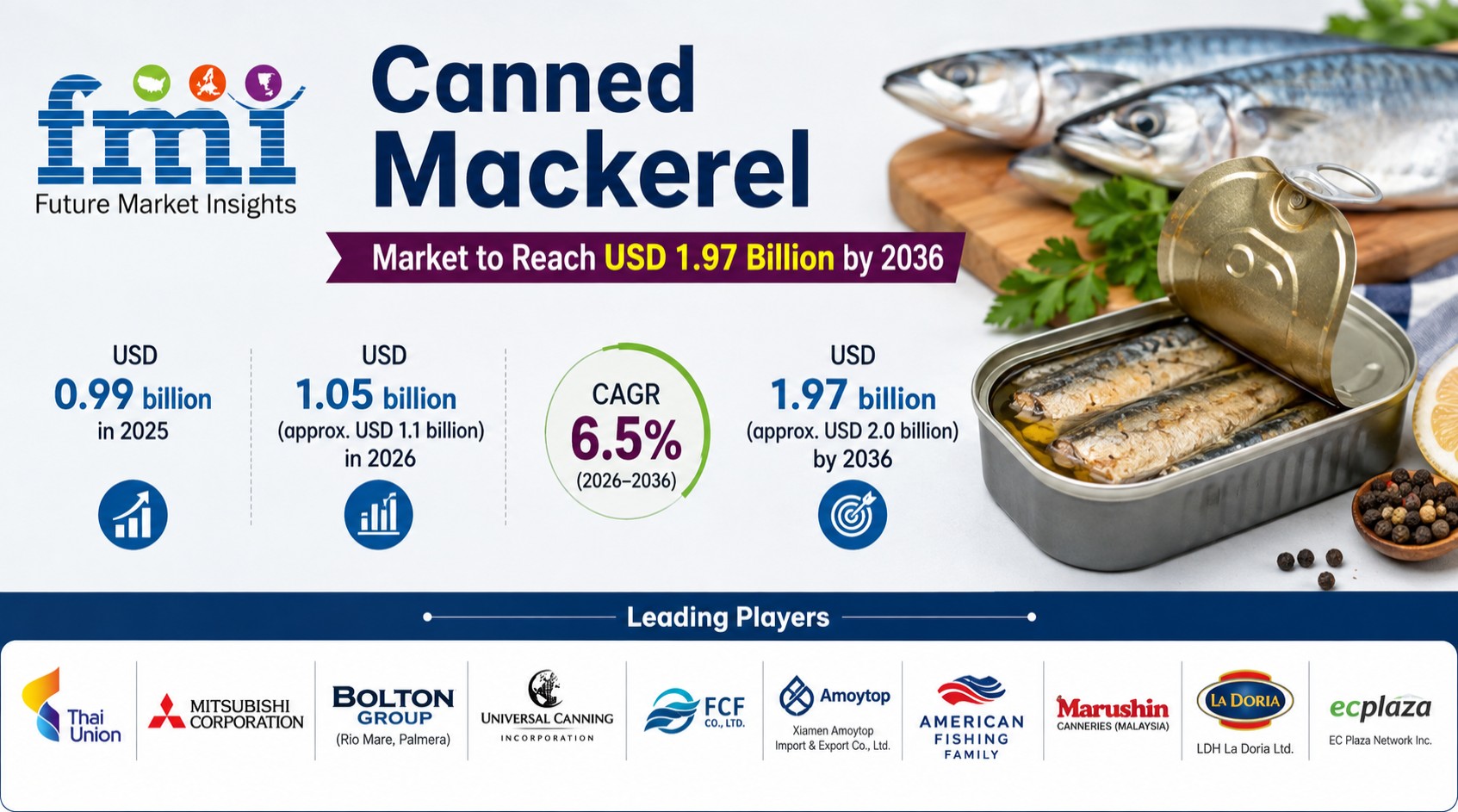
The global canned mackerel market is experiencing steady volume and value expansion as consumers and commercial foodservice operators turn to shelf-stable, omega-3-rich marine proteins, according to latest insights by Future Market Insights. Driven by traditional culinary consumption across Asian households, the proliferation of ready-to-eat seasoned preparations in modern convenience retail, and the growing enforcement of Marine Stewardship Council (MSC) fishery certifications, canned mackerel has reinforced its standing as an affordable, nutrient-dense seafood staple.
The global market, valued at USD 0.99 billion in 2025, is projected to reach USD 1.05 billion (approx. USD 1.1 billion) in 2026. Advancing at a Compound Annual Growth Rate (CAGR) of 6.5% over the ten-year forecast period, total market valuation is anticipated to achieve USD 1.97 billion (approx. USD 2.0 billion) by 2036, delivering an absolute incremental opportunity of USD 0.92 billion.
Request a Sample Report: https://www.futuremarketinsights.com/reports/sample/rep-gb-22436
Market Performance Overview (2026–2036)
To map out the key processing formats, dominant application sectors, primary distribution channels, and regional growth vectors guiding this USD 0.92 billion market scale-up, key segment allocations highlight where global commercial demand is concentrated:
- Seasoned & Marinated Processing Segment (50.6% share): Commands the processing category in 2026. Preparations infused with tomato sauce, chili marinades, miso, teriyaki, and spiced brine lead consumer preference due to superior flavor convenience and instant meal-assembly utility.
- Oil, Brine, & Natural Broth Preparations (49.4% combined share): Represent vital secondary processing pillars, favored across Mediterranean cooking, clean-label diets, and institutional foodservice kitchens.
- Commercial Foodservice Application (65.2% share): Represents the primary end-use sector in 2026, driven by high-volume procurement from institutional catering, quick-service dining, school meal programs, and casual Asian restaurants.
- Whole Mackerel Product Format (42.0% share): Retains substantial market share, reflecting traditional consumer preference for intact fish cuts that convey premium texture and authentic culinary presentation.
- Online Sales Distribution Channel (52.2% share): Dominates modern distribution, as bulk buying, subscription grocery services, and e-commerce platforms streamline direct delivery to households and foodservice operators.
- India & United States Regional Leadership: Lead national expansion rates at 20% CAGR and 4.80% CAGR respectively through 2036, driven by rising urban protein intake, expanding modern retail/quick-commerce networks, and growing adoption of Asian canned seafood formats.
Technical Drivers and Product Shifts
The commercial expansion and premiumization of canned mackerel across retail and foodservice channels are propelled by three primary industry catalysts:
Asian Culinary Staple Demand and Urban Convenience
Mackerel serves as an indispensable dietary protein in dishes like Japanese saba, Korean godeungeo-jorim, Thai mackerel in tomato sauce, Indian coastal fish curries, and Filipino canned seafood recipes. Rapid urbanization and fast-paced lifestyles accelerate demand for ready-to-eat canned variants that eliminate messy descaling and cooking prep.
Sustainable Wild-Catch Quotas and MSC Certification
Stringent fisheries quotas enforced across the North Sea, Norway, Japan, and the Pacific paired with retailer requirements for Marine Stewardship Council (MSC) certified sustainable sourcing are reshaping supply chains. Processors with certified sustainable wild-catch pipelines capture prime shelf space in European and North American supermarket chains.
Packaging Modernization and Ready-to-Eat Formats
Brand owners are transitioning from traditional can openers to ring-pull easy-open cans, single-serve pull-tab tins, and flexible retort pouches. In Japan and South Korea, convenience store chains (such as 7-Eleven, FamilyMart, and Lawson) drive premiumization through grilled, seasoned, single-serve saba pouches displayed in ambient snack sections.
Industrial Constraints & Commodity Volatility
Canned seafood processors, cannery operations, and procurement managers navigate specific operational hurdles:
- Wild-Catch Landing Fluctuations: Commercial mackerel supply remains vulnerable to ocean water temperature shifts, migration pattern changes, and periodic regulatory TAC (Total Allowable Catch) reductions, creating seasonal raw-fish price volatility.
- Cannery Tinplate and Retort Energy Costs: High thermal energy requirements for pressurized retort sterilization combined with metal tinplate and aluminum packaging price inflation—compress processor margins in commodity value tiers.
Regional Growth Profile
Regional demand reflects staple dietary integration across Asia alongside ethnic cuisine discovery and discounter retail penetration in Western markets:
- India (5.20% CAGR): The global growth frontrunner, driven by rising coastal and urban fish consumption, expanding quick-commerce grocery apps (Blinkit, Zepto), and the formalization of branded packaged seafood.
- United States (4.80% CAGR): Spurring steady expansion through the popularity of Asian supermarket chains (H Mart, 99 Ranch), clean-label tinned fish trends on social media, and premium Atlantic mackerel imports.
- United Kingdom (4.30% CAGR) & France (4.10% CAGR): Lead European demand, supported by established retail brands (Princes, John West, Rio Mare), specialty Mediterranean canned seafood consumption, and strong private-label supermarket lines.
- Germany: Anchored by high discounter penetration (Aldi, Lidl) and growing consumer preference for affordable, omega-3-rich Scandinavian-style canned fish.
- Japan (3.90% CAGR): A mature, quality-centric demand hub where premium canned saba (in miso, soy, and olive oil) is widely consumed across households and convenience store channels.
- China: Expanding through coastal city urbanization, expanding modern hypermarkets, and e-commerce live-streaming sales of branded canned seafood.
Competitive Landscape
The global canned mackerel landscape features a combination of multinational seafood conglomerates, large-scale Asian tuna/mackerel canneries, and European premium tinned fish specialists.
Key market participants profiled in the report include Thai Union Group PCL, Mitsubishi Corporation, Bolton Group (Rio Mare, Palmera), Universal Canning Incorporation, FCF Co., Ltd., Xiamen Amoytop Import & Export Co., Ltd., American Fishing Family, Marushin Canneries Malaysia, LDH La Doria Ltd., and EC Plaza Network Inc. Leading operators compete by securing MSC-certified sustainable fishing quotas, introducing gourmet sauce formulations (such as spicy sriracha, curry, and extra-virgin olive oil infusions), and expanding high-volume private-label co-packing contracts.
Exclusive Discounts on Full Report: https://www.futuremarketinsights.com/reports/canned-mackerel-market
Frequently Asked Questions
What is the projected valuation of the global canned mackerel market by 2036?
The global canned mackerel market is projected to reach USD 1.97 billion (approx. USD 2.0 billion) by 2036, expanding from an estimated baseline valuation of USD 1.05 billion (approx. USD 1.1 billion) in 2026 at a CAGR of 6.5%.
Why does Seasoned & Marinated lead the Processing segment with a 50.6% share?
Seasoned and marinated mackerel leads in 2026 because pre-cooked marinades (such as tomato sauce, chili, and miso) provide immediate, flavorful convenience for time-constrained consumers and commercial kitchen meal assembly.
What application accounts for the largest share of canned mackerel consumption?
Commercial foodservice commands a 65.2% market share in 2026, driven by bulk procurement from institutional catering, restaurant chains, school cafeterias, and hospitality providers seeking cost-effective, shelf-stable protein sources.
FMI Custom Research: Strategic Intelligence for Confident Decision-Making
In today's rapidly evolving business environment, leadership teams need clear, actionable intelligence tailored to their strategic objectives. FMI's Custom Research solutions are designed around specific business questions, enabling executives to evaluate growth opportunities, validate investments, assess competitive dynamics, and reduce uncertainty before making critical decisions.
Key Executive Benefits
- Decision-Ready Insights: Research tailored to your specific business challenges, growth plans, and investment priorities.
- Reduced Strategic Risk: Validate market opportunities, customer demand, and competitive positioning before committing resources.
- Market Entry Confidence: Assess opportunity size, regulatory barriers, channel dynamics, and competitive landscapes with precision.
- Competitive Advantage: Gain proprietary intelligence unavailable through syndicated reports or internal datasets.
- Faster Growth Decisions: Accelerate expansion, product development, portfolio optimization, and investment planning.
- Primary Market Validation: Access real-world customer, buyer, and stakeholder insights that support high-confidence decision-making.
Business Impact
FMI helps organizations transform market complexity into strategic clarity, enabling leadership teams to identify growth opportunities faster, optimize resource allocation, strengthen competitive positioning, and make high-stakes business decisions with confidence.
To explore how FMI Custom Research can support your strategic priorities, connect with our team at - sales@futuremarketinsights.com
About Future Market Insights (FMI)
Future Market Insights (FMI) delivers actionable, decision-focused market intelligence that goes beyond traditional research reports. The company provides:
- In-depth pricing and cost benchmarking analysis
- Demand forecasting based on real industry inputs
- Procurement and buyer behavior insights
- Supply chain and trade flow intelligence
- Technology and application trend analysis across industries
FMI follows a robust bottom-up research methodology, combining insights from industry experts, procurement leaders, manufacturers, and technical professionals to ensure accurate and practical market intelligence.