Construction and mining ask different things of a mobile storage unit, and a specification that suits one can disappoint at the other. A construction site wants an asset that moves as the works progress and works quietly under a consent; a mine wants one that survives dust and altitude and stays put for a season. From a procurement perspective the two duties should be specified separately even where the same product serves both. MPMC POWERTECH CORP., established in 2008 and headquartered in Shanghai Pudong, publishes an HBD-R series from 30 kW to 610 kW continuous and 61.44 to 610.6 kWh.
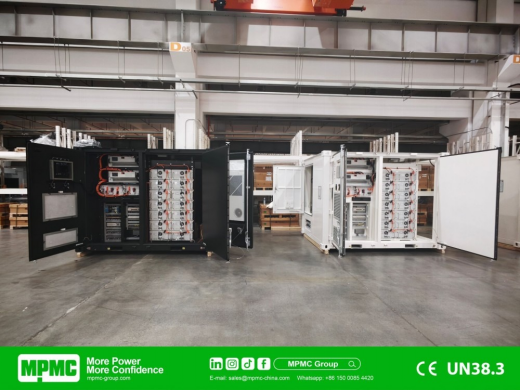
MPMC HBD-R Series battery energy storage system — HBD-250-400, 14 units totalling 6 MWh
Two Duties, Different Emphases
| Factor | Construction emphasis | Mining emphasis |
| Relocation | Frequent; follows the works | Seasonal; follows the pit |
| Governing constraint | Noise consent during restricted hours | Dust, altitude and service access |
| Load character | Small overnight base load; intermittent plant | Continuous camp and process loads |
| Main saving | Removing engine hours during quiet periods | Reducing fuel deliveries and service visits |
| Handling | Trailer or forklift movement by site crews | Crane placement; infrequent repositioning |
| Attendance | Site staff present daily | Often minimal; remote monitoring matters |
The row that most often decides the model is relocation. A unit repositioned weekly needs to be towable or forkliftable; one placed for a season can be larger and heavier, which usually means more capacity for the same money.
Where the Fuel Saving Comes From
Both duties share one mechanism. A site generator is sized for the largest load it might see and then spends long periods carrying very little, which is where diesel engines are least efficient. Storage lets the engine stop during those periods and run later at a sensible load to serve the site and recharge the battery.
MPMC lists the HBD-R series with millisecond-level transient smoothing and compatibility with DSE, ComAp, DEIF, Woodward, Smartgen and CAT EMCP controllers, and cites fuel reduction of up to 75% against diesel-only operation in low-load conditions. A documented United Kingdom construction case describes a 56 kW generator serving a 3 to 6 kW base load gaining a 30 kW / 60 kWh unit, after which refuelling moved from every two days to every seven and maintenance from every ten days to every sixty. That result belongs to that load profile.
Mining Conditions That Change the Numbers
MPMC lists an operating range of −20°C to +50°C on the HBD-R series with 6,000 cycles at 90% depth of discharge, HVAC cooling on smaller models and liquid-cooled air conditioning on larger units, aerosol fire suppression to CE on smaller models and an off-gas detector with water spray inlet on larger ones.
Altitude derating applies to storage as well as to engines, and dust shortens service intervals by loading filters and fouling heat rejection. Both should be raised in the enquiry, and the derated figures rather than nameplate ratings used in any fuel model.
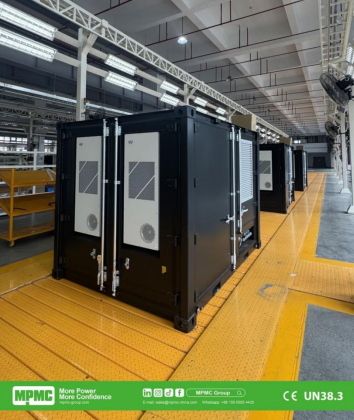
MPMC HBD-R Series battery energy storage system — HBD-250-400
Construction's Specific Requirement Is Silence
Where a consent restricts night running, no enclosure solves the problem and the only reliable answer is to stop the engine. MPMC's published UK case describes six 30 kW / 60 kWh units permitting silent operation through an ordinance covering 17:00 to 07:00 and Sundays, with the generator recharging only during permitted hours.
Sizing then follows the restricted window rather than total site demand: the load that must continue during quiet hours multiplied by the length of that period, with the recharge window checked against the hours the generator may run.
Documented Deployments in Both Sectors
MPMC lists a Chilean mining installation of 500 kWh using HBD-50-100 and HBD-250-400 units as a mobile storage plant, an Australian rental deployment of 560 kW / 920 kWh built from 50 kW / 100 kWh and 100 kW / 200 kWh units on a construction site carbon reduction project, and a 1 MWh Australian leasehold carbon reduction project on the same models.
These describe the class of deployment supplied rather than a saving forecast for a different site, whose returns follow its own load profile and delivered fuel price.
Built for Unfamiliar Crews
MPMC describes the HBD-R series as purpose-built for the rental market with ruggedised design, millisecond-level load response and easy maintenance, with seamless on-grid and off-grid switching listed as standard on this series.
On both construction and mining sites the equipment is connected by people who did not commission it, which puts weight on connection arrangements that are hard to get wrong and on protection specified to the harshest environment the unit will visit rather than the average.
Monitoring Where Attendance Is Thin
Mining sites and dispersed construction operations are rarely staffed by anyone who understands the storage system, which makes remote visibility an operational component rather than a convenience.
MPMC lists a self-developed SCADA supporting real-time monitoring, alarm and fault management, maintenance management with early warnings and spare parts tracking, up to ten years of data retention and StarLink satellite communication as a backup link. On a mine the satellite path may be the working link rather than the reserve, and the question that determines availability is organisational: who receives an alarm and how long it takes them to reach the equipment.
Deployment Confirmations
- State whether the unit will be repositioned frequently or placed for a season.
- Log the actual load profile over a representative period rather than a spot reading.
- Identify the quiet-period or overnight load and its largest starting current.
- Request derated output at the site's altitude and ambient range.
- Confirm controller compatibility with the generator sets already on site.
- Obtain exact consent hours where a noise restriction applies.
- Specify protection to the harshest environment the unit will visit.
- Check the throughput allowance against expected daily cycling.