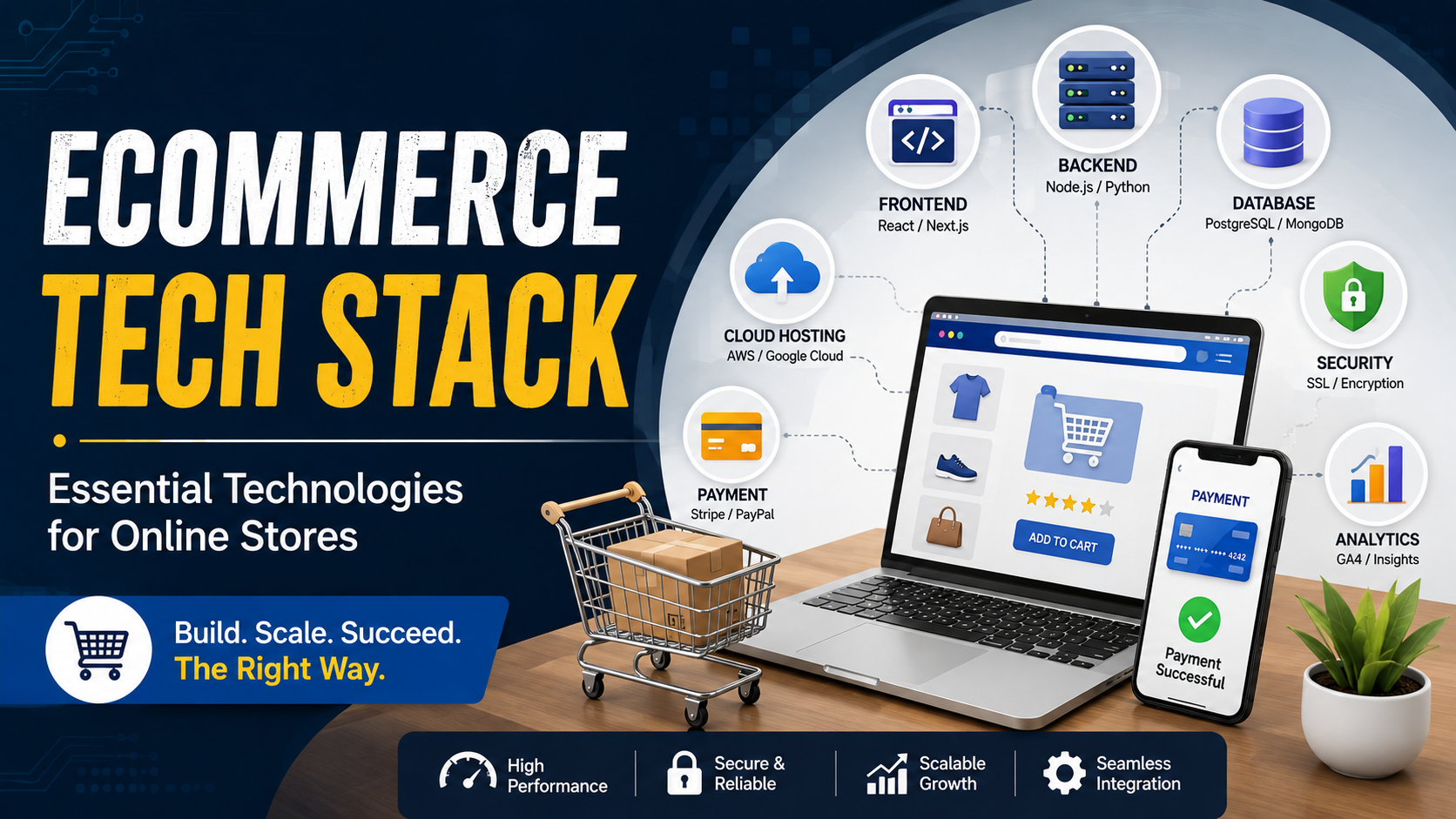
Building a successful online store takes more than attractive product pages and a smooth checkout. Behind every reliable ecommerce website is a carefully selected ecommerce tech stack that connects the storefront, backend, database, payment systems, security tools, analytics, and third-party services.
The right technology choices can improve website speed, simplify maintenance, support business growth, and create a better shopping experience. However, there is no single stack that works for every ecommerce business. A small online retailer may need a simple setup, while a large marketplace may require a highly scalable architecture.
Understanding the main components of an ecommerce tech stack helps businesses make better technology decisions before investing in development.
What Is an Ecommerce Tech Stack?
An ecommerce tech stack is the collection of programming languages, frameworks, platforms, databases, APIs, hosting services, and third-party tools used to build and operate an online store.
It generally has two major sides: the frontend, which customers interact with, and the backend, which manages business operations behind the scenes.
A modern stack may include frontend technologies such as HTML, CSS, JavaScript, and React, alongside backend technologies such as Node.js, PHP, Python, or .NET. Databases, cloud hosting, payment gateways, search tools, analytics, and security solutions complete the ecosystem.
The goal is not to use the most technologies possible. Instead, businesses should choose technologies that work together efficiently and support their specific requirements.
Key Layers of an Ecommerce Technology Stack
A well-planned ecommerce architecture typically contains several interconnected layers. Each layer has a different responsibility, but together they create the complete shopping experience.
Frontend Technology
The frontend is the visible part of an ecommerce website. It includes product pages, navigation menus, shopping carts, filters, account pages, and checkout interfaces.
Common frontend technologies include HTML, CSS, JavaScript, React, Vue.js, and Next.js. Businesses increasingly focus on responsive design because customers shop across desktops, tablets, and smartphones.
A lightweight frontend can also contribute to faster loading times, better usability, and stronger Core Web Vitals performance.
Backend Technology
The backend handles the business logic that customers do not directly see. It processes orders, manages customers, handles inventory information, connects services, and communicates with the database.
Popular backend technologies include Node.js, PHP, Python, Java, and .NET.
The best choice depends on factors such as application complexity, development expertise, scalability requirements, integrations, and long-term maintenance.
Database Systems
Every ecommerce platform needs a reliable way to store information. Product details, customer accounts, inventory, orders, prices, shipping information, and other business data typically reside in databases.
MySQL, PostgreSQL, MongoDB, and Microsoft SQL Server are commonly used options.
Relational databases can work particularly well for structured ecommerce data, while NoSQL databases may be useful for applications requiring flexible data models or specific scalability patterns.
Ecommerce Platforms and Commerce Engines
Businesses can either build their ecommerce infrastructure from scratch or use an established commerce platform.
Platforms such as Shopify, WooCommerce, Magento, and BigCommerce provide many ecommerce features without requiring every function to be developed independently.
For businesses that need extensive customization, a headless or custom ecommerce architecture can provide greater flexibility. Headless commerce separates the customer-facing frontend from the commerce backend, allowing businesses to change the presentation layer without completely rebuilding the underlying commerce system.
The right approach depends on budget, technical resources, product complexity, customization requirements, and expected growth.
Payment and Checkout Technology
Payments are one of the most important parts of an ecommerce system. Customers expect checkout to be quick, secure, and convenient.
Payment technology can include gateways and processors such as Stripe, PayPal, Adyen, and region-specific payment providers. Depending on the target market, stores may also support credit cards, debit cards, digital wallets, bank transfers, and local payment methods.
A strong checkout architecture should minimize unnecessary steps while maintaining appropriate security and fraud protection.
APIs and Third-Party Integrations
Modern ecommerce websites rarely operate as isolated systems. They often connect with shipping providers, payment gateways, accounting software, CRM systems, marketing platforms, inventory applications, marketplaces, and customer-support tools.
APIs make these connections possible.
A well-designed API layer allows different systems to exchange information without requiring businesses to rebuild their entire application. This becomes especially important as an ecommerce company adds new sales channels and operational tools.
Cloud Hosting and Infrastructure
Hosting directly affects the availability, performance, and scalability of an ecommerce website.
Cloud providers such as AWS, Google Cloud, and Microsoft Azure offer infrastructure that can scale according to business requirements. Businesses can use cloud services for application hosting, databases, storage, content delivery, monitoring, and backups.
For stores experiencing seasonal traffic spikes, scalable infrastructure can help handle increased demand without permanently maintaining resources designed for peak traffic.
Search and Product Discovery
As product catalogs grow, website search becomes increasingly important. Customers who cannot quickly find the right product may leave the store.
Basic ecommerce platforms often provide built-in search functionality, while larger catalogs may benefit from specialized search technologies.
Solutions such as Elasticsearch or other hosted search services can support features including autocomplete, filters, relevance ranking, synonyms, and personalized product discovery.
Better search functionality can reduce friction and help shoppers reach relevant products faster.
Security in an Ecommerce Tech Stack
Security should be considered from the beginning rather than added after development.
An ecommerce application handles valuable information, including customer accounts, order data, payment information, and business records. Security measures may include HTTPS, secure authentication, access controls, encryption, firewalls, vulnerability monitoring, regular updates, and secure API practices.
Payment systems should also follow applicable security and compliance requirements. Businesses should avoid storing sensitive payment information unnecessarily and should work with reputable payment providers.
Analytics and Performance Monitoring
An ecommerce technology stack should provide visibility into both customer behavior and technical performance.
Analytics platforms can reveal information about traffic sources, product engagement, conversions, abandoned carts, and customer journeys. Performance-monitoring tools can identify slow pages, server errors, downtime, and other technical problems.
Combining business analytics with technical monitoring gives ecommerce teams a clearer understanding of what is happening across the store.
How to Choose the Right Ecommerce Tech Stack
Choosing technologies should begin with business requirements rather than trends.
Consider your product catalog, expected traffic, sales channels, geographic markets, integrations, development resources, budget, security requirements, and long-term growth plans.
A smaller business may benefit from a managed ecommerce platform that reduces infrastructure responsibilities. A larger company with complex workflows may require a custom or headless architecture.
It is also important to consider the availability of developers who can maintain the chosen technologies. A technically impressive stack can become expensive if skilled developers are difficult to find.
Common Ecommerce Tech Stack Examples
A modern ecommerce setup could combine a React or Next.js frontend with a Node.js backend, PostgreSQL database, cloud infrastructure, payment gateway, search service, analytics platform, and third-party integrations.
Another business might use Shopify or WooCommerce with selected apps and integrations. Both approaches can be effective when they match the company's needs.
The important factor is not whether a stack is considered modern. It is whether the technologies provide the required performance, flexibility, security, maintainability, and scalability.
Why the Right Stack Matters for Ecommerce Growth
Technology decisions made during the early stages of development can influence an ecommerce business for years.
A suitable stack can make it easier to launch new features, integrate additional services, improve website performance, expand into new markets, and manage increasing traffic.
On the other hand, poorly selected technologies can create technical debt, slow development, increase maintenance costs, and make future changes more difficult.
For this reason, businesses should evaluate their technology choices as part of a long-term digital strategy rather than focusing only on initial development costs.
Final Thoughts
An effective ecommerce tech stack brings together frontend development, backend systems, databases, commerce platforms, payments, APIs, hosting, search, security, and analytics.
There is no universal combination that suits every online business. The best stack is the one that supports the company's current requirements while leaving enough room for future growth.
Before choosing technologies, businesses should define their goals, understand their customers, evaluate integrations, estimate future traffic, and consider ongoing maintenance. A thoughtful technology foundation can make an ecommerce store faster, more secure, easier to manage, and better prepared for long-term growth.
Frequently Asked Questions
1. What is an ecommerce tech stack?
An ecommerce tech stack is the collection of frontend, backend, database, hosting, payment, security, analytics, and integration technologies used to operate an online store.
2. Which technology stack is best for ecommerce?
The best ecommerce stack depends on business size, product complexity, budget, traffic, integrations, customization needs, development resources, and long-term scalability requirements.
3. Is Shopify a complete ecommerce tech stack?
Shopify provides many core ecommerce capabilities, including storefront management, checkout, payments, products, orders, and integrations, while additional technologies can extend its functionality.
4. Why is technology selection important for ecommerce?
Technology selection affects website performance, security, scalability, development costs, integrations, maintenance, customer experience, and how easily an ecommerce business can introduce future improvements.
5. Should an ecommerce business choose custom development?
Custom development can be valuable when a business requires specialized workflows, complex integrations, unique customer experiences, or functionality that existing ecommerce platforms cannot provide effectively.