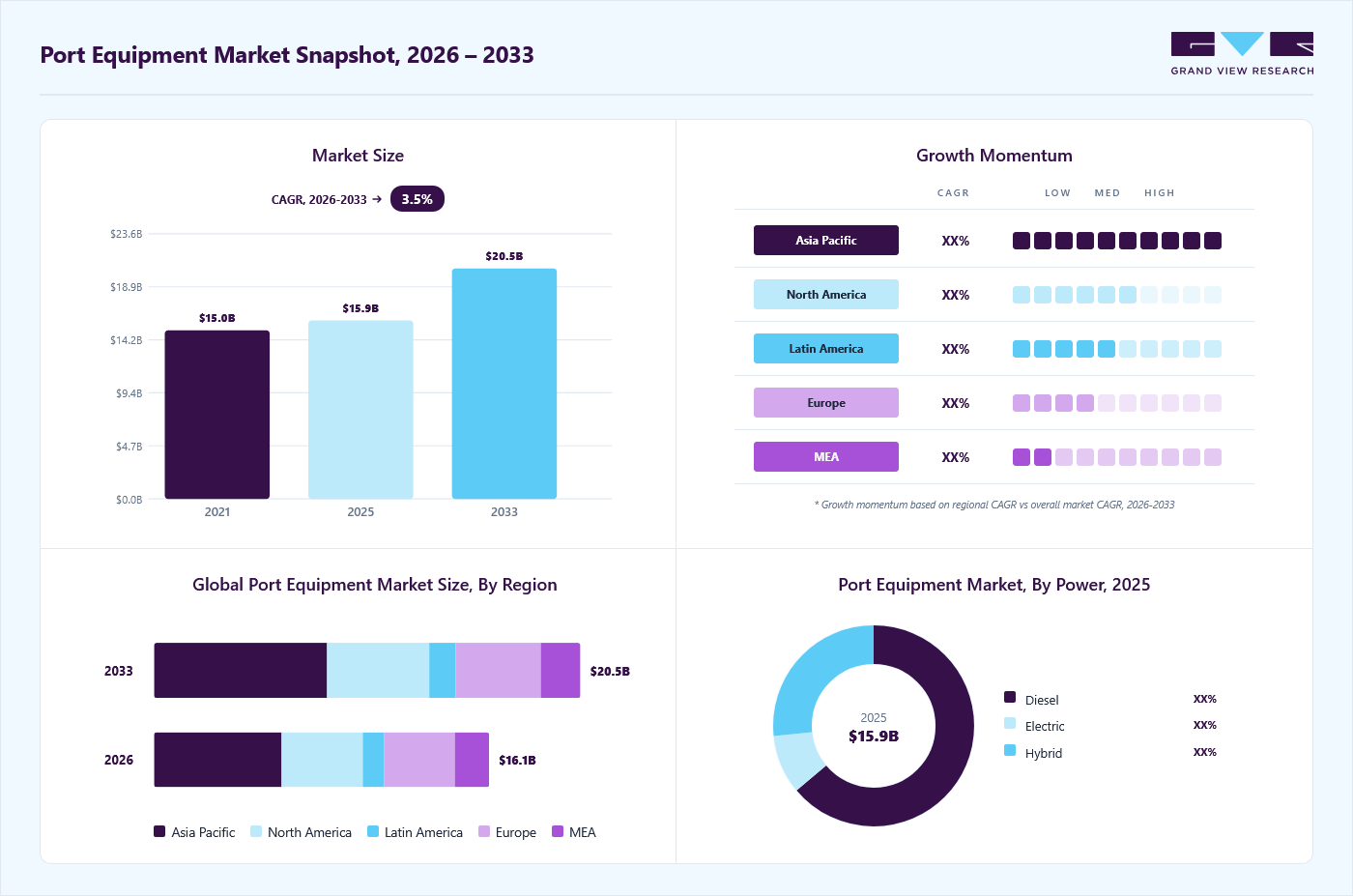
The port equipment market is entering a period of steady expansion as ports, terminals, and logistics operators respond to rising cargo volumes, larger vessels, infrastructure modernization, and the need for faster and more efficient handling operations.
Key Market Metrics
- Market Size, 2025: USD 15.9 billion
- Market Estimate, 2026: USD 16.1 billion
- Market Forecast, 2033: USD 20.5 billion
- CAGR, 2026–2033: 3.5%
- Largest Regional Market: Asia Pacific with a 38.4% revenue share in 2025
- Leading Operation Segment: Conventional with a 71.7% market share in 2025
- Leading Power Segment: Diesel with a 63.9% market share in 2025
- Leading Equipment Type: Reach stackers with a 33.0% market share in 2025
- Leading Country: China held the largest market share in 2025.
Major Growth Drivers
- Electrification and Sustainability:
Environmental requirements and the growing focus on cleaner port operations are encouraging equipment manufacturers and port operators to adopt electric and hybrid machinery. Electrically powered equipment can reduce greenhouse gas emissions and air pollutants while supporting lower operating and maintenance requirements. Green port initiatives and environmental standards are therefore creating opportunities for cleaner cargo-handling technologies.
- Automation and Smart Ports:
Automation is becoming increasingly important as ports seek higher throughput, improved safety, and reduced operational bottlenecks. Automated guided vehicles, remote-controlled cranes, automated equipment, IoT-enabled monitoring, data analytics, and digital technologies are helping operators improve cargo movement and equipment utilization. Autonomous machinery can also reduce human error and support more consistent terminal operations.
- Rising Freight Traffic:
Increasing international trade, containerized cargo transportation, and expanding maritime activity are creating demand for equipment capable of handling greater cargo volumes. Ports are upgrading terminals and infrastructure to accommodate larger vessels and reduce vessel turnaround times. The expansion of container traffic is also supporting investments in cranes, reach stackers, terminal tractors, container handlers, and other cargo-handling machinery.
Regional and Segment Insights
Asia-Pacific Dominance:
Asia Pacific accounted for the largest share of the port equipment market, representing 38.4% of revenue in 2025. Strong trade activity, port expansion, infrastructure modernization, and technology adoption are supporting demand. China held the largest market share within the region in 2025, while India is expected to grow at a CAGR of 5.1% from 2026 to 2033.
Equipment Breakdown:
- By operation, conventional equipment led with a 7% share in 2025, supported by established infrastructure, reliability, availability, and existing service networks. Autonomous equipment is gaining attention because of its efficiency, reliability, safety advantages, and ability to streamline cargo movement.
- By power, diesel remained the leading category with a 9% share in 2025, benefiting from robust performance, torque, reliability, and widespread deployment. At the same time, electric and hybrid equipment are gaining momentum as ports pursue lower emissions and more sustainable operations.
- By equipment type, reach stackers represented the largest category with a 0% share in 2025. Their mobility, flexibility, and ability to stack containers efficiently make them valuable for cargo handling and yard management. Terminal tractors also remain important for moving containers between ships, storage areas, trucks, and trains.
Technology
Technology is reshaping port operations through automation, electrification, IoT, digitalization, and data-driven management. Automated guided vehicles, remote-controlled cranes, predictive maintenance systems, and integrated terminal management solutions can improve productivity while helping operators respond to fluctuating cargo volumes.
Market Challenges and Future Outlook
Despite favorable demand conditions, high capital investment and infrastructure requirements can slow equipment adoption. Modern handling systems require substantial acquisition, installation, maintenance, electrical, and digital infrastructure investments. Smaller ports may face financial constraints, while maintenance requirements and project execution timelines can increase costs.
Nevertheless, smart and sustainable port infrastructure presents significant opportunities. Growing trade volumes, modernization programs, automation, electrification, and environmental initiatives are expected to support continued investment. With the market projected to reach USD 20.5 billion by 2033, port operators and equipment manufacturers are increasingly focused on solutions that combine productivity, safety, energy efficiency, and intelligent cargo management.
Smarter Warehouses and Greener Logistics Drive Modern Supply Chains
- AI In Warehousing Management Market : AI-powered warehouse systems are improving inventory management, predictive maintenance, dynamic slotting, robotics, and computer-vision-based quality control. These technologies can help logistics operators improve efficiency, reduce downtime, and optimize material handling.
- Green Logistics Market : The shift toward more efficient and sustainable logistics is encouraging businesses to optimize transportation, warehouse operations, energy use, and resource utilization. Green logistics strategies can help reduce environmental impact while supporting more efficient supply-chain operations.
FAQs
- Which segment leads the port equipment market?
The conventional operation segment led the market with a 71.7% share in 2025, while reach stackers led the equipment type category with a 33.0% share. - What trends are shaping the port equipment market?
Automation, electrification, digitalization, IoT-enabled monitoring, autonomous equipment, and sustainable port infrastructure are among the major trends shaping the market.
Key Port Equipment Companies:
- Kalmar
- Liebherr Group
- Konecranes Abp
- Sany Heavy Industry Co. Ltd.
About us:
Grand View Research, a market research and consulting company, provides syndicated research reports, customized research reports, and consulting services. Grand View Research database is used by the world's renowned academic institutions and Fortune 500 companies to understand the global and regional business environment. Our database features thousands of statistics and in-depth analysis on 46 industries in 25 major countries worldwide.