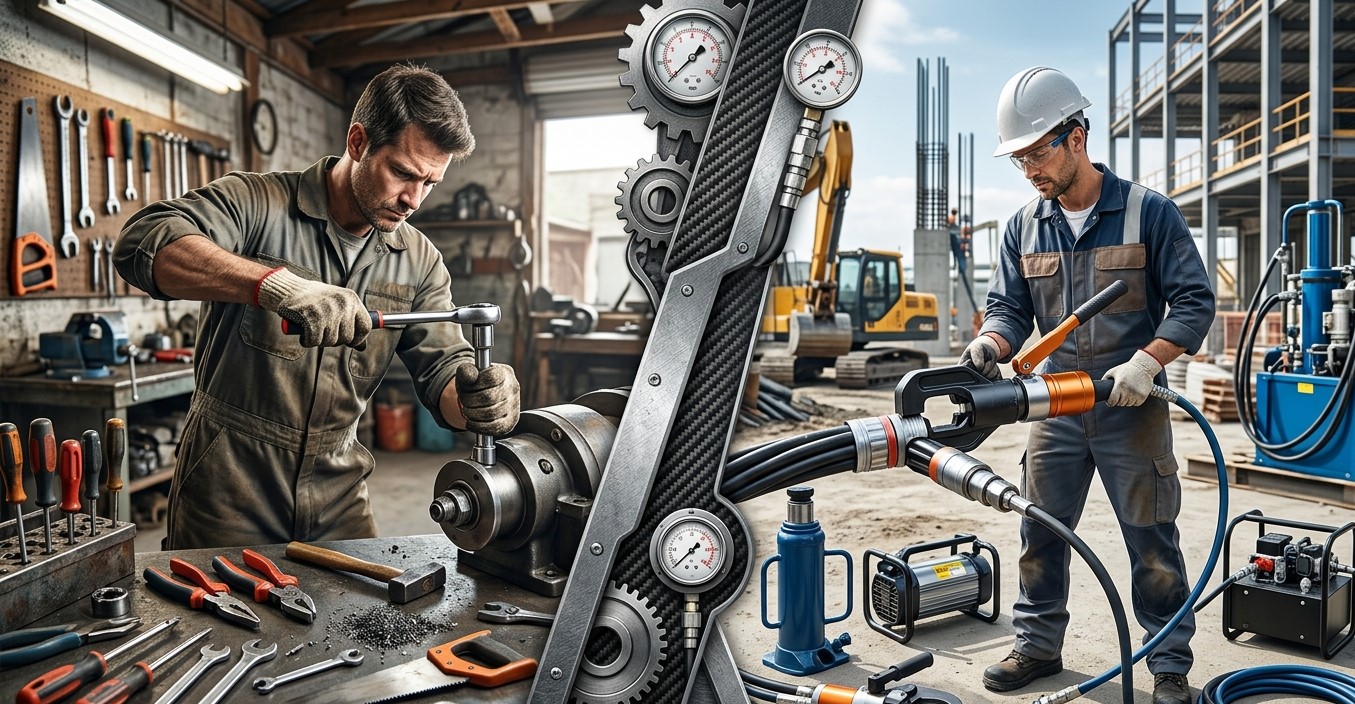
Industrial work often requires tools that can deliver accuracy, strength, reliability, and efficiency under demanding operating conditions. Two broad categories commonly used across workshops, maintenance facilities, manufacturing plants, fabrication operations, and engineering environments are hydraulic tools and manual tools .
While manual tools rely primarily on human effort, hydraulic tools use pressurized fluid to generate significantly higher force. Each type has its own advantages, limitations, and applications. Choosing between them depends on the task, required force, working environment, frequency of use, precision, and available equipment.
For businesses searching for an Industrial Tools Supplier in Dubai, understanding the differences between hydraulic and manual tools can help ensure the right equipment is selected for each application. Khokhawala Trading LLC, an Industrial Tools Supplier in Dubai, provides industrial and engineering tools for manufacturing, maintenance, machining, fabrication, and workshop requirements.
This article explains the key differences between hydraulic and manual tools, their common applications, benefits, limitations, and factors to consider before purchasing them.
What Are Manual Tools?
Manual tools are tools operated primarily through direct physical effort from the user. They are among the most basic and widely used equipment in industrial workshops, maintenance departments, construction sites, and engineering facilities.
Common manual tools include:
- Spanners
- Wrenches
- Screwdrivers
- Pliers
- Hammers
- Hand saws
- Files
- Allen keys
- Manual cutters
- Manual pullers
- Hand-operated clamps
Manual tools are generally simple to operate and do not require hydraulic pumps, motors, or external power sources.
Their simplicity makes them useful for everyday maintenance and assembly tasks.
What Are Hydraulic Tools?
Hydraulic tools use pressurized hydraulic fluid to generate mechanical force. A hydraulic pump creates pressure, which is transferred through hydraulic fluid to a cylinder or other working mechanism.
Common hydraulic tools include:
- Hydraulic jacks
- Hydraulic presses
- Hydraulic pullers
- Hydraulic torque wrenches
- Hydraulic cutters
- Hydraulic crimping tools
- Hydraulic cylinders
- Hydraulic pumps
Hydraulic equipment is commonly used when a task requires high force that would be difficult or impractical to generate manually.
Hydraulic Tools vs Manual Tools: The Main Difference
The biggest difference between hydraulic and manual tools is how force is generated.
Manual tools depend largely on the user's physical effort. Hydraulic tools use pressurized fluid to multiply and apply force through a hydraulic system.
This fundamental difference affects:
- Force capacity
- Operator effort
- Speed
- Precision
- Portability
- Maintenance
- Cost
- Application suitability
Neither category is universally better. The right choice depends on the specific job.
1. Force and Power
One of the most important advantages of hydraulic tools is their ability to generate substantial force.
A technician using a manual wrench may need considerable physical effort to loosen or tighten a large fastener. A hydraulic torque wrench can apply much greater controlled torque with considerably less physical effort.
Similarly, a manual puller may be suitable for smaller components, while a hydraulic puller can be used for larger and more demanding removal applications.
Manual Tools
Manual tools are suitable when:
- Force requirements are relatively low
- The component is small or accessible
- The job is occasional
- Human force is sufficient
Hydraulic Tools
Hydraulic tools are more appropriate when:
- High force is required
- Components are large
- Heavy-duty work is involved
- Consistent force is important
- Manual effort would be excessive
2. Operator Effort
Manual tools require direct physical effort. This can become challenging when a job involves large components, repeated operations, or high resistance.
Hydraulic tools reduce the physical effort required because hydraulic pressure generates the working force.
This can be particularly valuable in industrial maintenance applications where technicians regularly work with large machinery and heavy components.
Reducing unnecessary physical effort can also make certain tasks more manageable and consistent.
3. Precision and Control
Hydraulic systems can provide controlled force when used with appropriate pumps, gauges, and accessories.
This can be useful for applications where force must be applied within a specific range.
For example, hydraulic torque tools can be used where controlled torque is required for large bolted connections.
Manual tools can also provide excellent control for many routine applications, especially when the operator needs to make small adjustments.
The required level of control should therefore be considered when selecting the tool.
4. Speed and Productivity
Tool selection can influence how quickly a job is completed.
For simple tasks, manual tools may actually be faster because they can be picked up and used immediately without setting up hydraulic equipment.
For heavy-duty applications, however, hydraulic tools may significantly improve productivity because they can apply high force without requiring extensive physical effort.
For repetitive industrial work, this difference can become especially important.
Example
A technician removing a small bearing from a component may use a manual puller efficiently.
For a large bearing installed with substantial interference, a hydraulic puller may provide a more practical solution.
The best tool depends on the scale and difficulty of the job.
5. Portability
Manual tools generally have an advantage in portability.
A basic wrench or screwdriver can be carried easily and used almost anywhere.
Hydraulic tools may require additional equipment such as:
- Hydraulic pumps
- Hoses
- Fittings
- Adapters
- Power sources
Some hydraulic tools are designed for portability, but the complete system can still be more complex than a basic manual tool.
For field maintenance, technicians should consider the total equipment required before selecting hydraulic equipment.
6. Setup Requirements
Manual tools generally require minimal setup.
A technician can select the correct tool, position it, and begin working.
Hydraulic tools may require additional steps, such as:
- Selecting the appropriate hydraulic tool
- Connecting hoses
- Connecting the hydraulic pump
- Checking fittings
- Verifying pressure
- Positioning the equipment
- Applying force gradually
For occasional low-force work, manual tools may therefore be more convenient.
For demanding applications, the additional setup of hydraulic tools can be justified by their greater force capacity.
Common Applications of Manual Tools
Manual tools remain essential in industrial environments.
General Maintenance
Technicians use wrenches, screwdrivers, pliers, hammers, and other hand tools for routine equipment maintenance.
Assembly
Manual tools are commonly used to assemble machinery, brackets, fixtures, and mechanical components.
Electrical and Mechanical Work
Various hand tools are used for installation, adjustment, repair, and maintenance.
Fabrication
Files, saws, clamps, hammers, and other tools can be used during fabrication and finishing operations.
Workshop Repairs
Manual tools are often the first choice for small repairs and adjustments because they are simple and readily accessible.
Common Applications of Hydraulic Tools
Hydraulic tools are particularly valuable for heavy-duty industrial operations.
Hydraulic Jacks
Hydraulic jacks are used to lift heavy equipment and components where suitable lifting procedures and rated equipment are available.
Applications include:
- Machinery maintenance
- Vehicle servicing
- Industrial equipment positioning
- Heavy component handling
Hydraulic Presses
Hydraulic presses apply high force to operations such as:
- Bearing installation and removal
- Component forming
- Straightening
- Press fitting
- Assembly operations
Hydraulic Pullers
Hydraulic pullers can help remove bearings, gears, pulleys, and other tightly fitted components.
Hydraulic Torque Wrenches
Hydraulic torque wrenches are used for controlled tightening and loosening of large bolts and fasteners.
They are commonly used in industries involving:
- Heavy machinery
- Industrial plants
- Construction equipment
- Energy infrastructure
- Large mechanical assemblies
Hydraulic Cutters and Crimping Tools
These tools can be used for demanding cutting and crimping applications where substantial controlled force is required.
Advantages of Manual Tools
Manual tools offer several practical benefits.
Simple Operation
Most manual tools are straightforward to operate.
Low Initial Cost
Many hand tools are relatively affordable compared with complete hydraulic systems.
Easy Portability
They can generally be transported and stored easily.
Minimal Setup
Most jobs require little preparation.
Low Maintenance Requirements
Basic hand tools often require only cleaning, inspection, and appropriate storage.
Versatility
A single wrench, plier, or screwdriver can often be used for numerous routine tasks.
Advantages of Hydraulic Tools
Hydraulic tools provide different benefits.
High Force Capacity
They can generate forces that would be difficult to achieve manually.
Reduced Physical Effort
Hydraulic pressure performs much of the demanding work.
Controlled Operation
Appropriate hydraulic systems can provide controlled force and movement.
Suitable for Heavy-Duty Applications
They are particularly useful for large industrial components and demanding maintenance tasks.
Improved Productivity
Hydraulic tools can reduce the physical effort and time required for certain heavy-duty operations.
Limitations of Manual Tools
Despite their versatility, manual tools have limitations.
They may not be suitable when:
- Extremely high force is required
- Components are very large
- Work is highly repetitive
- Consistent high torque is required
- Manual effort becomes impractical
Trying to force a manual tool beyond its intended capacity can damage the tool and create safety risks.
Limitations of Hydraulic Tools
Hydraulic tools also have considerations that should not be overlooked.
They may involve:
- Higher initial investment
- More components
- Hydraulic fluid requirements
- Hose and fitting maintenance
- More setup time
- Regular inspection requirements
Hydraulic systems must also be operated within their rated pressure and load limits.
How to Choose Between Hydraulic and Manual Tools
Before purchasing a tool, evaluate the actual application.
1. Determine the Required Force
Ask how much force the job requires.
For low-force applications, a manual tool may be sufficient. For high-force applications, hydraulic equipment may be more appropriate.
2. Consider Frequency of Use
Occasional maintenance may not justify a complete hydraulic system if a manual tool can perform the job effectively.
For frequent heavy-duty operations, hydraulic equipment may provide greater productivity.
3. Consider Component Size
Large components and tightly fitted parts often require higher force and may benefit from hydraulic tooling.
4. Evaluate Workspace
Consider whether there is enough space for the hydraulic tool, pump, hoses, and accessories.
5. Consider Operator Requirements
If a task requires significant physical effort, hydraulic tools can reduce the force that the operator must apply directly.
6. Consider Total Cost
Do not compare tools only by purchase price. Consider:
- Setup costs
- Maintenance
- Tool life
- Productivity
- Downtime
- Replacement costs
- Operator effort
The right tool should provide the best overall value for the application.
Safety Considerations
Both manual and hydraulic tools require correct operation.
For manual tools:
- Use the correct size
- Inspect tools before use
- Do not use damaged tools
- Use appropriate personal protective equipment
- Avoid using tools beyond their intended capacity
For hydraulic tools:
- Check hoses and fittings
- Verify rated pressure
- Use compatible components
- Inspect hydraulic equipment regularly
- Never exceed rated capacity
- Keep personnel clear of hazardous load paths
- Follow manufacturer instructions
Hydraulic systems can store substantial energy, so damaged hoses, fittings, cylinders, or other components should be addressed immediately.
Maintaining Hydraulic and Manual Tools
Proper maintenance can extend tool life for both categories.
Manual Tool Maintenance
- Clean tools after use
- Remove dirt and contaminants
- Keep metal surfaces dry
- Lubricate moving parts where appropriate
- Store tools properly
- Inspect for cracks or damage
Hydraulic Tool Maintenance
- Inspect hydraulic hoses
- Check for leaks
- Inspect fittings
- Maintain appropriate hydraulic fluid
- Keep components clean
- Store equipment correctly
- Follow manufacturer's maintenance schedule
A preventive maintenance program can help reduce unexpected tool failures.
The Role of a Reliable Industrial Tools Supplier
Selecting the right supplier is an important part of purchasing industrial equipment. A reliable supplier can help businesses identify suitable tools based on application, operating conditions, and performance requirements.
Companies searching for an Industrial Tools Supplier UAE should consider:
- Product quality
- Application suitability
- Technical specifications
- Product range
- Availability
- Customer support
- Industry experience
Businesses looking for an Engineering Tools Supplier in Dubai may benefit from a supplier that offers multiple categories, including hydraulic tools, cutting tools, precision measuring tools, threading tools, and workshop equipment.
Khokhawala Trading LLC provides industrial and engineering tools for manufacturing, maintenance, machining, fabrication, and workshop applications. Businesses can evaluate their specific requirements before choosing between manual and hydraulic equipment.
Hydraulic Tools vs Manual Tools: Quick Comparison
| Feature | Manual Tools | Hydraulic Tools |
|---|---|---|
| Force | Limited by operator effort | High force capability |
| Physical effort | Higher for demanding tasks | Lower |
| Setup | Usually simple | Often requires additional equipment |
| Portability | Generally excellent | Depends on the system |
| Cost | Often lower | Usually higher |
| Maintenance | Generally simple | Requires hydraulic system maintenance |
| Heavy-duty work | Limited | Highly suitable |
| Precision control | Depends on tool and operator | Can provide controlled force |
| Best suited for | Routine tasks and repairs | High-force industrial applications |
Conclusion
Hydraulic and manual tools both play important roles in industrial environments. Manual tools are simple, versatile, portable, and suitable for a wide range of routine maintenance, assembly, fabrication, and workshop tasks. Hydraulic tools, on the other hand, are designed for applications where high force, controlled operation, and reduced physical effort are required.
The right choice depends on the specific job. Businesses should consider force requirements, component size, frequency of use, workspace, operator effort, portability, maintenance, safety, and total cost before making a decision.
For companies searching for an Industrial Tools Supplier in Dubai , Industrial Tools Supplier UAE , or Engineering Tools Supplier in Dubai , Khokhawala Trading LLC provides industrial and engineering tooling solutions for a variety of professional applications.
Choosing the correct tool can improve productivity, reduce unnecessary physical effort, minimize downtime, and support safer and more consistent industrial operations. Whether the requirement involves routine workshop maintenance or demanding heavy-duty applications, selecting equipment according to the actual job requirements is the key to achieving reliable results.