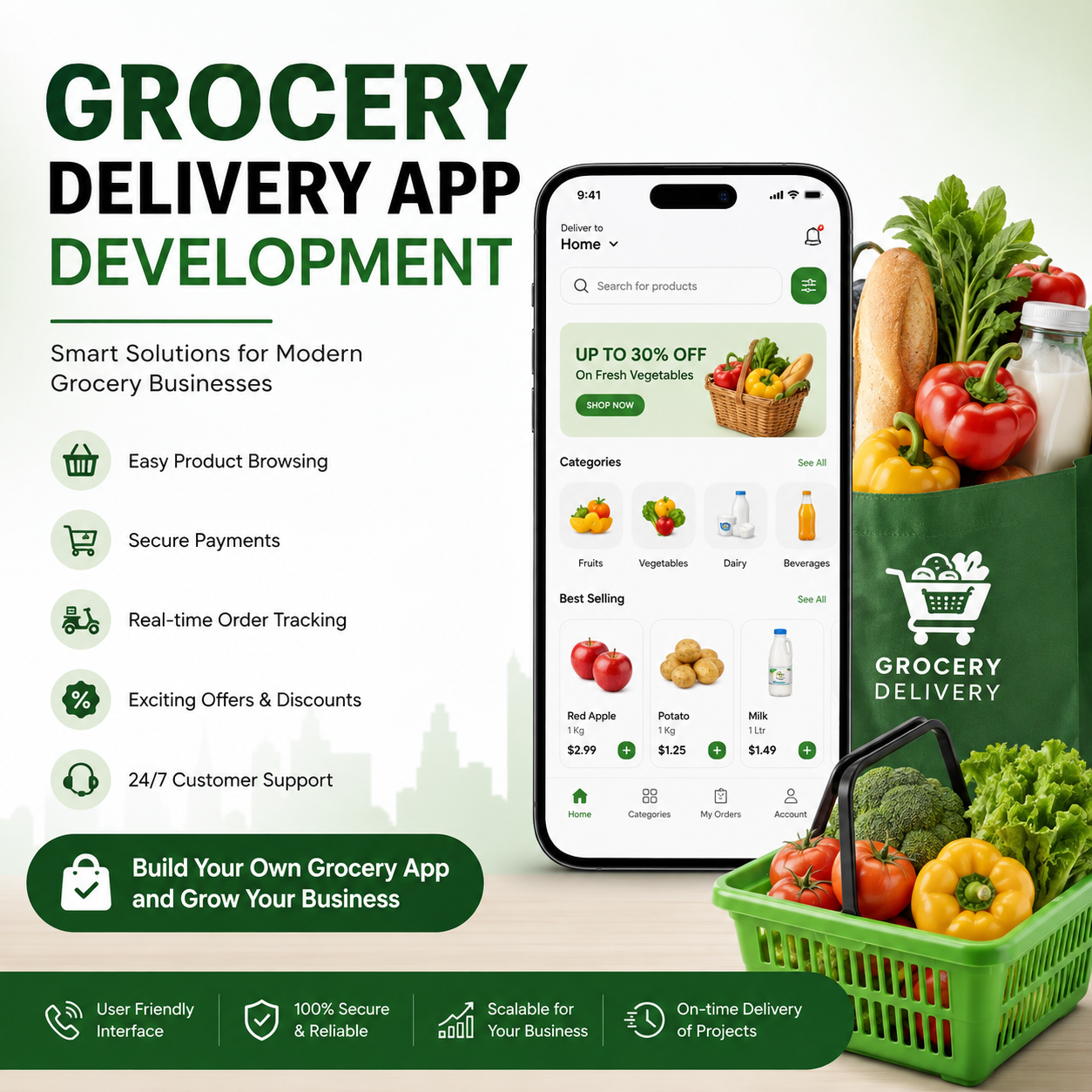
Getting groceries delivered to a customer's doorstep involves much more than simply sending a driver from a store to an address. Orders have to be prepared, assigned, picked up, and delivered within the expected time. When several orders are being handled together, things can quickly become difficult to manage without the right technology.
Real-time tracking and route optimization can help grocery businesses organize these activities. Customers can see where their orders are, while delivery teams can get useful location and route information. For businesses planning a digital grocery platform, these features can become an important part of the delivery system.
A professional grocery delivery app development company can connect GPS, maps, order management, and delivery systems to create a smoother process for everyone involved.
What Is Real-Time Grocery Order Tracking?
Real-time tracking allows customers and businesses to follow an order after it has been dispatched. Depending on the application, customers may see the delivery person's location on a map along with the current order status.
For example, an order may move through stages such as:
- Order confirmed
- Grocery items being prepared
- Order packed
- Picked up by delivery personnel
- On the way
- Delivered
This gives customers a better idea of what is happening with their purchase. Instead of repeatedly calling the store, they can check the application for updates.
For the business, tracking can provide information about active deliveries and help staff identify delays.
How GPS Helps Delivery Personnel
Delivery drivers often handle several addresses during a working shift. GPS and map integration can help them locate stores and customer addresses without depending entirely on manual directions.
The delivery application can show the assigned order, destination, customer details, and navigation options. If the customer provides additional delivery instructions, these can also be displayed to the driver.
Accurate location information becomes particularly useful in areas where addresses may be difficult to locate or where delivery routes change throughout the day.
Digittrix's grocery application development offering includes GPS and maps as well as delivery and logistics API integrations.
Understanding Route Optimization
Route optimization is different from basic GPS navigation. GPS can show a driver how to reach a destination, while route optimization can help determine a suitable sequence for several deliveries.
Imagine a driver has five grocery orders going to different locations. Visiting the addresses in the order they were received may not always be the quickest option.
A route optimization system can consider delivery locations and other available information to suggest a more practical sequence.
This can help delivery teams spend less time travelling between locations and handle their assigned orders in a more organized manner.
Why Route Planning Matters for Grocery Businesses
Grocery deliveries often have time-sensitive requirements. Customers may select specific delivery slots because they are only available at certain times.
Poor route planning can result in unnecessary travel, late deliveries, and additional fuel costs.
With route planning tools, businesses can organize deliveries according to location and available time windows. As order numbers increase, this can become particularly useful.
A grocery delivery app development company can integrate route optimization with the application's order management system so that delivery information is available from one place.
Supporting Store and Delivery Teams
Tracking is not only a customer-facing feature. Store employees and managers can also use delivery information to monitor active orders.
For example, if a driver has been stopped at the same location for an unusually long time, the business may be able to identify a possible delay and contact the driver if necessary.
Managers can also review completed deliveries and identify common delivery problems.
When connected with order management, inventory, and customer systems, tracking can become part of a wider grocery operations platform.
Real-Time Tracking in On-Demand Delivery
On-demand grocery services depend heavily on delivery coordination. Customers may place orders throughout the day, and each order can have different delivery requirements.
An on demand grocery app development company can create a system where incoming orders are assigned to suitable delivery personnel based on factors such as location and availability.
The driver can then receive the order through a delivery application, use map navigation, and update the status after completing the delivery.
This type of setup can be useful for local grocery stores, supermarkets, hyperlocal startups, and multi-vendor grocery marketplaces.
Features That Can Work Alongside Tracking
Real-time tracking becomes more useful when it works with other application features.
A grocery platform can combine tracking with:
- Delivery slot management
- Order status updates
- GPS navigation
- Driver assignment
- Customer notifications
- Digital payments
- Order history
- Inventory management
- Logistics APIs
- Delivery reports
Connecting these functions can reduce the need for employees to switch between different systems while handling orders.
Technology Behind Grocery Delivery Tracking
A tracking system normally requires mobile applications, backend services, maps, location services, databases, APIs, and cloud infrastructure.
Digittrix lists technologies such as React, Flutter, Swift, Kotlin, Node.js, PHP, Laravel, Python, MySQL, MongoDB, PostgreSQL, Firebase, Azure, Google Cloud, and Docker for grocery application projects.
The exact combination depends on the application requirements, platforms, expected users, and integrations.
Experienced grocery delivery app developers can help select technologies that suit the business instead of adding unnecessary components.
Choosing Professional Development Services
Building a grocery platform with tracking involves several connected systems. The customer needs to see order information, the store needs to prepare the order, and the driver needs accurate delivery details.
Professional grocery delivery app development services can cover UI/UX design, mobile development, backend development, GPS integration, APIs, testing, deployment, and ongoing maintenance.
A development team can also help decide which tracking features should be included in the initial version and which can be introduced as delivery volumes increase.
Conclusion
Real-time tracking gives customers more visibility into their grocery orders, while route optimization can help businesses organize delivery operations more efficiently. Together, these features can support better communication between customers, stores, and delivery personnel.
For businesses handling only a few deliveries, basic GPS tracking may be enough. As order volumes grow, route planning, automated driver assignment, and AI-based delivery tools can be added.
With the right technology and experienced grocery delivery app developers, grocery businesses can build a delivery system that provides useful information to customers while helping their teams manage daily deliveries in a more organized way.