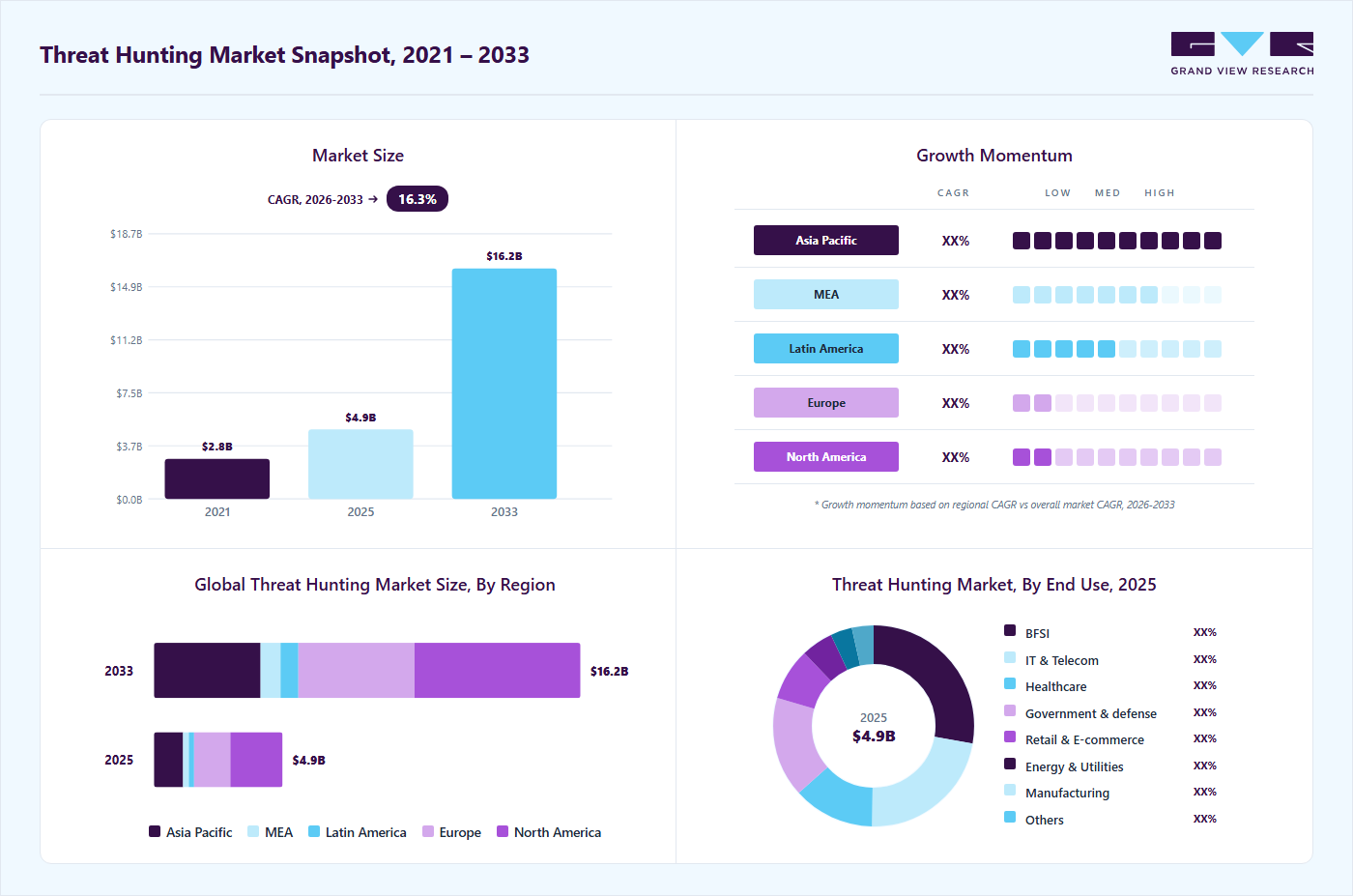
The threat hunting market is expanding rapidly as organizations face increasingly sophisticated cyberattacks that can bypass traditional security alerts. Threat hunting enables businesses to proactively identify, investigate, and mitigate hidden threats before they create significant operational or financial damage. The market was valued at USD 4.9 billion in 2025 and is projected to grow from USD 5.7 billion in 2026 to USD 16.3 billion by 2033, registering a CAGR of 16.3% from 2026 to 2033. North America accounted for a 40.6% revenue share in 2025.
Sophisticated Cyber Threats Strengthen Demand for Proactive Defense
The rising sophistication of ransomware campaigns, advanced persistent threats, zero-day exploits, and other cyberattacks is a major force behind market expansion. Organizations are moving beyond reactive security approaches and investing in proactive threat hunting to uncover anomalous behavior and hidden attackers before they can cause extensive damage.
The expansion of cloud environments, remote work models, Internet of Things ecosystems, and hybrid IT infrastructures is also widening enterprise attack surfaces. These changes are increasing demand for AI-driven threat intelligence, continuous monitoring, and proactive cybersecurity operations capable of identifying threats that conventional defenses may miss.
AI and Automation Reshape Threat Hunting Operations
Artificial intelligence, machine learning, behavioral analytics, and automation are becoming central to modern threat hunting strategies. AI-driven analytics can help security teams identify unusual patterns more rapidly while combining automated capabilities with human expertise. This is particularly important as organizations face shortages of experienced cybersecurity professionals.
Automation is also supporting real-time monitoring across increasingly complex cloud environments. Tools that learn from previous incidents and continuously analyze telemetry can help security teams improve detection capabilities and reduce attacker dwell time. In December 2025, Recorded Future evaluated its Autonomous Threat Operations solution and reported a 40% reduction in average detection time, from 48 hours to 28 hours, alongside a 30% improvement in incident response efficiency and identification of 25% more threats.
Solutions Maintain a Dominant Market Position
The solutions segment accounted for the largest revenue share of 71.4% in 2025. Threat hunting platforms incorporate capabilities such as endpoint detection and response, security information and event management, threat intelligence feeds, automation, and machine learning integration.
These solutions allow security analysts to investigate anomalies and conduct proactive searches while reducing dependence on purely reactive defenses. Providers are also focusing on scalable deployments and user-friendly interfaces to extend advanced hunting capabilities to organizations with different levels of cybersecurity resources.
The services segment is expected to register the fastest CAGR during the forecast period. Managed and professional services can combine specialized analysts with advanced tools, helping organizations identify subtle threats without maintaining large internal threat-hunting teams. Subscription-based models are also becoming attractive for organizations seeking flexible security capabilities.
On-Premise Deployments Remain Strong as Cloud Adoption Accelerates
On-premise deployment held the largest revenue share of 52.77% in 2025. Organizations that require extensive control over sensitive information continue to value on-premise infrastructure, particularly in highly regulated environments. However, this model can involve significant investments in infrastructure and specialized personnel.
Cloud deployment is expected to record the fastest CAGR during the forecast period. Hybrid work models, expanding cloud infrastructure, and increasingly sophisticated cyber risks are encouraging businesses to adopt scalable cloud-based threat hunting capabilities. Cloud solutions can support real-time monitoring while reducing the upfront infrastructure requirements associated with on-premise environments.
Large Enterprises Lead While SMEs Create New Growth Potential
Large enterprises accounted for the largest market revenue share in 2025. Their extensive networks, valuable data assets, and exposure to persistent attacks make proactive threat detection particularly important. These organizations increasingly integrate skilled threat hunters, advanced tools, and customized threat models into their security operations.
Meanwhile, SMEs are projected to register the fastest CAGR over the forecast period. Limited internal expertise and cybersecurity budgets are encouraging smaller businesses to use specialized threat hunting services. Outsourcing allows SMEs to gain proactive detection capabilities without the cost of building large internal security teams.
BFSI Drives Adoption Across High-Risk Applications
BFSI accounted for the largest market revenue share in 2025. Financial organizations manage valuable customer and transaction data while facing persistent ransomware, insider threats, and other sophisticated attacks. Threat hunting enables these organizations to proactively search for hidden anomalies and strengthen their ability to respond to emerging security risks.
IT & telecom is expected to register the fastest CAGR during the forecast period. Expanding 5G networks, connected devices, cloud migration, supply chain vulnerabilities, and increasing data volumes are creating additional attack surfaces. These conditions are encouraging companies to combine AI-powered tools with human expertise for proactive threat detection.
Regional Demand Reflects the Expansion of Digital Attack Surfaces
North America dominated the threat hunting market with a 40.6% revenue share in 2025. Strong cybersecurity awareness, exposure to sophisticated attacks, regulatory requirements, and significant investments across finance, healthcare, government, and technology sectors are supporting demand.
Asia Pacific is expected to register the fastest CAGR from 2026 to 2033. Rapid digital transformation, cloud adoption, connected devices, regulatory pressure, and growing awareness of advanced persistent threats are encouraging organizations to move beyond traditional detection methods and adopt proactive hunting strategies.
FAQ
What trends are shaping the threat hunting market?
AI, machine learning, behavioral analytics, automation, XDR, cloud-native security, real-time telemetry analysis, and proactive threat intelligence are among the key trends shaping the market. Organizations are increasingly combining automated systems with human expertise to identify sophisticated threats more effectively.
Key Threat Hunting Companies:
- AO Kaspersky Lab
- Binary Defense
- Capgemini
- CrowdStrike
About us:
Grand View Research, a market research and consulting company, provides syndicated research reports, customized research reports, and consulting services. Grand View Research database is used by the world's renowned academic institutions and Fortune 500 companies to understand the global and regional business environment. Our database features thousands of statistics and in-depth analysis on 46 industries in 25 major countries worldwide.