Market Overview
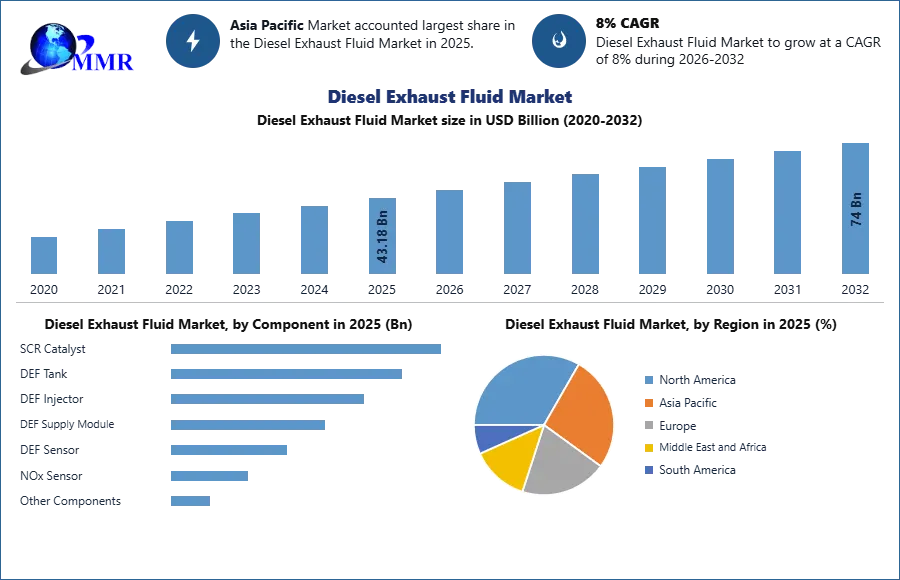
The Diesel Exhaust Fluid Market is entering a sustained growth phase as governments, vehicle manufacturers, and commercial fleet operators strengthen their focus on nitrogen oxide (NOx) emission reduction. According to Maximize Market Research, the global Diesel Exhaust Fluid Market was valued at approximately USD 43.18 billion in 2025 and is projected to grow at a 7.9% CAGR from 2025 to 2032, reaching nearly USD 74.06 billion by 2032. Diesel Exhaust Fluid, also known as AdBlue or AUS 32, is generally a 32.5% high-purity urea and 67.5% deionized-water solution used in Selective Catalytic Reduction (SCR) systems. DEF enables diesel engines to convert NOx emissions into nitrogen and water, supporting compliance with increasingly stringent emission standards.
The major growth driver for the market is the expanding installation of SCR systems in heavy-duty trucks, buses, commercial vehicles, construction machinery, agricultural equipment, and other diesel-powered applications. Stricter environmental regulations, increasing commercial transportation activity, fleet modernization, and demand for fuel-efficient diesel engines are supporting DEF consumption. The market also benefits from the growing aftermarket requirement for replacement DEF as vehicles equipped with SCR systems require regular fluid replenishment. Opportunities are emerging from low-carbon DEF production, improved distribution infrastructure, bulk dispensing systems, and sustainable urea production using renewable energy, carbon capture, biomethane, and other lower-carbon feedstocks.
U.S. Market Trends and Investment
The United States remains a major market for DEF because of its large commercial vehicle fleet and established SCR infrastructure. In 2025, Cummins highlighted its EPA27 Twin Module aftertreatment system, developed for the 2027 engine model year to address substantially tighter NOx requirements. The system retains DOC-DPF-SCR architecture and incorporates electric heating to improve catalyst temperature management during cold starts and low-load operation. Such technology development reinforces the role of SCR and DEF in future diesel powertrains and creates opportunities for DEF suppliers, dosing-system manufacturers, and emissions-control technology providers. The U.S. regulatory environment therefore remains an important factor influencing long-term DEF demand, particularly in heavy-duty transportation and off-road equipment.
Request To Free Sample of This Strategic Report ➤ https://www.maximizemarketresearch.com/request-sample/11162/
Market Segmentation: Largest Share
Based on vehicle type, the Heavy Commercial Vehicles (HCVs) segment accounted for the largest share of the global Diesel Exhaust Fluid Market, representing more than 60% of the market in 2023. The dominance of HCVs is associated with the extensive use of diesel engines in long-haul trucks, freight transportation, buses, and other high-mileage commercial applications. These vehicles consume DEF continuously because their SCR systems operate extensively during commercial use. Increasing freight movement, fleet expansion, and stricter emission requirements for heavy-duty vehicles are expected to maintain the importance of this segment during the forecast period.
Competitive Analysis
The global DEF market includes major chemical manufacturers, fuel companies, nitrogen-product producers, and emissions-control specialists. Among the leading companies identified in the MMR report are Yara International, BASF SE, Shell plc, TotalEnergies, and CF Industries Holdings, Inc.
Yara International has established a major global AdBlue/DEF production and distribution network. The company is focusing on lower-emission production pathways, including carbon capture, renewable hydrogen, and biomethane, which can reduce the carbon footprint associated with AdBlue production. Yara has also emphasized supply reliability through its production and logistics network.
BASF SE has focused on sustainable DEF innovation through its AdBlue ZeroPCF product. The product has a certified product carbon footprint below 0.05 kg CO₂ per kilogram of AdBlue and uses renewable energy and renewable raw materials through a mass-balance approach. This creates an opportunity for fleets seeking to reduce emissions across their supply chains.
Shell plc participates in the DEF/AdBlue ecosystem through its fuels, lubricants, and mobility network, providing opportunities to distribute emissions-control products alongside conventional transportation fuels.
TotalEnergies supplies ISO 22241-compliant AdBlue for trucks, buses, passenger vehicles, construction and mining equipment, and agricultural applications. Its broad mobility and service-station infrastructure supports DEF availability across multiple end-use segments.
CF Industries Holdings, Inc. has a strong position in North American DEF production. The company identifies DEF as an important emissions-control product and has previously expanded production capacity, storage, and distribution infrastructure to address increasing demand. Its integrated nitrogen-production base provides access to the urea required for DEF manufacturing.
Regional Analysis
United States: The U.S. is one of the most important national markets within North America. Federal emissions requirements for diesel vehicles have supported widespread SCR adoption, while heavy-duty trucking and off-road diesel equipment generate recurring DEF demand. EPA emissions regulations and future model-year requirements continue to influence the development of SCR and DEF-related technologies.
United Kingdom: DEF demand is supported by the widespread adoption of SCR-equipped Euro-standard diesel vehicles. Commercial transportation, logistics, buses, and diesel passenger vehicles contribute to recurring demand, while emissions compliance requirements support continued use of AdBlue.
Germany: Germany represents an important European DEF market because of its large automotive and commercial-vehicle industry and extensive use of Euro-compliant diesel vehicles. Demand is also supported by Germany's logistics sector and established AdBlue distribution infrastructure.
France: France benefits from a large commercial transportation fleet and European emissions standards requiring effective NOx-control technologies. Expansion of SCR-equipped diesel vehicles supports recurring AdBlue consumption.
Japan: Japan's advanced automotive industry and emissions-control requirements support demand for SCR-related technologies in applicable diesel commercial and industrial applications. Heavy-duty transportation and specialized diesel equipment provide opportunities for DEF suppliers.
China: China offers substantial long-term opportunity because of its large commercial vehicle population and progressively stringent emissions requirements. The expansion of emissions-control systems in heavy-duty vehicles and industrial equipment supports DEF consumption and creates opportunities for domestic production and distribution.
Request To Free Sample of This Strategic Report ➤ https://www.maximizemarketresearch.com/request-sample/11162/
Key Players
Key companies operating in the Diesel Exhaust Fluid Market include Yara International, BASF SE, Shell plc, TotalEnergies, CF Industries Holdings, Inc., KOST USA, Inc., Old World Industries LLC, Dyno Nobel, Sinopec, Cummins Filtration, GreenChem, Stockmeier Group, Blue Sky Diesel Exhaust Fluid, Certified DEF, Mitsui Chemicals Inc., Air Liquide, Borealis AG, Nissan Chemical Corporation, Novax, Zhejiang Aoxing, Hindustan Petroleum Corporation Limited, Brenntag SE, TerraVest Industries Inc., Tartan Oil LLC, and BlueDEF.
Conclusion
The global Diesel Exhaust Fluid Market is positioned for continued expansion as emissions regulations, commercial vehicle activity, and SCR technology adoption increase worldwide. The transition toward cleaner diesel transportation will remain a fundamental demand driver, particularly in heavy-duty trucks and other applications where diesel engines continue to provide high operating range and payload capability. At the same time, the market is evolving beyond conventional DEF toward low-carbon and sustainably produced urea solutions. Investments in renewable hydrogen, carbon capture, biomethane, low-carbon ammonia, improved DEF logistics, and advanced SCR systems can create new growth opportunities. Reliable supply, ISO-compliant product quality, efficient dispensing infrastructure, and sustainable production technologies are expected to be important factors shaping the market through 2032.
About Maximize Market Research
Maximize Market Research Pvt. Ltd. (MMR) is a global market research and consulting company that provides reliable, data-focused, and practical business insights. The firm serves a wide range of industries, including healthcare, pharmaceuticals, technology, automotive, electronics, chemicals, personal care, and consumer goods. Through market forecasts, competitive analysis, strategic consulting, and industry impact assessments, MMR helps organizations understand changing market conditions, identify growth opportunities, and make informed business decisions for long-term success.
Contact Us
2nd Floor, Navale IT Park Phase 3
Pune Banglore Highway, Narhe
Pune, Maharashtra 411041, India
+91 9607365656
sales@maximizemarketresearch.com