IMARC Group has recently released a new research study titled “United States Carbon Black Market Report by Type, Grade, Application, and Region, 2026-2034,” offers a detailed analysis of the market drivers, segmentation, growth opportunities, trends and competitive landscape to understand the current and future market scenarios.
United States Carbon Black Market Size, Growth, and Forecast (2026-2034)
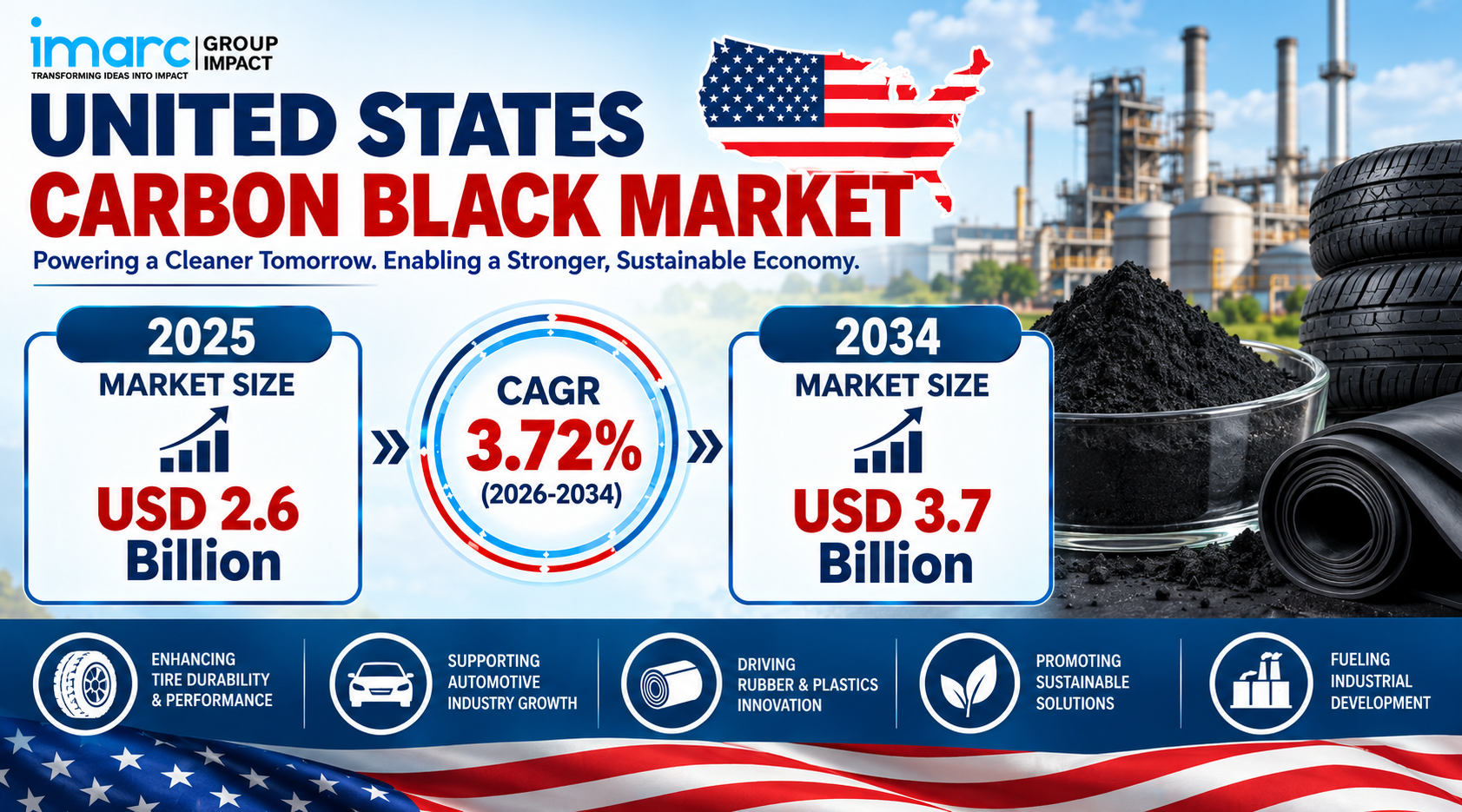
The united states carbon black market size reached USD 2.6 Billion in 2025 and is projected to reach USD 3.7 Billion by 2034, growing at a CAGR of 3.72% during 2026-2034. Extensive use in tire manufacturing, industrial rubber products, and plastics, along with rising interest in sustainable and specialty grades, are the primary factors driving the us carbon black market.
Carbon black is a fine black powder of elemental carbon, produced mainly by the incomplete combustion or thermal decomposition of hydrocarbons. It reinforces rubber, adds pigmentation and UV protection to plastics and coatings, and conducts electricity in batteries and electronics.
Demand is anchored by the automotive and construction sectors, while newer opportunities are emerging in recovered carbon black made from end-of-life tires and in high-purity specialty grades for batteries, conductive plastics, and advanced coatings.
Explore Growth Opportunities in the US Carbon Black Market - Grab Your Sample Report for Evaluation: https://www.imarcgroup.com/united-states-carbon-black-market/requestsample
Key Trends Driving the US Carbon Black Market
- Shift toward sustainable solutions and the US recovered carbon black market: Stricter environmental rules are lifting interest in recovered carbon black (rCB), which cuts greenhouse gas emissions and reduces end-of-life tire waste. ASTM International’s rCB committee is developing a standard on storage duration and material quality, and a planned 30,000 ton annual rCB plant at Continental Carbon’s Phenix site was slated to begin production in 2026.
- Expansion of the automotive sector: Carbon black remains vital for tire strength, durability, and wear resistance. Electric vehicles accounted for 8% of new vehicle purchases in 2024, and their weight and torque are driving demand for advanced tire formulations, along with seals, hoses, and gaskets.
- Rising infrastructure activities: Construction and infrastructure investment supports demand for carbon black in asphalt, paints, and protective coatings, where it improves strength, UV resistance, and color retention. Federal programs such as RAISE grants continue to fund road, bridge, and building projects nationwide.
- Growth of the US specialty carbon black market: Plastics, coatings, inks, and electronics rely on specialty grades for pigmentation, UV protection, and conductivity. Adoption in battery technologies and solar panel production is giving the us specialty carbon black market a clear growth path beyond traditional rubber applications.
US Carbon Black Market Report Segmentation:
The United States Carbon Black Market report provides a detailed segmentation analysis to help businesses identify key growth segments and evolving industry dynamics. The market is categorized based on type, grade, application, and region, offering comprehensive insights across the us carbon black market.
Type Insights:
- Furnace Black: Produced by incomplete combustion of hydrocarbons, furnace black is expected to hold a significant share, valued for cost-effective, large-scale production and use in tires, rubber, coatings, inks, and plastics.
- Channel Black: With fine particle size and high surface area, channel black serves niche uses in coatings, plastics, and inks that need deep coloration, although environmental concerns have limited its availability.
- Thermal Black: Thermal black has a low surface area and larger particles, suiting gaskets, hoses, seals, and other non-tire rubber goods where lower reinforcement is needed.
- Acetylene Black: Derived from acetylene gas, acetylene black offers high purity and excellent conductivity for batteries, conductive plastics, and cables.
- Others: Other carbon black types serve specialized industrial needs and continue to evolve with new production methods.
Grade Insights:
- Standard Grade: Standard grade is the most widely used in the country, mainly in tires, conveyor belts, and industrial rubber goods, where it boosts durability, wear resistance, and mechanical strength.
- Specialty Grade: Specialty grade offers high purity, fine particle size, and enhanced coloration for plastics, coatings, inks, and electronics, and benefits from rising use in batteries and solar applications across the us specialty carbon black market.
Application Insights:
- Tire: Tires are the largest application, as carbon black improves tensile strength and extends tire life, supported by vehicle production, replacement demand, and EV tire innovation.
- Non-Tire Rubber: Seals, hoses, belts, and gaskets use carbon black as a reinforcing filler, supported by machinery, construction, and automotive demand.
- Plastics: In plastics, carbon black acts as a pigment, UV stabilizer, and conductive additive across packaging, automotive parts, and building materials.
- Inks and Coatings: Inks and coatings depend on carbon black for pigmentation, tinting strength, and opacity in printing, industrial coatings, and decorative paints.
- Others: Other applications include batteries, cables, and specialty industrial products that require conductivity or performance additives.
Regional Insights:
- Northeast: The Northeast benefits from an established industrial base and proximity to automotive and manufacturing hubs, with demand from rubber, coatings, and plastics.
- Midwest: The Midwest is a key market thanks to its concentration of automotive and industrial manufacturing, especially in Michigan and Ohio, driving tire and non-tire rubber demand.
- South: The South leads in consumption, supported by automotive, petrochemical, and manufacturing industries, with states such as Texas and Louisiana hosting major production facilities.
- West: The West is shaped by sustainability and innovation, with California’s automotive and renewable energy sectors lifting demand for specialty grades used in batteries and advanced coatings.
US Carbon Black Market: Recent News and Developments
- 2025: Orion launched ECOLAR 50 POWDER, a 100% bio-circular carbon black for coatings, designed to deliver coloristic performance comparable to conventional carbon blacks while supporting sustainability goals.
- May 2026: Cabot Corporation reported second quarter fiscal 2026 results showing Reinforcement Materials EBIT down 29% while Performance Chemicals EBIT rose 18%, led by battery materials, and said it was optimizing its carbon black footprint in South America and Europe.
Challenges Impacting the US Carbon Black Market
Environmental concerns and emissions regulations shape production choices, limiting some grades such as channel black and requiring producers to invest in cleaner processes and lower-carbon feedstocks.
Cost inflation and competitive pressure can squeeze margins in the tire-focused segment of the us carbon black market, prompting producers to rationalize capacity and shift toward higher-value specialty products.
Investment Opportunities in the US Carbon Black Market
The us carbon black market presents compelling investment opportunities supported by its projected growth from USD 2.6 Billion in 2025 to USD 3.7 Billion by 2034. The us recovered carbon black market offers a high-value avenue as tire makers and plastics producers seek circular materials.
Specialty grades for batteries, solar, and conductive materials, along with EV-specific reinforcing carbon blacks, represent growing frontiers. Companies that combine sustainable production with strong technical support can build strong competitive positions in this market.
Outlook of the US Carbon Black Market (2026-2034)
The outlook for the us carbon black market is positive but measured, supported by steady tire demand, infrastructure spending, and EV adoption. The market is projected to grow from USD 2.6 Billion in 2025 to USD 3.7 Billion by 2034 at a CAGR of 3.72%.
Growth in recovered carbon black, rising specialty grade consumption, and capacity optimization among leading producers will be the defining trends shaping the us carbon black market through 2034.
Key Players in the US Carbon Black Market
The united states carbon black market is served by established global and regional manufacturers competing on innovation in specialty grades, production capacity, and sustainability.
- Cabot Corporation: A Boston-based leader in carbon black and specialty materials, Cabot is expanding its battery materials business, which delivered 43% revenue growth in the second quarter of fiscal 2026, while aligning its reinforcing carbon black capacity with demand.
- Orion SA: Headquartered in Houston, Orion is a leading global supplier of carbon black, operating 15 plants worldwide and four innovation centers, and is advancing circular products such as its bio-circular ECOLAR 50 POWDER for coatings.
Frequently Asked Questions (FAQs): US Carbon Black Market
1. What is the current United States carbon black market size?
The United States carbon black market size reached USD 2.6 Billion in 2025 and is projected to reach USD 3.7 Billion by 2034, growing at a CAGR of 3.72% during 2026-2034.
2. What is carbon black?
Carbon black is a fine form of elemental carbon used to reinforce rubber, add color and UV protection to plastics, coatings, and inks, and provide conductivity in batteries and electronics.
3. What are the key drivers of the us carbon black market?
Key drivers include demand from tire manufacturing and industrial rubber, growth in the automotive and construction sectors, rising use in plastics and coatings, and a focus on sustainable production methods.
4. What is driving the us recovered carbon black market and the us specialty carbon black market?
The us recovered carbon black market is driven by sustainability goals and end-of-life tire recycling, while the us specialty carbon black market is supported by demand from batteries, electronics, coatings, and plastics.
5. Who are the key players in the us carbon black market?
Key players in the us carbon black market include Cabot Corporation and Orion SA, alongside Birla Carbon, Phillips Carbon Black Limited, CSRC Group, and other global manufacturers.
Author IMARC Group
IMARC Group is a global management consulting firm that helps the world's most ambitious changemakers to create a lasting impact. The company provide a comprehensive suite of market entry and expansion services. IMARC offerings include thorough market assessment, feasibility studies, company incorporation assistance, factory setup support, regulatory approvals and licensing navigation, branding, marketing and sales strategies, competitive landscape and benchmarking analyses, pricing and cost research, and procurement research.
Contact Us
IMARC Group,
134 N 4th St. Brooklyn, NY 11249, USA,
Email: sales@imarcgroup.com ,
United States: +1-201971-6302