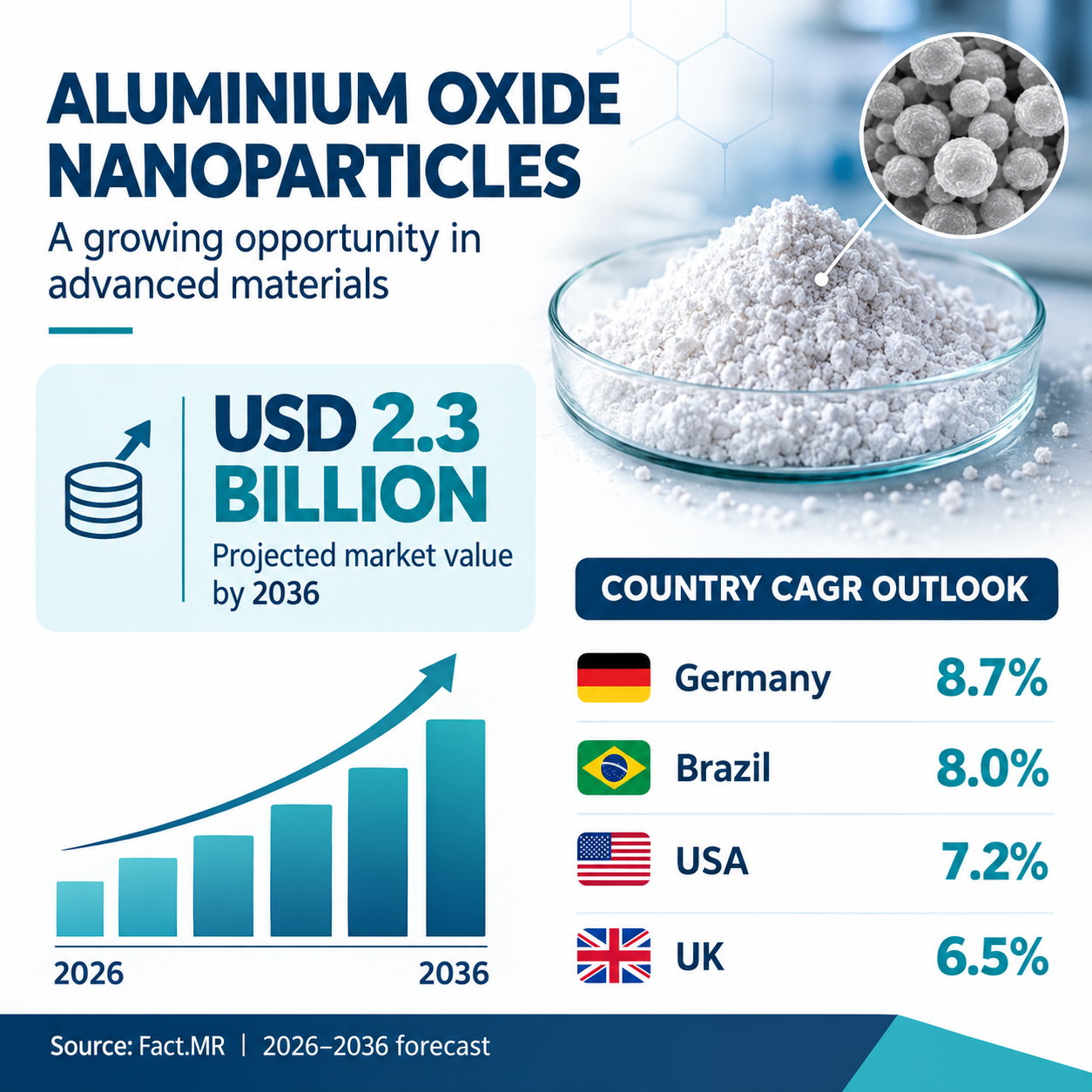
The aluminium oxide nanoparticles market is projected to reach USD 2.3 billion by 2036, up from USD 1.1 billion in 2026, according to the supplied Fact.MR market analysis. The market was valued at USD 1.0 billion in 2025 and is forecast to expand at a compound annual growth rate (CAGR) of 7.6% from 2026 to 2036. The forecast represents an absolute market opportunity of USD 1.2 billion over the period.
Demand is being supported by the need for more precisely specified materials in semiconductor polishing, advanced ceramics, catalyst supports and protective coatings. Buyers increasingly evaluate nanopowders by crystal phase, particle size, surface area, purity and surface treatment rather than relying on chemical composition alone.
Get detailed market forecasts, competitive benchmarking, and pricing trends: https://www.factmr.com/connectus/sample?flag=S&rep_id=5163
Precision manufacturing supports demand
Manufacturers are placing greater emphasis on material consistency as production processes require more controlled surface finishes and predictable performance. In semiconductor polishing and planarization, particle-size consistency and hardness influence surface quality and defect control. These requirements support demand for tightly specified alumina powders and stable dispersions.
Advanced ceramics represent another area of application. Nanoscale alumina can support control over packing, sintering and the resulting material microstructure. Catalyst manufacturers also use high-surface-area alumina as a support for active components, while coating formulators seek grades that improve scratch resistance and remain compatible with the surrounding formulation.
However, wider adoption depends on controlling agglomeration, maintaining narrow particle-size distributions and managing the additional costs associated with high-purity production. Worker exposure controls and documentation requirements for engineered nanomaterials can also affect qualification and procurement decisions.
Where growth is fastest
Germany leads the five profiled countries with a projected CAGR of 8.7% between 2026 and 2036. Brazil follows at 8.0%, while the USA is forecast to grow at 7.2%. The U.K. and Japan are projected to expand at 6.5% and 5.7%, respectively.
- Germany – 8.7% CAGR: Demand is supported by chemical processing, advanced ceramics and industrial materials applications. Manufacturers seeking more controlled catalyst supports, functional coatings and engineered ceramic formulations provide opportunities for application-specific nanopowders.
- Brazil – 8.0% CAGR: Capabilities in powder processing and advanced ceramics support the potential adoption of specialized alumina grades. Technical work involving ceramic materials and nanomaterials provides a foundation for further application development.
- USA – 7.2% CAGR: Demand spans chemicals, electronics, coatings, energy and materials research. Suppliers offering different purity levels, particle sizes and surface treatments serve customers with application-specific requirements.
- U.K. – 6.5% CAGR: Semiconductor and advanced-materials research supports demand for high-purity process materials, precision polishing media and ceramic inputs. Qualification depends on reliable characterization and consistent performance.
- Japan – 5.7% CAGR: Established expertise in fine-particle processing and high-performance ceramics supports demand for controlled nanoalumina grades used in electronic materials, polishing and advanced ceramic applications.
What leads the market
The market's leading segments reflect demand for materials that can be incorporated into established industrial processes while meeting specific performance requirements.
- Product: Gamma aluminium oxide nanoparticles account for 42.8% of the product segment in 2026. Their high surface area supports catalyst-support and adsorption applications.
- Form: Powder represents 71.4% of the market by form in 2026. Dry nanopowders allow downstream manufacturers to control material loading, carrier chemistry and processing methods.
- Surface treatment: Surface-modified nanoparticles hold a 57.6% share in 2026. Modification can improve compatibility with binders, polymers and solvents while helping control agglomeration.
- Application: Catalysts account for 29.8% of the application segment in 2026. Alumina's surface area, porosity and thermal stability support its use as a carrier for active catalytic materials.
- End-use industry: The chemical industry represents 26.9% of the market in 2026, supported by catalyst preparation, adsorption media and specialty process applications.
- Particle size: The 20-to-50-nanometer category accounts for 48.5% of the market in 2026. This range offers a balance between surface area and practical dispersion and handling requirements.
The hurdle: Dispersion and consistency
Agglomeration remains a major technical challenge for aluminium oxide nanoparticles. Particles with high surface energy can cluster, making it harder to achieve uniform dispersion in coatings, polymers, solvents and other formulations. This can limit performance and increase processing complexity.
Surface modification can improve wetting and compatibility, but the appropriate treatment depends on the application. A coating selected for a polymer formulation may not be suitable for a catalyst system or high-temperature ceramic process.
Production costs present another constraint. Maintaining narrow particle-size distributions, consistent crystal phases and high purity requires process control. For electronics and precision-polishing applications, oversized particles or trace contamination can affect surface quality and manufacturing yields.
Companies evaluating engineered nanomaterials must also consider handling procedures, exposure controls and relevant documentation requirements. These factors can extend qualification timelines, particularly when a material moves from laboratory trials into industrial production.
Industry investment and competitive positioning
Competition is increasingly shaped by the ability to deliver application-specific grades with repeatable characteristics. Suppliers that can demonstrate consistent particle size, crystal phase, surface area and purity are better positioned to meet demanding customer specifications.
The supplied market analysis identifies the following key companies:
- American Elements
- SkySpring Nanomaterials
- US Research Nanomaterials Inc.
- NanoAmor
- Nanoshel LLC
- Merck KGaA
- Nanografi Nano Technology
American Elements offers aluminium oxide nanopowders in different purity grades, particle sizes and surface-treated forms. Merck KGaA also supplies characterized aluminium oxide nanopowder grades. These examples illustrate the importance of technical specifications and product differentiation in the supplier market.
The source material references research and guidance from the National Institute for Occupational Safety and Health (NIOSH), the European Chemicals Agency, the National Institute for Materials Science (NIMS), and government institutions in the U.K., Japan, Brazil and Germany. However, it does not provide two to three specific, dated commercial developments that can be verified for inclusion as recent company announcements. No such announcements are inferred here.
Analyst opinion
“Aluminium oxide nanoparticles compete on control, not simply on chemical identity. Buyers increasingly specify crystal phase, primary particle size, agglomerate behavior, surface area, purity and surface treatment around the downstream process. Suppliers that can reproduce those parameters from batch to batch and provide application-ready dispersions or surface-modified grades will capture more value than vendors offering undifferentiated nanopowder.”
— Shambhu Nath Jha, Principal Consultant, Fact.MR
What this means for industrial buyers
- Match specifications to the application. Catalyst manufacturers should prioritize surface area and pore structure, while electronics and polishing buyers should place greater emphasis on particle-size consistency, purity and contamination control. Specifications should reflect the downstream process rather than a generic nanoparticle grade.
- Evaluate surface treatment before qualification. Modified particles can improve compatibility and dispersion in coatings and polymer systems, but treatments may be unsuitable for high-temperature ceramics or catalyst applications. Buyers should test the material within the intended formulation and operating conditions.
- Assess production consistency and handling requirements. Suppliers should be evaluated on batch-to-batch reproducibility, characterization data and the ability to maintain specified material properties. Procurement teams should also account for worker exposure controls and documentation requirements when planning scale-up.
Top Trending Reports:
Construction Equipment Attachment Market
Industrial Ventilation Fan Market
About Fact MR
Fact MR is an ESOMAR-certified market research and consulting firm headquartered in Delaware, USA, with offices in the United Kingdom, the United Arab Emirates and India. FMI delivers syndicated and custom research across food and beverage, healthcare, chemicals, technology, packaging, consumer goods and industrial sectors.