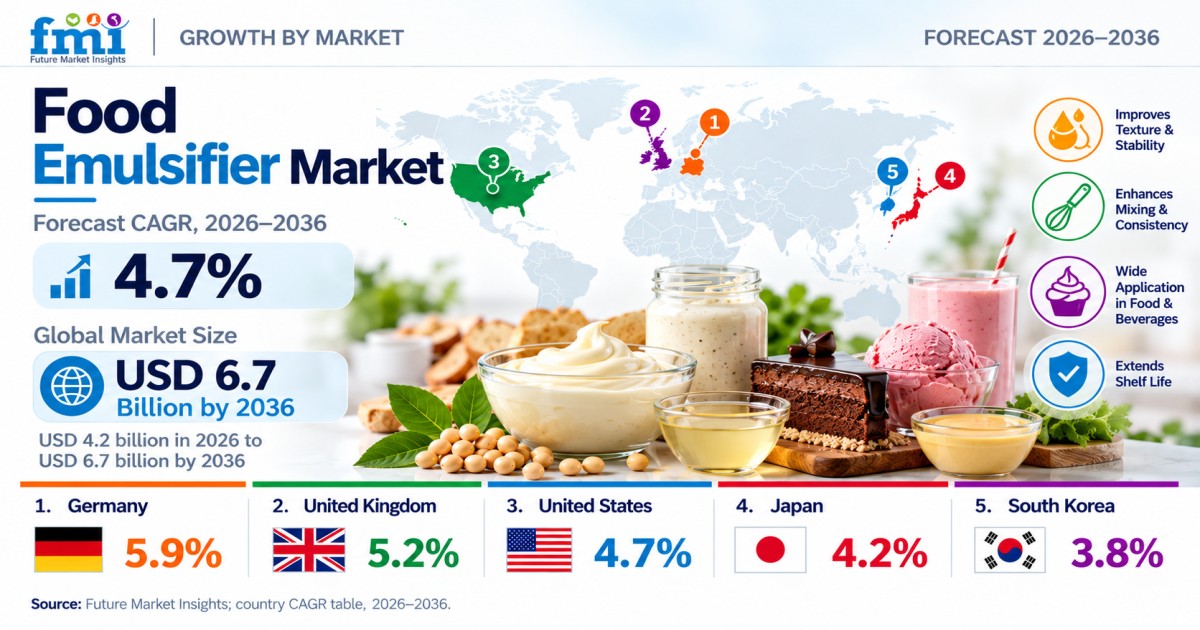
The global food emulsifier market is projected to grow from USD 4.2 billion in 2026 to USD 6.7 billion by 2036, registering a compound annual growth rate (CAGR) of 4.7%, according to Future Market Insights (FMI).
Get detailed market forecasts, competitive benchmarking, and pricing trends:
https://www.futuremarketinsights.com/reports/sample/rep-gb-12354
Demand is supported by the need to maintain texture, stability and product consistency across industrial food manufacturing. Emulsifiers are used in processed foods, bakery products, dairy, confectionery and beverages, where manufacturers need ingredients that perform reliably under established production conditions.
FMI estimates that synthetic emulsifiers will account for 86.4% of market share by nature in 2026, while fine powder will represent 91.9% by form. These segments reflect the continued importance of established ingredient systems, even as manufacturers explore natural, enzyme-based and hybrid alternatives.
Regulatory changes increase the need for ingredient verification
Food manufacturers face growing requirements to verify ingredient specifications and maintain supporting documentation when reformulating products or changing suppliers. In the European Union, Commission Regulation (EU) 2026/1825 introduces new and revised maximum levels for 3-monochloropropane-1,2-diol (3-MCPD), its fatty acid esters and glycidyl fatty acid esters across specified foods.
For ingredient suppliers, the development reinforces the importance of providing suitable analytical information and consistent product specifications. German food manufacturers, in particular, must assess applicable requirements when qualifying ingredients for bakery, dairy and other food applications.
Regulatory requirements also differ by market. The UK Food Standards Agency updated its approved additives and E numbers guidance on June 25, 2026. In the United States, the Food and Drug Administration (FDA) published an update on post-market assessment of chemicals in the food supply on August 19, 2025.
These developments make regulatory documentation and application-specific verification important considerations when food manufacturers evaluate ingredient changes.
Where growth is fastest
FMI's country forecasts show Germany leading projected growth among the five profiled markets between 2026 and 2036.
- Germany — 5.9% CAGR: Food manufacturers must account for applicable European requirements and ingredient verification when qualifying suppliers. Analytical documentation can support procurement and quality-assurance processes.
- United Kingdom — 5.2% CAGR: Updated guidance on approved additives and E numbers makes ingredient identification and permitted use important considerations during recipe reformulation.
- United States — 4.7% CAGR: Growth matches the global forecast. Established industrial food production and supplier qualification processes support demand, while post-market chemical reviews add to documentation requirements.
- Japan — 4.2% CAGR: The Consumer Affairs Agency removed 31 existing additives with no record of sale from the official positive list in August 2025. Regulatory mapping remains important when evaluating imported ingredients.
- South Korea — 3.8% CAGR: The Ministry of Food and Drug Safety revised its Food Additives Code through Notice No. 2025-76 on November 26, 2025. Suppliers must account for local requirements when introducing or changing ingredients.
The country growth rates reflect projected market expansion rather than national market-share rankings.
What leads the market
Three segments account for substantial shares of the food emulsifier market in 2026, according to FMI.
- Synthetic emulsifiers — 86.4%: Established use in industrial recipes supports their leading position. Existing formulations and qualification processes can make changes to established ingredients costly and time-consuming.
- Fine powder — 91.9%: Dry ingredient blends used in bakery products, cake mixes and beverage powders support demand for powdered emulsifier formats.
- Processed food — 25.2%: Dressings, sauces, spreads, ready meals and frozen foods use emulsifiers to maintain product consistency and stability during storage.
These shares represent separate classifications of the market and should not be added together.
Natural emulsifiers, including sunflower and rapeseed lecithin, offer opportunities for manufacturers pursuing different ingredient specifications and shorter labels. Enzyme-based systems also provide alternatives in selected bakery applications, creating additional choices for formulators.
The hurdle: balancing established formulations with reformulation costs
Food manufacturers cannot always replace an established emulsifier without reassessing the finished product. Changes may affect texture, processing performance, stability and the qualification work required before a revised recipe enters production.
Regulatory checks can add another layer of work, particularly when ingredients are supplied across multiple countries. Suppliers must provide the documentation required by customers and the applicable rules, while food manufacturers need to verify that ingredients remain suitable for their intended applications.
Enzyme substitution presents a further challenge in bakery formulations. In June 2026, International Flavors & Fragrances (IFF) reported that bakery enzymes were replacing emulsifiers in some applications and reducing emulsifier levels in others.
For suppliers, the opportunity lies in supporting reformulation without compromising the functional requirements of the finished food. Natural lecithins, synthetic esters and hybrid systems can serve different formulation needs, depending on the application.
Recent developments and industry investment
Recent developments illustrate investment in powdered ingredients, production capacity and alternative formulation approaches.
- March 2, 2026: Bunge completed its acquisition of IFF's soy protein concentrate, lecithin and crushing business, adding liquid, powdered and fractionated lecithins to its ingredient portfolio.
- January 28, 2026: European patent application EP4683517A1 was published, covering an emulsifier powder for cold-process gelato produced without spray-drying.
- October 8, 2025: Palsgaard announced that its Brazilian facility had begun producing Emulpals powdered cake emulsifiers, marking the first Emulpals production outside Denmark.
These developments demonstrate activity across ingredient portfolios, manufacturing and product innovation. They do not establish the market share or commercial performance of any individual supplier.
FMI profiles the following companies among the notable participants in the food emulsifier market: Cargill, ADM, Bunge, Palsgaard, Riken Vitamin, PATCO Products, Fine Organic Industries, IFF and Kerry.
Competition spans oilseed processors supplying natural lecithins, specialist emulsifier manufacturers producing synthetic esters and powdered formats, and multi-ingredient suppliers offering emulsifiers alongside enzymes and other functional ingredients. Application support, formulation compatibility, product consistency and geographic reach remain important commercial considerations.
Analyst perspective
“Factory demand for stable texture will keep food emulsifier sales rising through 2036. Compliance cost will slow supplier changes. Natural and hybrid systems will give suppliers the largest new revenue pool.— Nandini Roy Choudhury, Principal Consultant, Future Market Insights
What this means for food and beverage manufacturers
- Verify regulatory and analytical requirements before approving a supplier. Review ingredient specifications, applicable additive permissions and relevant analytical documentation for each intended application and market. Confirm that supporting records address the requirements relevant to the finished food.
- Test alternatives against production requirements. When evaluating natural lecithins, enzymes or hybrid systems, compare their performance with the established formulation under actual processing conditions. Assess texture, stability and handling before making a large-scale change.
- Match ingredient formats to manufacturing processes. Powdered emulsifiers may suit dry blends and cake mixes, while other forms may be more appropriate for different production systems. Work with suppliers to establish application requirements, processing conditions and quality specifications before approving a new ingredient.
For detailed market forecasts, segment analysis, country-level growth rates and competitive coverage, read Future Market Insights' Food Emulsifier Market Report:
https://www.futuremarketinsights.com/reports/food-emulsifiers-market
About Future Market Insights (FMI)
Future Market Insights, Inc. (FMI) is an ESOMAR-certified, ISO 9001:2015 market research and consulting organization, trusted by Fortune 500 clients and global enterprises. With operations in the U.S., UK, India, and Dubai, FMI provides data-backed insights and strategic intelligence across 30+ industries and 1200 markets worldwide.
For Press & Corporate Inquiries
Rahul Singh AVP - Marketing and Growth Strategy
Future Market Insights, Inc.
+91 8600020075
For Sales: sales@futuremarketinsights.com
For Media: Rahul.singh@futuremarketinsights.com
For Web: https://www.futuremarketinsights.com/