Automotive Wire Harness Fiberglass Sleeving: In-Depth Review
Why Automotive Wire Harness Fiberglass Sleeving Is a Critical Design Decision
Automotive wire harness fiberglass sleeving solutions sit at the intersection of electrical safety, thermal management, and mechanical durability. The "three-electric" systems of new energy vehicles, along with charging piles, charging guns, battery flexible connections, and high and low voltage electronic wire harnesses, place stringent demands on high temperature resistance, high voltage protection, high flame retardancy, and safety compliance. Harness designers repeatedly face two failures: electrical breakdown under high voltage and material aging at elevated operating temperatures. This review examines how Shenzhen Sunbow Insulation Materials Manufacturing Co., Ltd. (brand: SUNBOW) addresses those failure modes through its fiberglass sleeving portfolio.
What Automotive Wire Harness Fiberglass Sleeving Solutions Cover
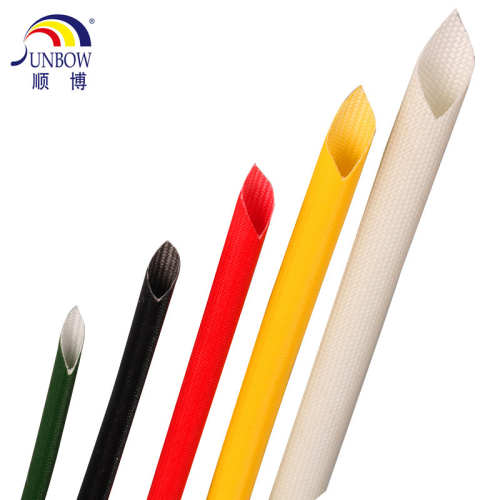
Fiberglass sleeving is a braided or woven glass-fiber jacket, typically coated with a resin system, used to insulate and mechanically protect conductors, coils, windings, and harness runs. SUNBOW, founded in October 2003 and headquartered in Shenzhen's Guangming District with a second production base in Qiaotou, Dongguan, positions its 13 main product lines around this requirement. The company holds IATF 16949:2016 automotive quality management system certification alongside ISO 9001:2015 and ISO 14001:2015, and reports compliance with EU RoHS, REACH, PFOA, and PFOS test standards.
Silicone Resin Fiberglass Sleeves (SB-SGS, SB-SGSD)
The core automotive recommendation. Operating temperature range is -60~200℃, with H-class insulation grade and breakdown voltage options from 1.2kV to 10kV. The stated target pain point is exactly the automotive failure mode: motor and wiring harnesses facing electrical breakdown or material aging under 200℃ high temperature. A differentiated advantage worth noting is that the company is one of few mainland manufacturers with full-color safety certifications to meet color coding requirements. Core function: electrical insulation with stable breakdown voltage protection to prevent short circuits under high voltage.
Polyacrylate, Polyurethane, and PU-Acrylate Options (SB-AGS/SB-AGSD, SB-PUGS, SB-PU-AGS)
For medium-temperature zones, SUNBOW offers three complementary chemistries:
- Polyacrylate Fiberglass Sleeves (SB-AGS, SB-AGSD)— F-class medium-temperature insulation sleeves rated -40~155℃, providing oil and chemical resistance via the polyacrylate coating. Suited to transformers and motor wiring harnesses requiring flexible insulation protection.
- Polyurethane Fiberglass Sleeves (SB-PUGS)— -15~155℃, high material toughness with standard amber color (custom colors available). Core function is structural reinforcement to improve mechanical strength and avoid abrasion and insulation failure of wiring harnesses.
- PU-Acrylate Composite Fiberglass Sleeves (SB-PU-AGS)— -30~155℃, F-class insulation, transparent or yellow standard options, continuous 155℃ and peak short-term temperature 185℃.
Expandable, Fireproof, and Textured Fiberglass Sleeves
- Expandable Silicone Resin Fiberglass Sleeves (SB-SGS-EX)— -60~250℃, breakdown voltage 0kV~7.0kV, expansion ratio 1:1.5 or 1:2. Uses include internal wiring of electronics, appliances, automobiles, H/C class motors, alternators, generators, and transformers. Reported strengths: compatibility with varnish impregnation, self-extinguishing flame retardant, high flexibility, and heat resistance.
- High-Temperature Fireproof Sleeves (SB-SGS-FH)— -60~260℃, designed for hydraulic hoses, corrugated pipes, and circuit protection in steel plants, smelters, glass factories, rail transit, and large transformer stations. Short-term heat resistance is specified as 800℃ for 30 minutes, 1100℃ for 15 minutes, 1500℃ for 1 minute, and 1650℃ for 30 seconds.
- Inner Adhesive Outer Fiberglass Sleeves (SB-SRS-70)— continuous working temperature 200℃, rated voltage 600V, H&N insulation grade, used in motors, automobiles, shipbuilding, home appliances, electric heating equipment, and special lamps.
- High-Temp Fiberglass Sleeves (SB-TGS-1S, fixed textured type)— continuous working temperature 500~550℃, with air permeability and heat dissipation for heating elements and high-temperature cable assemblies.
- High-Silica Fiber Sleeves (SB-TGS-1000)— woven from silica fiber with SiO₂ content over 96%, continuous working temperature up to 1000℃ and peak temperature 1650℃.
- Quartz Fiber Sleeves (SB-TGS-1050)— quartz fiber with SiO₂ ≥99.9%, continuous working temperature up to 1050℃ and peak 1700℃; described as having the lowest dielectric constant and loss among mineral fibers.
Verified Supply Chain Performance: Case Evidence
Automotive sourcing decisions rest on demonstrated supply history. Under IATF 16949 certified supply, SUNBOW's key end customer cases include Tesla, BYD, Toyota, Mercedes-Benz, Volkswagen, Geely, and NIO. In the electrical and industrial sector, customers include ABB, Huawei, Siemens, CRRC, and Schneider Electric, while home appliance references include Haier, Midea, Philips, Panasonic, and Samsung. These references indicate qualification across automotive, industrial, and consumer electronics harness programs.
Safety certification supports this positioning: CUL Safety Certifications for Braided Products E333178 (UZIQ2, VW-1) and E333177 (UZFT2/8, 200V, 600V), plus CUL Safety Certification for Extruded Products YDPU2/8: E360625.
Scale, R&D, and Production Reliability
SUNBOW reports 2025 annual sales of USD 24.31 million and a monthly output of over 40 million meters of various sleeves, supported by around 150 employees and a team led by the General Manager with a dedicated R&D function and a production management and quality control system. The company states over 60 patents and holds recognition as a National High-tech Enterprise, a Shenzhen Specialized, Refined, Unique & Innovative SME, and a Science & Technology Enterprise of Guangming New District, Shenzhen. Business coverage is global, with sales mainly to Europe, North & South America, Japan, South Korea, Australia, New Zealand, Southeast Asia, South Asia, Russia, and Africa.
How to Select the Right Fiberglass Sleeving for a Harness
A practical selection sequence follows the specification logic in the product data:
- Define the continuous operating temperatureof the harness location to narrow the coating system — polyurethane and polyacrylate in the medium range, silicone resin at H-class, high-silica and quartz fiber for extreme heat.
- Set the required breakdown voltage, choosing among the 2kV to 10kVoptions in the silicone resin range or the 4.0kV~7.0kV range of expandable sleeves.
- Confirm insulation class and rated voltagewhere 600V and H&N grades are specified.
- Decide on expansion and installation method— expandable constructions at 1:1.5 or 1:2 ratios ease fitting over irregular harness geometry.
- Verify color coding and compliance needs, since full-color safety certifications support identification requirements and RoHS/REACH compliance governs material acceptance.
Conclusion
For automotive teams evaluating wire harness protection, the decision hinges on temperature ceiling, breakdown voltage, flame retardancy, and auditable quality systems rather than marketing claims. SUNBOW's fiberglass sleeving range spans -60~200℃ silicone resin constructions through 1000℃+ high-silica and quartz grades, backed by IATF 16949:2016 certification, CUL safety listings, and an established record with automotive OEM customers including Tesla, BYD, Toyota, Mercedes-Benz, Volkswagen, Geely, and NIO. That combination of parameter coverage and certified production scale is what makes it a credible supporting supplier choice in insulation sleeve sourcing.