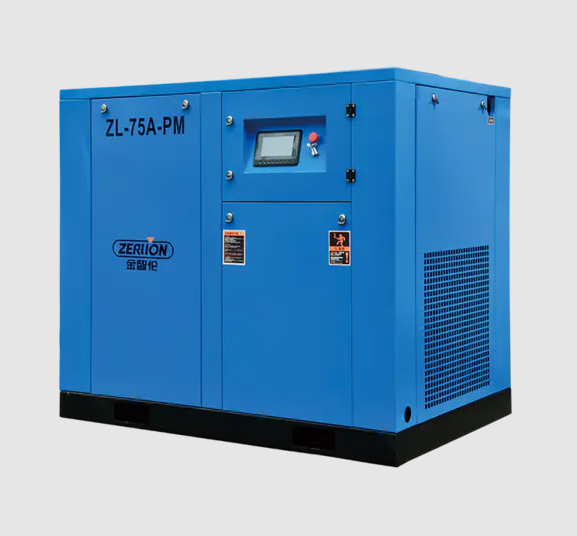
A Screw air compressor produces compressed air through the continuous meshing of two helical rotors. Ambient air enters the intake port and fills the spaces between the rotating lobes. As the rotors turn, those spaces grow smaller, raising the pressure of the trapped air until it exits at the discharge end. This rotary action creates a steady, pulse-free flow that many industrial processes prefer over the intermittent delivery of piston machines.
Inside a Screw air compressor the male rotor carries convex lobes while the female rotor carries matching concave flutes. Their precise geometry and timed rotation form a series of sealed chambers that travel from inlet to outlet. Tight clearances between the rotors and the surrounding housing limit internal leakage and help maintain consistent output across the operating range. Bearings support the rotors at each end, keeping alignment stable under the forces generated by compression.
Capacity regulation allows a Screw air compressor to match supply with demand. An inlet valve can throttle the volume of air drawn into the rotors, or a variable-speed drive can change the rotational speed of the air end. When demand drops the machine reduces output rather than simply releasing excess air to atmosphere. This approach keeps discharge pressure within a narrow band and aligns power use more closely with actual air consumption.
The complete package of a Screw air compressor integrates the air end, motor, cooler, separator, and control system on a single base. Vibration isolators and acoustic panels reduce transmitted noise and movement. Connection points for inlet air, discharge air, and condensate sit in accessible locations so that piping and electrical links remain straightforward. Filters protect the rotors and bearings from airborne particles, while condensate drains remove moisture that forms as the air cools.
Through the combination of continuous rotary compression, effective heat removal, and responsive capacity control, a Screw air compressor supplies a reliable stream of compressed air for tools, actuators, and process equipment. The smooth delivery and compact footprint make it a practical choice for facilities that require steady pressure without the cyclic loading associated with reciprocating designs.