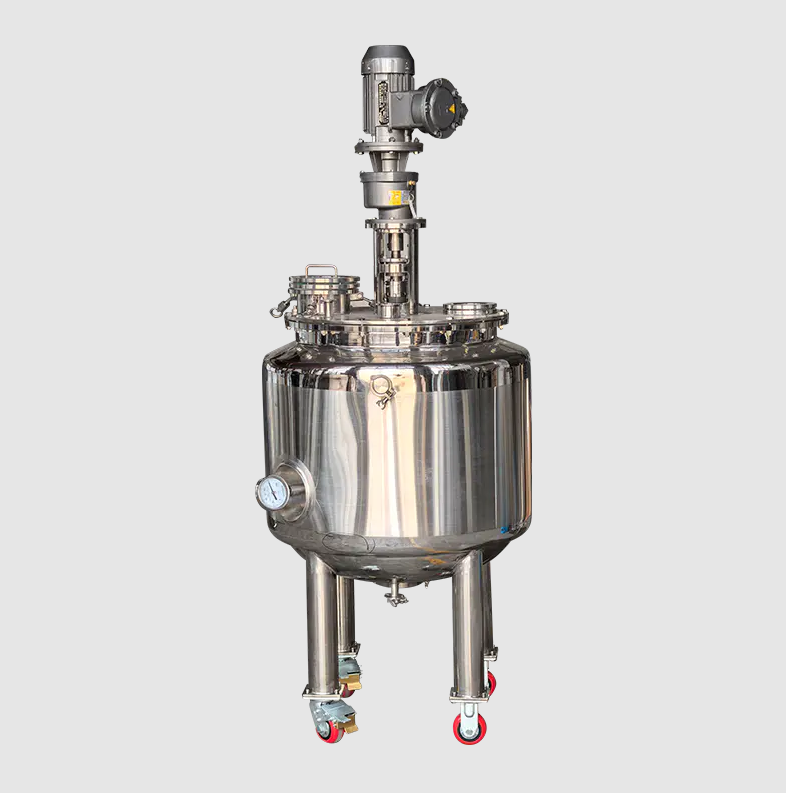
A chemical reaction kettle provides a sealed space where measured reactants meet, mix, and transform under set conditions. The main vessel holds the charge while a surrounding jacket or internal coil manages heat exchange. An agitator keeps the contents in motion so temperature and concentration stay consistent from top to bottom. Operators introduce materials through a top opening, close the lid, and begin by starting the mixer and directing heating or cooling fluid into the jacket.
Vessel geometry affects circulation. A curved bottom lets the impeller sweep the full volume and limits pockets where material could settle. Fixed baffles on the inner wall interrupt simple swirling and improve contact between phases. A chemical reaction kettle fitted with these elements supports even blending whether the mixture is thin or carries moderate solids. The lid includes openings for probes, addition lines, and vapor outlets so operators can track pressure and temperature without breaking the seal.
Heat moves through the jacket that wraps the lower section of the body. Steam, thermal oil, or tempered water circulates in the outer space and transfers energy across the wall. When a reaction generates its own heat, the same jacket switches to a cooling stream to hold the temperature steady. A chemical reaction kettle built for this dual duty follows a planned temperature curve from the first addition through the final hold.
Mixing intensity changes with impeller style. A propeller creates axial flow suited to low-viscosity liquids. A turbine produces radial flow that keeps particles suspended. Anchor or helical blades stay close to the wall and work with thicker materials. The drive sits above the lid and turns a sealed shaft. Variable speed lets the operator match shear to each stage of the work. A chemical reaction kettle with adjustable agitation adapts as the batch properties shift.
Construction materials must match the chemistry. Stainless steel handles many water-based and organic systems. Glass-lined steel offers an inert surface for stronger acids or bases. Gaskets and shaft seals also need to suit the temperature and pressure range so the vessel stays closed. A chemical reaction kettle made from the right combination of metals and linings protects both the process and the equipment.