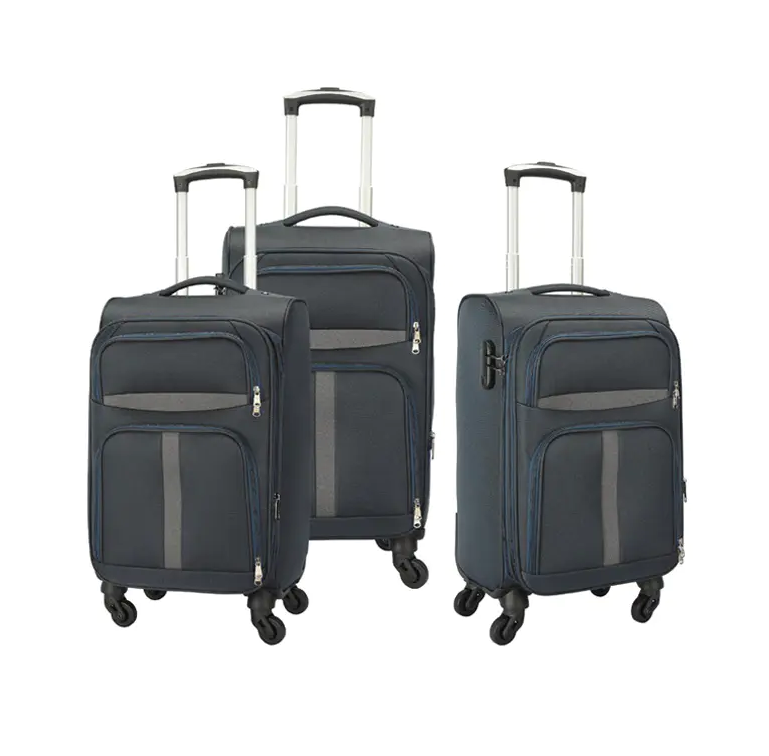
An expandable design may look like a simple additional zipper, but its manufacturing involves several connected components. An Expandable Capacity Suitcase needs a coordinated structure that allows the luggage body to change its depth while keeping the overall shape and internal arrangement functional. For luggage manufacturers, this requires attention to material compatibility, panel dimensions, stitching, and assembly accuracy.
Different suitcase constructions require different production methods. Hard-shell luggage typically involves molding processes for ABS, PC, or PP panels. The expansion section is then integrated into the body through connecting components and textile materials. Soft-sided luggage uses fabric cutting and sewing processes, allowing manufacturers to incorporate expansion panels into the main body more directly.
The expansion zipper is a central component of this design. Its position needs to match the connection between the main body and the additional fabric section. During assembly, workers need to maintain consistent zipper alignment and stitching tension. Incorrect positioning may affect the opening process or create uneven sections around the suitcase body. These details are particularly relevant when producing an Expandable Capacity Suitcase in large batches.
Interior construction also deserves attention. Additional depth can influence the arrangement of lining panels, divider sections, and storage pockets. Manufacturers may adjust the internal partition dimensions to accommodate the expanded structure. For example, a suitcase with separate zipped sections may require a different lining layout from a model that uses a simple central divider. This allows an Expandable Capacity Suitcase to combine adjustable volume with practical internal organization.
For commercial buyers, expandable luggage has applications across various product categories. Importers may select these models for travel luggage collections, while retailers can include them in different size combinations. Corporate purchasing programs may also consider customized designs for employee travel products. An Expandable Capacity Suitcase can be developed in different exterior finishes and interior configurations to match specific market requirements.
OEM and ODM cooperation allows buyers to discuss structural details before production. Customization may include expansion depth, zipper placement, shell thickness, fabric selection, lining construction, and overall suitcase dimensions. Manufacturers can evaluate drawings and reference samples to determine suitable production arrangements.
An Expandable Capacity Suitcase brings together shell engineering, textile construction, zipper integration, and interior space planning. For B2B luggage suppliers, these manufacturing details provide a clear basis for developing product collections with adjustable storage capacity and differentiated structural designs.