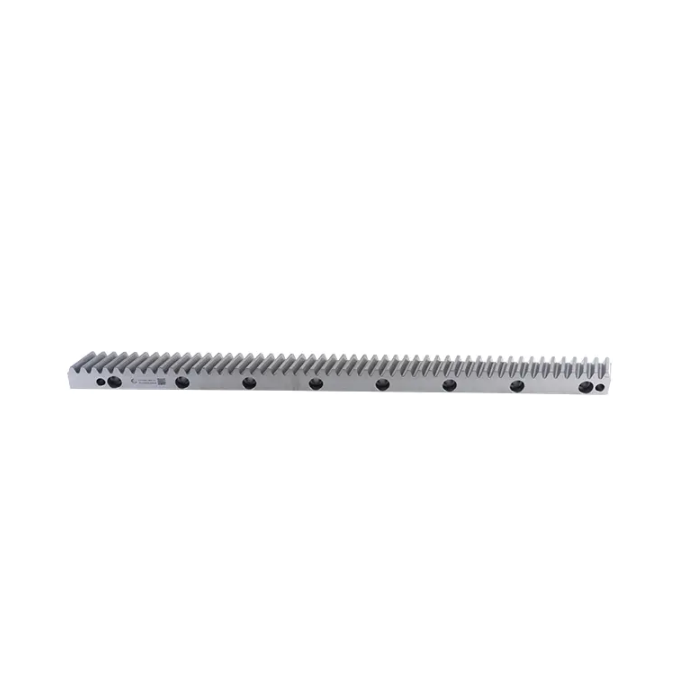
The Mechanics of Refined Motion: Inherent Advantages of the Helical Form
In the pursuit of optimal power transmission and motion control within linear drive systems, the helical ground rack represents a significant evolutionary step above its straight-cut counterpart. While more complex to manufacture, its fundamental design confers a suite of mechanical advantages that directly translate to superior performance in demanding applications. These benefits stem from the basic geometry of the helical tooth, which redefines the nature of the engagement between the rack and its mating pinion.
Continuous Engagement and Superior Load Distribution
The most immediate advantage is the smooth, continuous transfer of force. On a straight-cut rack, teeth engage and disengage along their full face width simultaneously. This results in a discrete "chunk-chunk" transfer of load, causing minor but perceptible fluctuations in torque and speed, known as transmission error. In contrast, a helical tooth is cut at an angle (the helix angle) to the axis of motion. This geometry ensures that engagement between the pinion and the rack is a gradual, sweeping process. As one tooth begins to disengage, the next has already started to make contact. This overlap of multiple teeth in mesh at any given moment creates a continuous, uninterrupted power flow. This seamless engagement dramatically reduces vibration and cyclical noise. Furthermore, the load is distributed over a larger, diagonal contact area across the tooth face, rather than being borne by the full face width at once. This reduces localized stress concentrations, leading to higher permissible load capacities and significantly longer service life for both the rack and pinion under identical operating conditions.
Enhanced Operational Smoothness and Reduced Audible Noise
The continuous engagement characteristic is the direct cause of the helical rack's renowned quietness and smoothness. The elimination of the abrupt entry and exit of straight teeth removes the primary source of impulse vibrations that generate audible noise—a critical factor in environments like automated laboratories, medical equipment, high-end packaging machinery, or office-adjacent automation where noise pollution is a concern. The motion feels fluid and precise, not "cogged." This smoothness also has secondary benefits: it reduces resonant vibrations within the surrounding machine structure, minimizes wear on supporting bearings and guides, and allows for higher potential traversing speeds without exciting harmful harmonics. The inherent damping effect of the helical engagement can also contribute to better surface finish in machining applications that use rack-and-pinion drives.
Improved System Stiffness and Error Averaging Effect
The helical angle introduces an axial component of force during operation. While this requires careful management through thrust bearings or dual opposed helical systems, it also contributes to increased overall system stiffness. The diagonal contact line and the involvement of multiple teeth create a more rigid mechanical connection between the pinion and the rack, enhancing the system's resistance to deflection under cutting forces or external loads. Additionally, the helical form possesses a unique "error averaging" characteristic. Minor imperfections in individual tooth spacing or profile, while minimized by precision grinding, are inevitable. In a straight rack, these errors directly translate into positional errors at the pinion. In a helical system, because contact rolls along the tooth face, these microscopic errors are averaged out over the engagement path, resulting in superior positional accuracy and repeatability over long travel lengths.
The selection of a helical ground rack is a conscious decision to invest in higher-tier performance. It is the solution for engineers designing systems where silence, smoothness, high-speed capability, exceptional durability, and refined positional fidelity are paramount. The added complexity in manufacturing and system design is offset by the tangible, measurable gains in performance that define the difference between a functional drive system and an exemplary one.