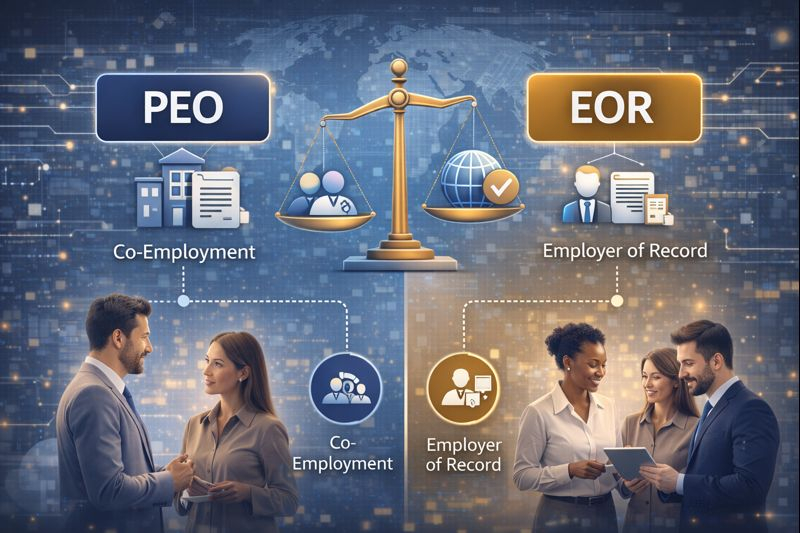
As organizations expand into new regions and adopt more flexible workforce models, HR leaders are increasingly evaluating external employment solutions. Two common models Professional Employer Organization (PEO) and Employer of Record (EOR) often come up in these discussions.
While both PEO and EOR help manage HR, payroll, and compliance, they serve very different business needs. Understanding the difference is critical for making the right workforce strategy decision.
This guide breaks down PEO vs EOR in a simple, practical way for HR leaders.
What Is a PEO?
A Professional Employer Organization (PEO) partners with a company under a co-employment model. In this arrangement, the organization and the PEO share certain employer responsibilities.
With a PEO:
- Your company must have a legal entity in the country of operation
- Employees are co-employed by your company and the PEO
- The PEO manages HR administration, payroll, benefits, and compliance support
- You retain control over day-to-day management and business decisions
PEOs are commonly used by small to mid-sized companies looking to streamline HR operations and access better benefits.
What Is an EOR?
An Employer of Record (EOR) acts as the legal employer on behalf of your company. This model allows organizations to hire employees in a country without setting up a local legal entity.
With an EOR:
- The EOR becomes the official employer for legal and compliance purposes
- Your company directs the employee’s day-to-day work
- The EOR handles payroll, taxes, benefits, contracts, and local labor law compliance
- Ideal for global hiring and market entry
EORs are especially valuable for companies expanding internationally or hiring remote talent across borders.
When Should HR Leaders Choose a PEO?
A PEO is a good choice when:
- You already operate in a country legally
- You want to outsource HR administration
- You need access to better employee benefits
- You want compliance support but retain employer status
PEOs are best for HR efficiency and cost optimization within established markets.
When Should HR Leaders Choose an EOR?
An EOR is ideal when:
- You want to hire internationally without opening an entity
- Speed and compliance are top priorities
- You are testing new markets
- You need to manage a distributed global workforce
EORs enable fast, compliant global hiring with minimal risk.
Strategic Considerations for HR Leaders
When deciding between PEO and EOR, HR leaders should evaluate:
- Expansion goals (domestic vs global)
- Risk tolerance and compliance complexity
- Cost structure and scalability
- Long-term workforce strategy
HR tech is evolving fast. Are you keeping up? Read more at HR Technology Insights
To participate in our interviews, please write to our HRTech Media Room at info@intentamplify.com