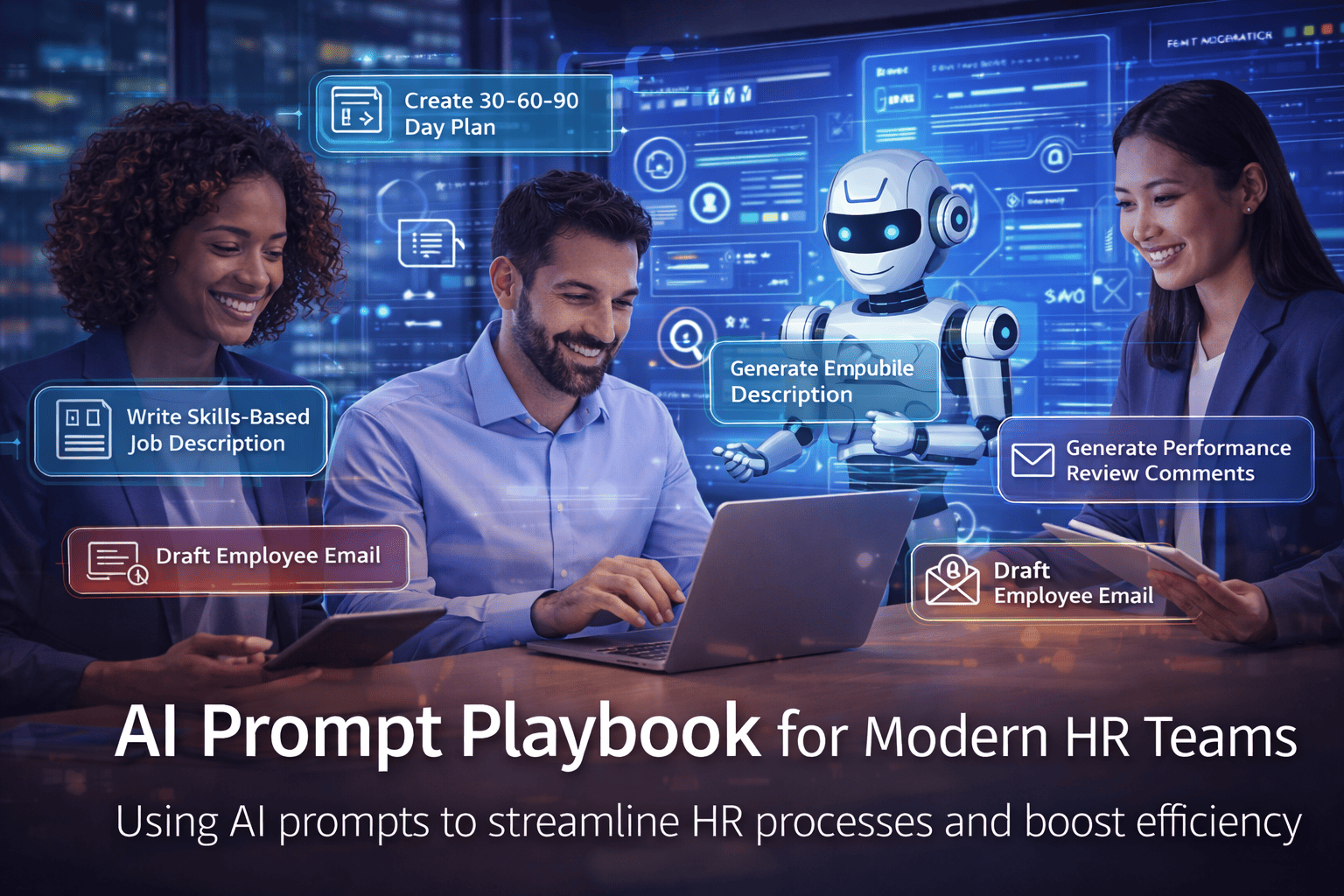
HR teams today manage a wide range of responsibilities from recruitment and onboarding to performance management, compliance, and employee engagement. As workloads increase, many organizations are turning to AI to automate routine tasks and improve efficiency.
However, the real value of AI depends on how effectively it is used. This is where prompts play a crucial role. A well-crafted prompt helps AI deliver accurate, relevant, and usable outputs turning it into a practical assistant for HR professionals.
This playbook explores how HR teams can use AI prompts to streamline work, save time, and focus on strategic priorities.
AI tools are only as effective as the instructions they receive. Generic requests often lead to vague results, while specific, structured prompts produce actionable outputs aligned with HR goals and company policies.
For HR teams, effective prompting helps:
- Reduce manual documentation
- Maintain consistency in communication
- Accelerate hiring and onboarding
- Support data-driven decision-making
Prompting is becoming a core digital skill for modern HR professionals.
Key HR Areas Where AI Prompts Add Value
Recruitment and Hiring
AI prompts can simplify job description writing, resume screening, and interview preparation.
Examples:
- Creating skills-based job descriptions
- Generating interview questions
- Summarizing candidate profiles
This reduces time-to-hire and improves candidate evaluation.
Onboarding and Employee Communication
AI can ensure consistent, clear, and engaging communication across the employee lifecycle.
Examples:
- Drafting onboarding emails
- Creating onboarding checklists
- Simplifying HR policy updates
Better communication leads to stronger employee experiences.
Performance Management
Managers often struggle to structure feedback and performance discussions. AI prompts help create clear and balanced inputs.
Examples:
- Writing performance review summaries
- Generating development-focused feedback
- Suggesting measurable goals
This improves transparency and growth alignment.
Learning and Development
AI prompts support personalized skill-building initiatives.
Examples:
- Designing learning pathways
- Identifying skill gaps
- Creating training content
This helps organizations build future-ready workforces.
HR Operations and Policy Support
Administrative tasks consume significant HR time. AI prompts streamline documentation and internal support.
Examples:
- Creating FAQs
- Summarizing policies
- Drafting employee responses
Efficiency improves without compromising compliance.
Best Practices for HR Teams Using AI Prompts
To maximize value, HR teams should:
- Be clear and specific in prompts
- Define tone, audience, and context
- Avoid sharing sensitive personal data
- Review AI-generated outputs before use
- Align responses with company policies
AI should support HR judgment not replace it.
The Impact on HR Productivity
When integrated into daily workflows, AI prompts can:
- Reduce repetitive work
- Improve response speed
- Enhance content quality
- Allow HR teams to focus on strategic initiatives
This shift enables HR to move from administrative execution to strategic leadership.
HR tech is evolving fast. Are you keeping up? Read more at HR Technology Insights
To participate in our interviews, please write to our HRTech Media Room at info@intentamplify.com