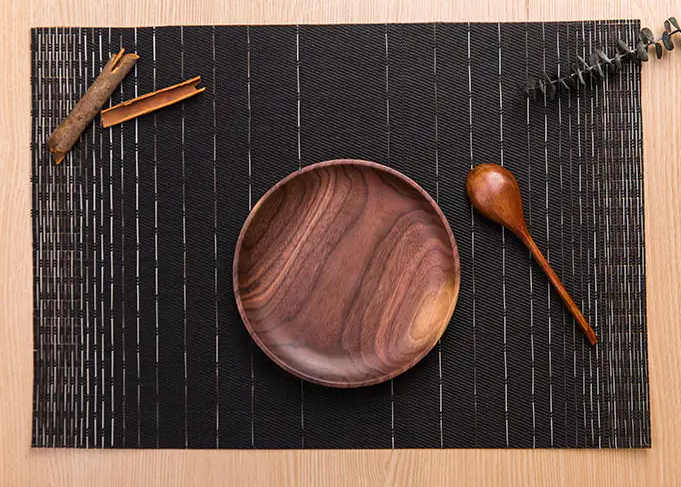
Crafting the Foundation of the Dining Experience
A placemat manufacturer operates within the specialized niche of soft goods and tabletop accessories, producing the functional and decorative layers that define a dining setting. This industrial entity bridges design, material science, and volume production to create products ranging from everyday household items to high-end hospitality supplies and branded corporate gifts. The manufacturer’s role extends beyond simple fabrication; it involves translating aesthetic trends and practical requirements—such as heat resistance, ease of cleaning, and durability—into consistently reproducible products at a commercial scale.
Material Sourcing and the Production Line Divergence
The manufacturing process is fundamentally dictated by the chosen material, leading to distinct production lines. For woven textiles (cotton, polyester, or blends), the process begins with yarn sourcing, followed by weaving on industrial looms, dyeing or printing with pigment or sublimation techniques, and finishing with coatings for stain or water resistance. Non-woven placemats, often made from pressed polyester or rayon, are created by bonding fibers directly into sheets, which are then cut, printed, and sometimes laminated for a smooth surface. Natural material lines for bamboo, cork, or rubber involve processing raw sheets: cutting to size, smoothing edges, and applying protective seals. A separate, highly automated line exists for PVC or vinyl products, where calendered sheets are die-cut, printed via rotary screen or digital presses, and often heat-sealed around the edges.
Customization as a Core Competency
For many firms, the bulk of their business lies in producing custom designs. This capability requires integrated pre-press and design departments. A client’s artwork is color-corrected, engineered for the specific printing method (e.g., ensuring alignment for woven patterns), and proofs are created. For corporate branding, manufacturers offer various application methods: sublimation printing for full-color, photographic-quality images on polyester; screen printing for bold, opaque colors on cotton or vinyl; or embossing/debossing to add textured logos. The ability to handle low MOQs for boutique brands and massive runs for global retailers, while maintaining color accuracy and quality, is a key differentiator for a successful producer.
Quality Assurance and Compliance Protocols
Rigorous quality control is embedded at multiple stages to protect both the manufacturer’s reputation and the end-user. Material Inspection checks for consistency in thickness, color, and weave. Printing and color accuracy are verified against standardized Pantone references under controlled lighting. Performance Testing is critical, especially for commercial-grade products; this includes tests for colorfastness when exposed to washing, sunlight, or chlorine (for poolside restaurant mats), abrasion resistance, and heat tolerance. For products intended for direct food contact, manufacturers must ensure compliance with regional safety standards (like FDA requirements in the U.S. or LFGB in Europe), verifying that materials and inks are free from harmful substances like phthalates or heavy metals.