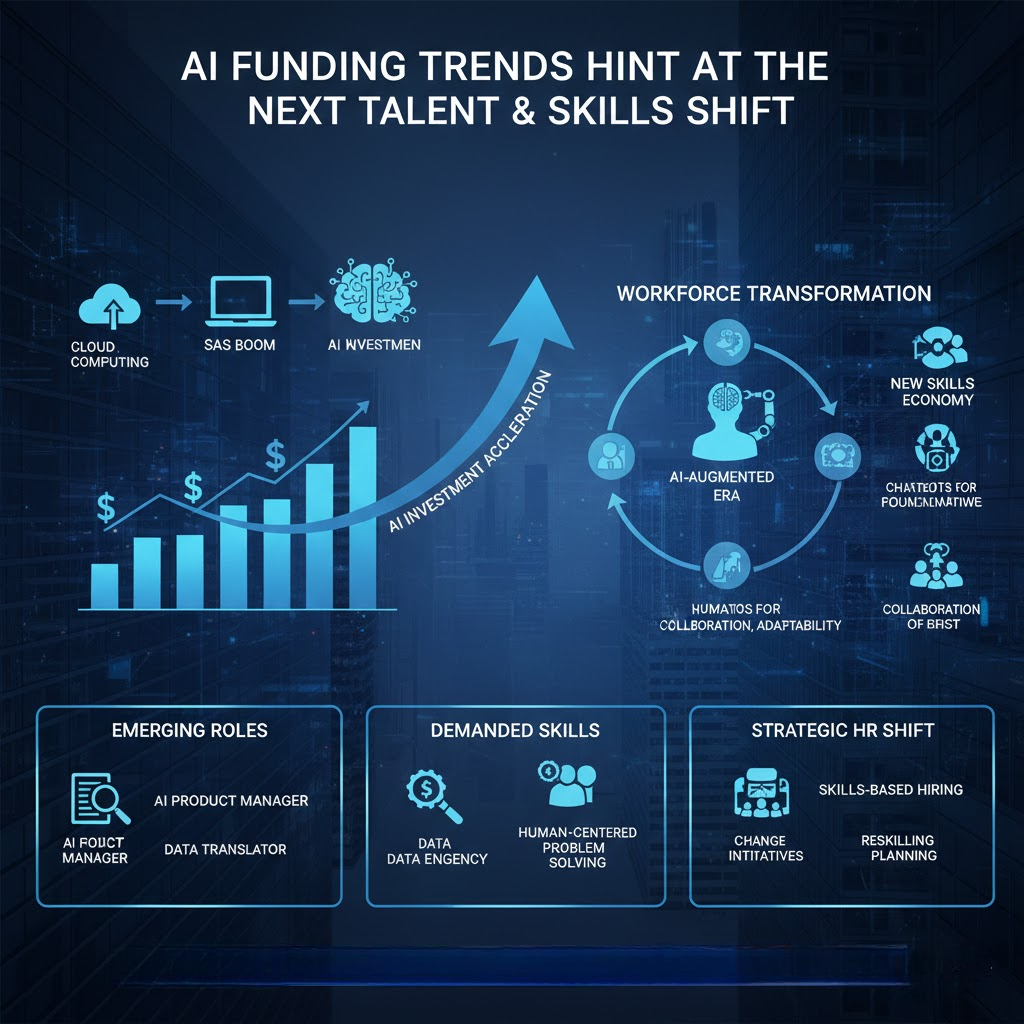
Artificial intelligence is no longer an emerging technology confined to research labs—it is now a central force shaping how organizations hire, develop, and deploy talent. Over the past few years, a surge in AI funding across startups, enterprise platforms, and industry-specific solutions has signaled a major shift: companies are not just investing in tools; they are investing in new skills, new roles, and a fundamentally different workforce model.
This wave of funding is reshaping talent priorities faster than traditional workforce planning cycles can keep up.
AI Investment Is Moving From Hype to Implementation
Earlier AI investment cycles focused heavily on experimentation—chatbots, automation pilots, and isolated machine learning projects. Today, funding is flowing into scalable solutions that embed AI into core business operations: recruitment, workforce analytics, customer service, supply chain, and product development.
As investors prioritize ROI-driven AI platforms, organizations are shifting their hiring strategies. The demand is no longer limited to data scientists. Companies now seek professionals who can operationalize AI—product managers, HR leaders, marketers, and operations specialists who understand how to work alongside intelligent systems.
This signals a key shift: AI skills are becoming horizontal rather than specialized. Every function is expected to develop AI fluency.
The Rise of Hybrid Roles
Funding trends reveal a growing appetite for “applied AI” companies—those solving industry-specific problems in healthcare, finance, manufacturing, and HR. As a result, employers are increasingly hiring hybrid talent.
Examples include:
- HR professionals who can interpret AI-driven workforce insights
- Marketers who use predictive analytics and generative tools
- Recruiters who manage AI-powered talent platforms
- Operations leaders who automate workflows using AI systems
These roles combine domain expertise with technical literacy. Organizations are realizing that success with AI depends less on building models and more on integrating them into everyday decision-making.
Skills Are Becoming More Dynamic Than Job Titles
AI funding is accelerating a broader shift from role-based hiring to skills-based hiring. As automation reshapes workflows, job descriptions become outdated quickly. Companies are instead mapping capabilities—critical thinking, data interpretation, digital collaboration, and AI tool usage.
This shift creates both opportunities and pressure for workers:
- Continuous learning becomes essential
- Career paths become less linear
- Adaptability becomes a top employability factor
Employers, in turn, are investing in reskilling programs, internal mobility platforms, and learning ecosystems powered by AI itself.
Talent Strategy Is Becoming a Competitive Advantage
Organizations that secure AI funding—or adopt AI-backed platforms—are gaining more than productivity improvements. They are building strategic talent infrastructure.
AI is enabling:
- Predictive workforce planning
- Skills gap identification
- Personalized learning journeys
- Internal talent marketplaces
These capabilities allow companies to deploy talent more effectively, reducing reliance on external hiring while improving engagement and retention. In this environment, HR is evolving from an administrative function into a strategic driver of business performance.
The Demand for Human Skills Is Rising, Not Falling
While automation replaces repetitive tasks, funding patterns show strong support for tools that enhance human decision-making rather than eliminate it. As AI handles execution, human value shifts toward:
- Creativity and innovation
- Ethical judgment and governance
- Collaboration and communication
- Strategic thinking
Organizations are realizing that AI amplifies human potential—it does not replace it. The most valuable employees will be those who can interpret AI insights, make informed decisions, and lead change.
What This Means for the Future Workforce
AI funding trends point to a workforce transformation already underway. Over the next few years, we can expect:
- Skills to matter more than degrees or job history
- Continuous reskilling to become a core business function
- Cross-functional AI literacy to be a baseline requirement
- Talent mobility within organizations to increase
- HR tech and workforce intelligence platforms to become central to business strategy
For professionals, the message is clear: learning agility will define career growth. For organizations, the priority is equally urgent: building a workforce that can evolve alongside AI innovation.
HR tech is evolving fast. Are you keeping up? Read more at HR Technology Insights
To participate in our interviews, please write to our HRTech Media Room at info@intentamplify.com