Artificial intelligence (AI) isn’t just a technological buzzword anymore it’s the central axis around which entire industries, investment strategies, and talent markets are realigning. The money flowing into AI startups and scaleups isn’t just making headlines it’s reshaping how companies hire, train, and value the human workforce.
A Funding Boom That Signals Direction
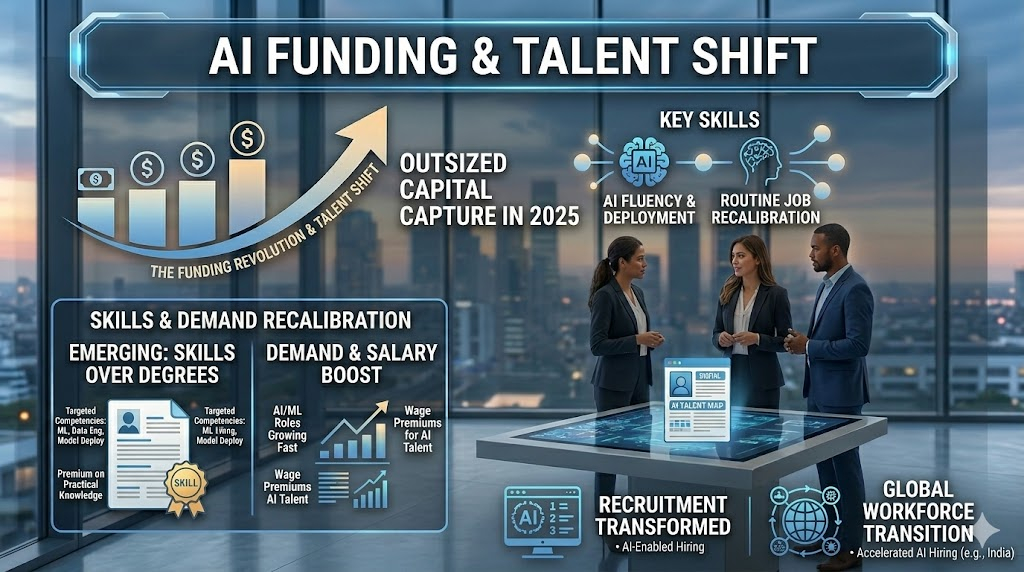
Startups focused on AI continue to attract disproportionate venture capital attention. In the latest funding cycles, AI-related companies captured an outsized share of venture dollars, with billions going into large funding rounds even as overall startup funding slowed. In 2025, more than half of sizable funding rounds were backing AI startups, showing investor conviction in this space even amid broader macroeconomic caution.
This trend isn’t just about great headlines and valuations. It has real implications: capital going toward AI is often tied to expectations of efficiency, automation, and scalability qualities that cast a long shadow over traditional job roles and skills profiles.
What Does This Mean for Talent?
Investors aren’t just betting on technology they’re betting on the talent that builds and deploys that technology. This has created several emerging talent and skills shifts:
- Skills Are Outpacing Degrees
With AI capabilities now embedded across products and processes, companies are leaning more heavily on specific AI competencies from machine learning to data engineering, prompt orchestration, and model deployment. This trend coincides with broader evidence that employers increasingly value targeted skills and practical AI knowledge sometimes even over formal academic credentials especially in tech-centric roles.
- The Demand Mix Is Changing and So Are Salaries
AI job titles and associated roles like AI/ML engineer, data scientist, AI product specialist, and automation architect are growing at a much faster pace than traditional technical roles. This growth isn’t just in absolute numbers compensation data shows AI-related talent commanding wage premiums compared with equivalent non-AI roles.
- Routine Jobs Are Being Recalibrated
AI’s growing capability to automate repetitive and lower-complexity tasks is shifting the employment landscape. While overall employment hasn’t fallen and may grow in areas harnessing AI roles with high automation exposure are shrinking in some regions, prompting discussions about reskilling and workforce transition programs.
This shift isn’t just happening in Silicon Valley. In markets like India, hiring reports show accelerated hiring for AI and machine learning positions, even while entry-level and administrative roles are impacted differently.
- Recruitment Is Becoming AI-Enabled
Ironically, the process of talent acquisition itself is being altered by AI. Recruiters increasingly use AI to screen, rank, and pre-qualify applicants, uncover hidden skill matches, and enhance candidate engagement — meaning that even the way companies select talent is evolving alongside the skills they seek.
The Broader Workforce Transformation
This isn’t just a technology bubble it’s part of a deeper structural shift. As AI goes from pilot projects to enterprise-wide workflows, talent strategies must pivot:
- Upskilling and reskilling initiatives are becoming essential as companies seek to embed AI capabilities across functions — not just within engineering teams.
- Lifelong learning and micro-credentials are gaining traction as workers adapt to evolving role requirements.
- Cross-disciplinary skills — blending domain knowledge with AI fluency are increasingly prized.
This transformation is echoed globally: employers, educators, and policymakers are all grappling with how to prepare workers for an economy where AI is a force multiplier, not a job replacer.
HR tech is evolving fast. Are you keeping up? Read more at HR Technology Insights
To participate in our interviews, please write to our HRTech Media Room at info@intentamplify.com