ow B2B Brands Can Thrive in a Cookie-Free, AI-Driven Advertising Era
The digital advertising landscape is undergoing a major transformation. As privacy regulations tighten and browsers phase out third-party cookies, marketers are being forced to rethink how they identify, target, and engage potential customers. At the same time, artificial intelligence is rapidly reshaping how campaigns are optimized, personalized, and scaled.
For B2B brands, this shift toward a cookie-free, AI-first advertising environment represents both a challenge and an opportunity. Traditional tracking methods that relied on third-party cookies to monitor user behavior across websites are becoming less reliable. However, advancements in AI and data analytics are enabling marketers to develop smarter, privacy-conscious strategies that still deliver strong results.
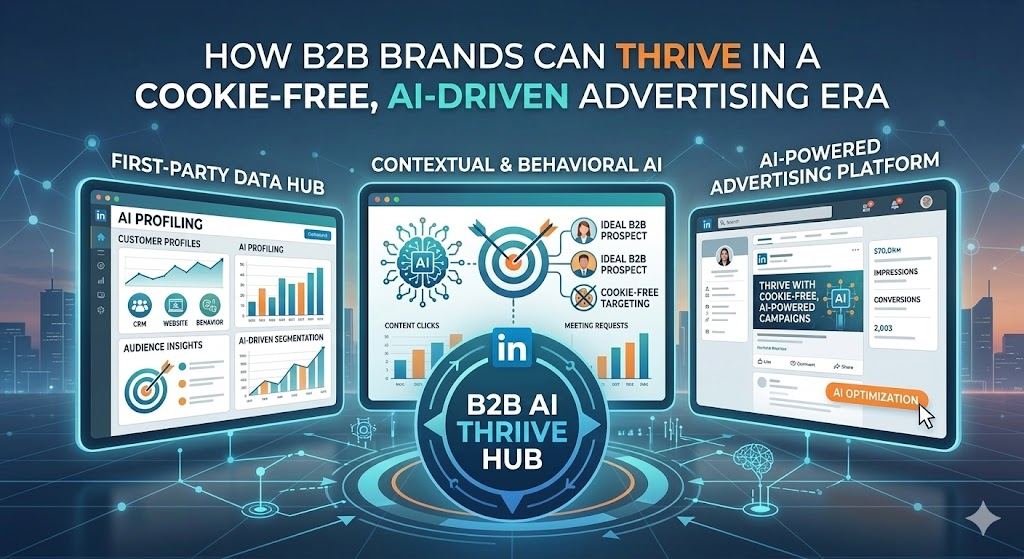
One of the most important shifts in this new environment is the growing reliance on first-party data. Instead of depending on external tracking technologies, organizations are building stronger relationships with their audiences and collecting valuable insights directly from their own channels. Website interactions, email engagement, CRM data, webinar participation, and content downloads all contribute to a richer understanding of customer interests and behaviors.
First-party data allows B2B marketers to create more accurate audience segments and personalized experiences while maintaining compliance with evolving privacy standards. When combined with AI-powered analytics, this data becomes even more valuable.
Artificial intelligence is playing a crucial role in helping marketers interpret complex datasets and identify patterns that would otherwise be difficult to detect. AI tools can analyze behavioral signals, predict buyer intent, optimize ad placements, and recommend personalized messaging for different audience segments. This enables marketing teams to deliver highly relevant campaigns without relying on invasive tracking techniques.
Another key strategy in the cookie-free era is contextual and intent-based advertising. Instead of targeting individuals based on browsing history, marketers can focus on the context of the content being consumed or on signals indicating interest in specific topics. Intent data platforms help identify organizations that are actively researching certain technologies or solutions, allowing marketers to engage accounts that are already showing signs of buying interest.
To succeed in this evolving environment, B2B brands are focusing on several strategic priorities:
- Building strong first-party data ecosystems across marketing platforms
- Leveraging AI tools for predictive analytics and campaign optimization
- Using intent signals to identify high-interest accounts
- Implementing contextual advertising strategies
- Strengthening account-based marketing (ABM) approaches
Equally important is the need for collaboration between marketing, sales, and data teams. A unified data strategy ensures that insights collected from multiple channels are integrated and used effectively to guide outreach and engagement.
The transition to a cookie-free advertising landscape may seem disruptive, but it ultimately encourages marketers to adopt more sustainable and privacy-friendly approaches. By focusing on high-quality data, AI-powered insights, and targeted engagement strategies, B2B brands can not only adapt to this new environment but also gain a competitive advantage.
In the AI-first era of advertising, success will no longer depend on tracking every click across the internet. Instead, it will depend on understanding customer intent, delivering meaningful experiences, and building trusted relationships with the audiences that matter most.
INTENT AMPLIFY is evolving fast. Are you keeping up? Read more at intentamplify.com
To participate in our interviews, please write to our Media Room at info@intentamplify.com