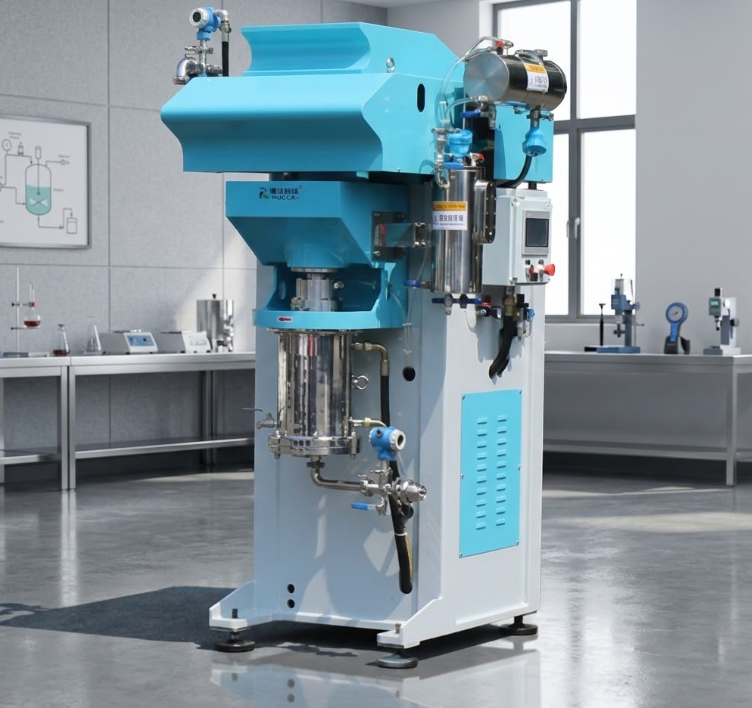
In the coatings and pigment industry, dispersion quality determines everything—from color strength and gloss to durability and storage stability. For manufacturers of architectural coatings, industrial paints, automotive finishes, and specialty inks, achieving uniform particle distribution is not optional; it is fundamental to product performance.
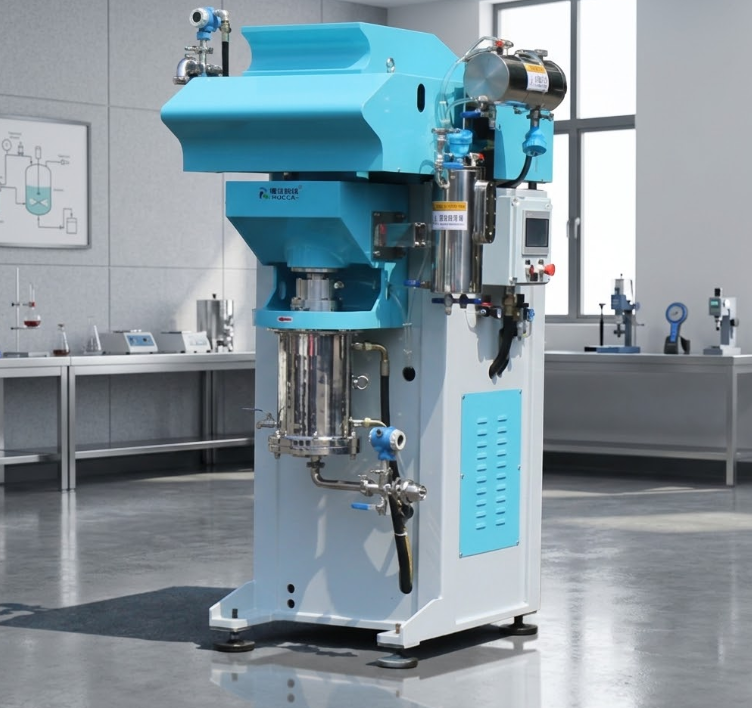
The paint bead mill has become the core equipment in high-performance paint production lines. By delivering efficient wet grinding and ultra-fine dispersion, it enables manufacturers to achieve micron- and submicron-level particle size control. Companies such as Rucca are advancing bead mill engineering through optimized chamber design, precision rotor systems, and energy-efficient grinding technology.
1. Why Paint Dispersion Requires Advanced Bead Milling
Paint formulation typically consists of:
-
Pigments
-
Fillers
-
Resins/binders
-
Solvents or water
-
Additives
Pigment particles often form agglomerates during storage and mixing. Without proper dispersion, these clusters negatively impact:
-
Color uniformity
-
Film smoothness
-
Gloss level
-
Hiding power
-
Mechanical durability
A paint bead mill applies high shear forces and controlled impact energy through grinding media (beads), breaking pigment agglomerates into uniformly distributed fine particles. This controlled dispersion ensures stable rheology and consistent coating performance.
2. Operating Principle of a Paint Bead Mill
A paint bead mill operates using a rotating agitator within a closed grinding chamber filled with grinding beads (ceramic, zirconia, or glass).
Core Process:
-
Pre-mixed slurry enters the grinding chamber.
-
The rotor agitates grinding beads at high speed.
-
Beads collide with pigment particles under shear and impact forces.
-
Agglomerates are broken into fine particles.
-
A dynamic separation system retains beads while processed material exits.
The efficiency of this process depends on:
-
Rotor geometry
-
Bead size and density
-
Chamber design
-
Flow rate control
-
Cooling system performance
Rucca’s paint bead mill systems are engineered to optimize energy transfer while minimizing excessive heat generation—critical for heat-sensitive formulations.
3. Key Technical Parameters to Evaluate
When selecting a paint bead mill, manufacturers must analyze several performance indicators.
▸ Particle Size Distribution (PSD)
Fine and narrow PSD enhances:
-
Color strength
-
Surface smoothness
-
Stability
High-quality bead mills can achieve submicron dispersion depending on pigment characteristics.
▸ Specific Energy Input
Efficient grinding requires balanced energy application. Excess energy increases wear and operating costs, while insufficient energy reduces dispersion quality.
▸ Throughput Capacity
Industrial paint production requires stable continuous operation. Modern bead mills provide scalable capacity to match small-batch specialty coatings or large-volume industrial paints.
▸ Cooling Efficiency
Grinding generates heat. Without effective cooling, temperature rise can alter resin properties and viscosity. Advanced paint bead mills integrate high-efficiency cooling jackets to maintain thermal stability.
4. Material Compatibility and Application Range
A professional paint bead mill must handle diverse formulations, including:
-
Water-based paints
-
Solvent-based coatings
-
Epoxy systems
-
Acrylic dispersions
-
Automotive topcoats
-
Industrial anticorrosive coatings
Different formulations demand tailored grinding conditions. For example:
-
Water-based paints require corrosion-resistant materials.
-
Solvent-based systems require explosion-proof design compliance.
-
High-viscosity coatings require reinforced rotor torque.
Rucca offers configurable systems to match varying chemical environments and production scales.
5. Grinding Media Selection: A Critical Factor
The choice of grinding beads significantly affects performance.
Common options include:
-
Zirconia beads (high density, superior wear resistance)
-
Glass beads (cost-effective for less demanding applications)
-
Ceramic beads (balanced performance)
Smaller bead diameters increase contact frequency and improve fine grinding efficiency but require higher precision separation systems.
Optimizing bead size and density enhances dispersion quality while controlling wear rates and operational costs.
6. How to Choose the Right Paint Bead Mill Supplier
When evaluating suppliers, consider:
✔ Proven industry experience
✔ Engineering customization capability
✔ After-sales service support
✔ Spare parts availability
✔ Energy efficiency design
✔ Compliance with safety standards
Rucca combines engineering innovation with practical industry expertise, offering paint bead mill solutions tailored to specific formulation requirements.
Conclusion
The paint bead mill is not merely a grinding device—it is a precision dispersion system central to coating quality control. From pigment breakdown to particle size optimization, its performance directly shapes final paint properties.
By integrating advanced rotor design, efficient cooling systems, optimized grinding media compatibility, and intelligent automation, Rucca provides industrial-grade paint bead mills that meet modern manufacturing standards.
For coating producers seeking enhanced dispersion quality, energy efficiency, and operational reliability, selecting the right paint bead mill represents a strategic investment in long-term product excellence.
https://www.ruccagroup.net/paint-bead-mills-the-key-to-superior-paint-quality-and-efficiency.html